The stories in this new anthology offer a different narrative framework through which to view an endlessly mythologized city.
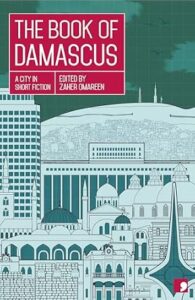
The Book of Damascus: A City in Short Fiction, edited by Zaher Omareen
Comma Press, July 2026
ISBN 9781910974148

The Book of Damascus (Comma Press, 2026), an anthology gathering ten stories by contemporary Syrian writers, was written largely in the final years of the Syrian civil war. This might easily have allowed catastrophe to become the collection’s sole organizing principle. Instead, The Book of Damascus is most interesting as an attempt to recover the city from the inherited narrative habits that have calcified around it. In so doing, it also explores new ways in which Syrian literature might orient itself within and beyond catastrophe—resisting, too, the temptation to let catastrophe harden Damascus into a trampled ideal: a city defined by loss rather than by the lives still being lived within it. The anthology’s central challenge is thus to make Damascus feel like an actual city rather than an idea of one. Much like the other offerings from Comma Press’s “Reading the City” series—which also saw fiction from and about Gaza and Havana similarly anthologized—in the finest stories, the city is not merely a backdrop, but a social world that emerges through the relations and practices that sustain it.
Khaled Khalifa’s preface makes clear just how thoroughly the war had altered the social landscape from which these stories emerged. Written from Damascus in 2023 only some months before Khalifa’s death, and at a time when Assad’s rule still seemed immovable, the preface describes a city of general amnesties that free only a handful of captives, queues for fuel and passports, refrigerators turned into cupboards due to prolonged lack of electricity, and streets so dark that residents routinely break bones tripping upon unseen obstacles. His recurring formulation—“I write to you from Damascus”—situates the stories that follow not after catastrophe, but inside it.
Salwa Zakzak’s “Butterflies in the Sky of Damascus” and Rawaa Sonbol’s “A Storyteller for Our Times” meet the challenge of recovering Damascus as a lived social world from the ground up, conjuring the city through labor and storytelling rather than through its familiar landmarks. “Butterflies” follows Aya and her younger sister, two girls who spend their days scavenging through the city, collecting whatever they can to sell or reuse. Its opening image of “colorful, vibrant butterflies” fluttering across the Damascene sky dissolves into another: “silent, terrified girls searching through the rubbish.” This Damascus is mapped through dumpsters, a swing strung between rubbish containers, pink nail polish, and the hard-won knowledge of where to search, where not to go, what to salvage, and how to keep what they find. Nothing captures that inversion more powerfully than a mother teaching her daughter how to survive inside a dumpster: “Jump with your eyes open looking up at the sky, so your face doesn’t sink under the rubbish and you don’t drown.” Maternal care itself has been rewritten by the city.
In Sonbol’s story, meanwhile, Damascus is explored through the disappearing tradition of the hakawati. Abu al-Noor, an antique seller, dreams “of becoming a storyteller, just like his Damascene ancestors.” At Al-Nawfara Café, customers complete the verses he recites, shout words of encouragement, and collectively sustain his performance. By becoming a hakawati, Abu al-Noor briefly restores storytelling as a communal practice through which the city remembers itself.
The state does not simply censor storytelling—it redirects it.
Both stories ask what becomes of these particular worlds when their meanings are determined from the outside. In Zakzak’s story, the girls’ intimate map of the city is ultimately upended and betrayed by the language of public tragedy as catastrophe befalls Aya and her sister. The story has spent pages rendering them as specific individuals, each with her unique characteristics, only for the news cycle to turn them back into anonymous “child scavengers.” Sonbol stages a different kind of transformation. Abu al-Noor’s trouble begins while recounting an episode in which the legendary knight Antarah sets out to avenge a man whose money and camels have been stolen. As Antarah reaches for his sword to pursue the thieves, Abu al-Noor notices “two huge men in black” entering the café. His evocations of heroism, justice, and the redress of wrongdoing are suddenly interpreted as political speech. Moments later, the performance is cut short, and Abu al-Noor is dragged away, catching “a glimpse of feet trampling on his grandfather’s fez.” After his release, Abu al-Noor resumes storytelling; he merely changes his audience, turning what he sees and hears in the café into reports handed over “to a man whose name he didn’t know.” The state does not simply censor storytelling—it redirects it. If Zakzak shows how individual lives are absorbed into headlines, Sonbol shows how communal memory is absorbed into surveillance.
The danger made visible in Zakzak’s ending becomes more pronounced elsewhere in the anthology. Catastrophe begins to exert a stronger gravitational pull, so that lives are increasingly understood through the deaths that await them rather than the worlds they inhabit.
Omar al-Jbaai’s “The First Hour of Traffic” and Odai al-Zoubi’s “Bitter Hymns” are very different stories, yet both eventually surrender much of their narrative attention to a death that comes to organize the life preceding it. In the former, the lovingly observed, comically eccentric portrait of Mr. Kaleh, with his “Chinese bicycle,” his furrowed eyebrows—“not a frown, just a furrow formed unintentionally over the years”—his government-issued suit, and the rumors surrounding his medal, gradually gives way to competing explanations of his death. The story’s attention drifts from Mr. Kaleh himself to what his death might mean. Yet those explanations never prove as compelling as the man himself. Like the story’s own gloss on his name—kaleh, “faded”—the ending’s search for meaning pales beside the singular portrait it has already created.
Al-Zoubi’s “Bitter Hymns” unfolds through a series of shifting perspectives—Saleem, his lover Nisreen, his wife Sarah, and his friend Mamdouh—circling an affair, a marriage under strain, the sudden death of Saleem’s childhood friend Ahmed, and the quieter rhythms of friendship and family life. Only in its final section does the story disclose its hidden center: a buried family trauma that entirely recasts Saleem’s relationship with Ahmed and much of what has preceded it. The delayed revelation invites us to reread much of what came before through this concealed history. A structurally elegant strategy, but one that ultimately constricts the story’s emotional range. Instead of allowing its several centers to coexist and branch outward, the revelation draws nearly every thread back toward itself. Ironically, the story’s strongest moments lie elsewhere: in the beachside conversations, the children’s forgotten blue tiger, the awkward jokes between friends, and Ahmed, sitting on a Latakia beach among holidaymakers from inland Syria, casually wondering, “Where do people from Latakia go to swim?” These details open the story out toward a social world larger than its eventual revelation. Like “Butterflies in the Sky of Damascus,” “Bitter Hymns” patiently assembles that world, only to risk eclipsing it with a single catastrophe.
Across these stories, death acquires an interpretive authority that the life preceding it ironically resists. Zakzak’s ending absorbs singular children into public tragedy; al-Jbaai’s replaces a richly particular man with speculation about his death; al-Zoubi’s rearranges an entire emotional landscape via the earthquake of a final revelation.
Yet the anthology’s greatest strengths lie less in verbal flourish than in formal imagination and conceptual rigor. Even where the English resists, the stories’ underlying intelligence remains unmistakable.
Zaher Omareen’s “What Only the Chickens and the Donkey Know About Abdulwahab” offers the anthology’s most compelling answer to this problem. Abdulwahab, an obese conscript from Hama serving in al-Dumayr, lives beneath the shadow of hereditary heart disease and a family history scarred by the 1982 Hama massacre—a trauma he inherited rather than experienced. Yet the story’s true orbit is not death but hunger: hunger for food, intimacy, pleasure, freedom, and an ordinary adulthood repeatedly deferred. Damascus once again emerges through lived experience rather than political symbolism: lottery tickets, cheap hotels, rotisserie chickens, taxis, and anonymous crowds in which Abdulwahab briefly escapes the burden of his past. His encounter with a sex worker ends not in sex but in conversation—a shared cigarette, borrowed aspirin, a lighter—the closest intimacy he has ever known, leaving “the image of that woman… carved into the bottom of his soul.” Only then does he finally enjoy the whole chicken he has long desired, absentmindedly playing with the lighter the woman has left behind. His death, absurdly precipitated by a collision with a donkey and ultimately caused by the aspirin he believed would save him, is both comic and tragic. Crucially, however, it does not retrospectively reorganize the narrative. Rather than reducing Abdulwahab’s life to its ending, the story allows his death to remain one episode in a life already rendered full, contingent, and irreducibly human. It becomes clear that the question is not about whether a story culminates in death, but whether the framing of the story permits that death to eclipse the life that precedes it.
If Omareen shows that death need not become a story’s organizing principle, Rasha Abbas’s “The Seven-Gated Lady” goes further still, rejecting explanatory closure altogether. The anthology’s most formally ambitious and richly imaginative story, “The Seven-Gated Lady” abandons documentary realism in favor of a mythic Damascus: a living architecture where the city’s seven gates become seven planetary trials. Folding together Ibn Asakir, Greek mythology, Shiite devotion, Ibn Arabi, and planetary symbolism into a single imaginative system, Abbas presents a city that is no longer merely inhabited but continuously transformed. Its recurring motifs—the doll, birds, blue flowers, the lion, backward-walking cows—never settle into stable symbols. Instead, they accumulate meaning through repetition, inviting the reader to enter the dream rather than decode it. Structurally, too, the story resists the anthology’s recurring movement toward revelation or tragic closure. Each gate opens onto another transformation, enlarging the mystery instead of resolving it. If many of the anthology’s stories seek to preserve Damascus by documenting or allegorizing it, Abbas remythologizes the city, making it strange, inexhaustible, and narratively alive once more. Her story suggests that realism is only one way of recovering Damascus; myth, too, can make the city visible again.
Where Abbas’s symbols continually exceed interpretation, the governing conceit of Alaa Rashidi’s “Marvellous Music Memory” repeatedly folds back on itself. The story begins with a striking premise. Its narrator, Samee Raneen—literally, “Hearing Resonance,” a name so on-the-nose that the story wisely retires it after its first mention—possesses a perfect musical memory until it is fractured by a war injury, leaving him uncertain whether his greatest compositions were lost or never existed at all. Each of the story’s four movements follows an almost identical structure: a musical memory summons a period of the narrator’s life; that period is organized around a pair of seemingly irreconcilable musical worlds—Western and Arabic classical music, romantic pop and revolutionary songs, Sufi devotion and techno, Baathist anthems and revolutionary chants—and the narrator dreams of composing their perfect synthesis, only for the composition to have vanished, or perhaps never to have existed at all. These lost works become powerful metaphors for a Syria whose contradictions can no longer be reconciled. The conceit’s elegance, however, soon hardens into a constraint. By the third movement, the repetitions feel schematic rather than cumulative. The narrator remains less a fully realized character than the organizing consciousness of the conceit itself, while the recurring, unmusical refrain—“Oh, the consequences of war!”—risks becoming another explanatory principle, much as catastrophe and retrospective revelation do elsewhere in the anthology. Admirably constructed though it is, “Marvellous Music Memory” describes its own premise rather than allowing it to develop unpredictably.
Majd Abu Shawish, the collection’s only credited translator, occasionally produces awkward syntax and uneven rhythms that can blunt the effect of otherwise vivid sentences. Al-Jbaai’s image of Mr. Kaleh slowly coming into view, for instance, has his face “gradually acquire features,” while elsewhere Qasioun Mountain peers down on Damascus “ever since it first unfolded onto its chest”—striking images whose phrasing sits uneasily in English. Yet the anthology’s greatest strengths lie less in verbal flourish than in formal imagination and conceptual rigor. Even where the English resists, the stories’ underlying intelligence remains unmistakable.
As a whole, The Book of Damascus suggests a way forward for Syrian fiction beyond catastrophe—remarkable for a collection written largely during the war. The collection’s most memorable stories refuse to let either the city or its inhabitants collapse into a single interpretive center. Whether through labor, storytelling, appetite, or myth, they recover Damascus as something continually emerging from the relations, practices, and contingencies that compose it. The weaker stories let one event become the interpretive center; the strongest trust the city—and the lives unfolding within it—to exceed it. In doing so, they make Damascus visible again without fixing it in place, allowing its meanings to remain unfinished: a trampled fez in an old café, girls who know how to survive inside a dumpster, a forgotten blue tiger, a whole rotisserie chicken, seven planetary gates.