A recent enthnographic study tries to understand the ties between past military violence and how it manifests materially in people’s lives today.
Resurgency: Outlasting the War on Terror in Iraq, by Kali Rubaii
Duke University Press 2026
ISBN 9781478038726
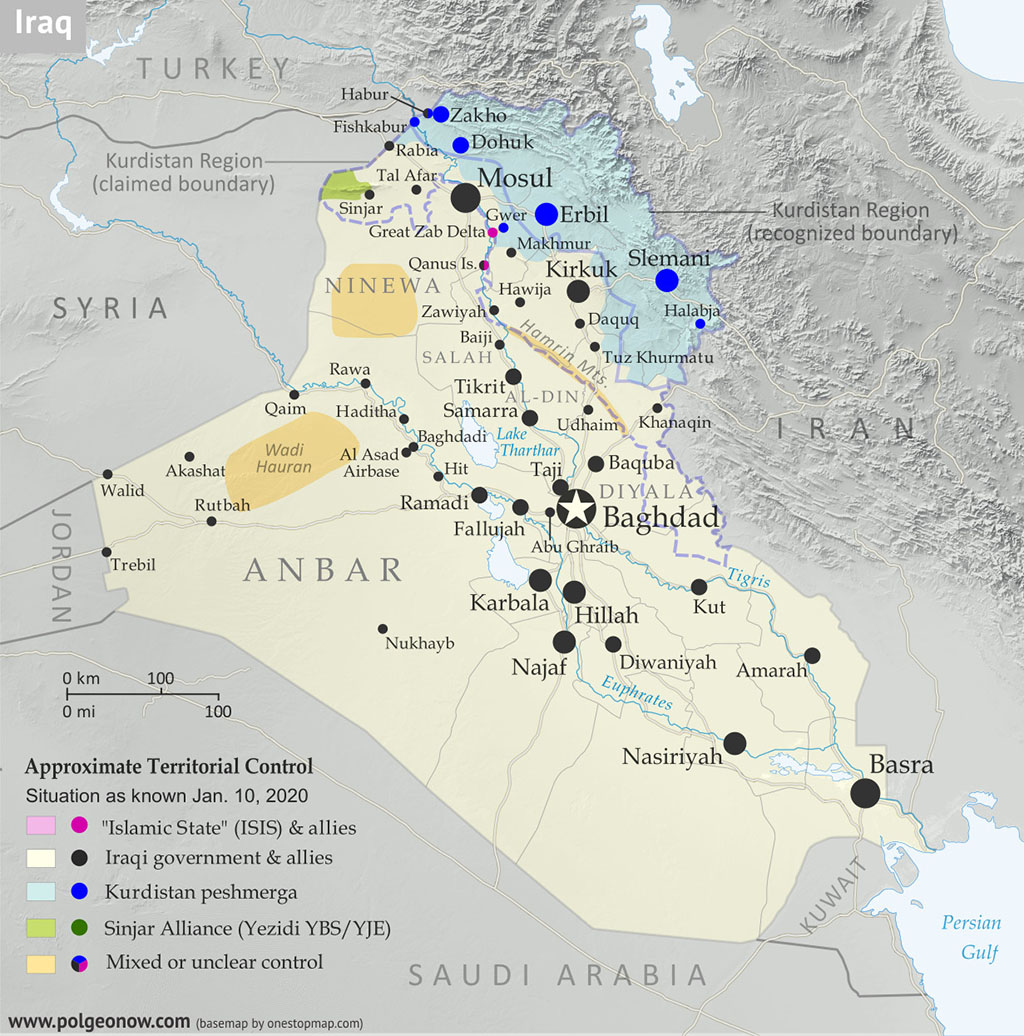
In her new book Resurgency, cultural anthropologist Kali Rubaii turns her attention to Iraq’s Anbar province. This neglected region has long been cast in western media and counterinsurgency manuals as Iraq’s “Wild West”—exoticized, vilified, and caricatured as a terrorist bedrock. How many readers, when encountering the word Fallujah—a key Anbari city and ethnographic site in Rubaii’s book—think of Al-Qaeda, Iraqi insurgents, or Blackwater contractors whose corpses were paraded over the Euphrates? This widely accepted yet erroneous “Anbar story” is one that Rubaii disrupts.
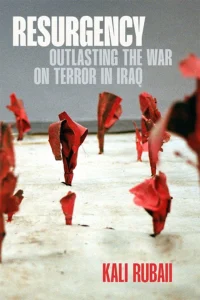
Her ethnographic study—spanning more than a decade—centers Anbari farmers as they navigate war-induced social and ecological collapse and their painstaking repair work, survival, and recovery long after the guns and warplanes have fallen silent. “Resurgency” is described as the potential for recovery from shock, a quiet, often unrecognized labor of outlasting the War on Terror and its tremors. From tending orchards under threat to returning surreptitiously to land under militia control to sustaining family life amid environmental devastation and uranium-induced injury, these survival strategies are deliberate, forged in response to political and material conditions.
In conversation with Nazli Tarzi for The Markaz Review, Rubaii discusses forensic ethnography, the War on Terror as experienced by Anbaris, military metaphor, meaning-making, and the complexities of trust and access between researcher and subject. She foregrounds the voices and life-altering experiences of a community persistently repairing and reimagining their futures. The book, in her own words, is an act of bearing witness, seeking to understand why, even in the face of death, Anbaris still believe that “today is better than tomorrow.”
The following interview has been edited for brevity and clarity.
NAZLI TARZI: It’s difficult to find a starting point, but why Anbari farmers?
KALI RUBAII: I have long-standing relationships with people in Anbar that precede my arrival in Iraq—centered in Fallujah, particularly its hospitals, where I was coordinating resource allocation and international solidarity a decade before I did research in Iraq.
When I arrived in Iraqi Kurdistan, many Anbari people were displaced. I started talking to farmers there, who stood out as the people doing the unsung labor of repairing Iraq’s landscape between episodes of military violence. There’s a level of expertise in survival and recovery that farmers have. I was trying to understand how people repair and recover with no prospect of total resolution. That work is inspiring and under-acknowledged when we think about war writ large or use traditional military analytics. It is particularly overlooked for people living amidst the detritus of war, economic reverberations, or the inevitable losses that come with displacement and the death of family members.
TMR: How would you introduce Anbar province to an agnostic audience?
RUBAII: Anbar province was over-determined as a site of resistance by American occupying forces. It also was a site of unified armed resistance and cultural and political resistance. Its history is geographically unique as the part of Iraq that borders Syria and has a Sunni majority population. The regional geopolitics rears its head acutely when we think about terms used by the U.S. military, like the “Sunni triangle.”
The way Anbar province was cast as the hotbed of Islamic terrorism—or ISIS—pops up in the counterinsurgency discourse and even in the garnering of funding, including by the Iraqi government, which shut down resistance in Anbar by invoking anti-terrorism campaigns. Anbari communities have unique, and perhaps exemplar, ways of engaging with and surviving that political and military bombardment. Fallujah and Ramadi are famous for mounting resistance to the U.S. occupation. In fact, the U.S. never fully captured Anbar province. The fact [that] it was both a captivating and uncapturable site of military resistance during the occupation is emblematic of the ways Anbar has served in that role historically and in the aftermath of the invasion.
TMR: I want to discuss your methodology as you mention both forensic ethnography as well as reparations anthropology in the book. What is your approach?
RUBAII: Forensic ethnography is the idea that, rather than painting a portrait of Anbari people, for example—which this book does not do—it tries to understand the ties between military violence that might be ascribed to twenty years ago and how it actually shows up materially in people’s lives today.
Much of forensic research is oriented toward finding a fingerprint and looking at materials to indicate one thing or another. Forensic ethnography uses ethnographic insight and an understanding of people’s lived experience as a form of evidence about the long-term forms of coercion that might readily disappear into the cacophony of daily life. In that sense, this is specifically concerned with understanding harm and how it’s understood by the people who bear the weight of that harm.
I’m ambivalent about reparations anthropology. I brought it up in the introduction as a way to identify how I came to the particular ethics of my approach. In western frames, reparations are a model of redistributing resources after harm. Rather than being the conclusion of an interaction, I view reparations as a prompt that opens a wound to approach conversations that would otherwise be smoothed over by the incredible hospitality of the people I was working with. They are the first to say, “you’re not your government” and “you didn’t do these things to me.” If I push harder and identify the political positionalities we serve—complicated by my own heritage—we can have real conversations about the politics of repair.
What kind of repair is good? What things should be left unrepaired? What kind of barriers are there to recovery? And how have those barriers been intentionally induced by government policies and military regimes?
TMR: Notwithstanding that effusive hospitality that is characteristically Anbari and Iraqi, how can one forge those relationships when the starting point is distrust?
RUBAII: I formed intimate relationships over the years, and we developed inside jokes and games that we played to help us navigate the unnameable kinds of relationships that had formed. In another instance, in order to travel alone with another man, his wife ended up calling me her daughter to make it work socially.
In Iraq, where distrust is a core theme, especially toward people with American citizenship, the speed of relationships extends beyond the scope of research. My capacity to engage in research or forensic uncoverings was delayed by ten years; it came as an echo of other [long-standing] relationships.
Those relationships are ongoing. Long-term commitment is key before asking someone, hey, can I write about your story in my book? I don’t think anyone can do this perfectly. We are inheritors of historical violence and don’t get to absolve ourselves. I was honored when someone said “I’m really angry at you” or “I hate you” or “God will get revenge.”
People have varied responses. Refusal is one I respect tremendously. It’s also important to bear witness to those violated in my name.
Sometimes I was understood as a ‘we’ in the Iraqi diaspora, sometimes as a ‘you’ or ‘they’ in the American empire. This is how relationships work when we’re honest about the fraught intersectional connections we have.
TMR: To what extent can we think of survival as resistance, given that in western scholarship resistance is often coded as hierarchical, organized, leadership-led, and front-facing? Are the people of Anbar simply going through the motions, or is there more to it?
RUBAII: That’s what the book is about: when you centre home rather than your opponent as your political centre, which itself is a gendered, classed, and perhaps epistemological difference—what resistance looks like changes. The argument that life goes on after war, and that people are resilient and resurgent, discounts how life is made to go on.
Say you’re working on the rhythm of seed time because you’re a farmer, or making the next generation because you are a mother—those are political choices. People are explicit about them. It takes tremendous repair of soil, hospitals, schools to make the next century happen. “Outlasting” is a particularly well-informed, politically motivated, highly intentional, and effortful project of sustaining life.
The book highlights people often discounted as giving in to oppression or not refusing loudly enough. The ethical mandate to continue planting trees, returning home, keeping home alive, is an inspiring orientation that subverts oppression. It’s not that daily life is always the moral ideal, but it is political.
TMR: Yes, particularly when it comes to Anbari families aware of the risks of congenital malformations when procreating. And equally, farmers who use agrochemicals to ensure their plants don’t perish. I didn’t think of it as deliberate.
In terms of your writing style, it’s neither conventionally anthropological nor clinical in the way that a lot of social science scholars write.
RUBAII: I’m always struggling with what writing is for. I found that when writing people’s stories or writing my experiences with people, it’s very easy to just describe what’s happening, what I’m seeing. And that is the best form of ethnography. The people I was working with were showing me through physical and affective forms of knowing, which is hard to translate into writing.
When trying to testify to a truth—especially a collective truth everyone already knows—you have no choice but to simply testify. But there is a theory here. Rather than stories being evidence of that frame, it’s the opposite. People’s stories are the truth and theory corroborates them. I found evidence for this in insurgency and counterinsurgency, or what I build on as counter-resurgency. Resurgency, then, is me politicizing repair and recovery.
Oftentimes, the way people articulate their theories, whether with reference to Quranic verses or their own phraseology, is so profound that it deserves direct translation. So many Iraqis are poets, and Arabic is a poetic language. Many things I choose to never write about because they deserve to be maintained in the unwritten archive of Anbar. There are secrets that we are supposed to keep.
Whether that is received well in political science, for example, versus in the art world is going to be determined more by my audience’s choices than my choices. When you’re doing interdisciplinary research, or you’re trying to do ethnography, which is generally a pretty flexible field, some of it comes out this way. In other cases, I find myself writing very scientific papers with quantitative evidence or poetry with broken form. Oftentimes the story that needs to be told determines what genre it is written in.
TMR: For myself, the book and the subjects broached are deeply personal. As an Iraqi, I engage with it differently than an American or western audience. It feels as though you let out those silent screams that have been accumulating for years—the screams of the people of Anbar. What did you learn from the people of Anbar?
RUBAII: Sorry, I’m emotional. When you have such a simple question, it kind of gets you.
It’s no coincidence that we’re both breaking down. It’s the incredible silencing and erasure of such strong people, who are in fact leaders of a very dark tomorrow. People don’t want to be stigmatized or do what my colleague Nirmala Erevelles calls epistemic labor. When disabled people or cancer survivors have to do all the meaning-making for everyone, it’s exhausting.
I never want to represent people in such a way that they have to do all that symbolic work. The infant slowly dying in an incubator shouldn’t have to stand in for the whole nation. Many people were initially skeptical of sharing their stories—it’s not that they don’t want a western audience, but the western gaze is creepy, invasive, and extractive. At the same time, there is cathartic and political power in saying, look at what you did to us. I want you to see, be a little hurt, read my story, and face this.
But your original question—what did I learn from Anbar? A lot, but one thing is that under state repression, there are forms of subversive, organized, meticulous strategy available as dissent.
The people of Anbar persistently maintain, remain, and repair. This is a region that has lasted through multiple civilizations, growing food in a desert via complex irrigation, living under political repression as beneficiaries and targets of violence. One of my greatest inspirations is the women of Anbar, insisting on centering their role as key geopolitical actors. They are active participants in the struggle of their people, at the center of that story.
TMR: Could you also speak to your critique of military language and metaphors? It reinforces a particular argument without spoon feeding the reader.
RUBAII: The wolf, the sheep, and the sheep dog are metaphors used to typecast places like Anbar as enemy territory. I start each chapter with a quote about military logic. One metaphor that recurs in military literature and counterinsurgency manuals is that the insurgent is a wolf in sheep’s clothing. The insurgent is an armed militant hiding as a civilian, a wolf within the innocent flock. Analysed directly without flipping the script, the metaphor justifies killing sheep—innocent people presumed to be combatants.
Ironically, sheep are an invasive species, and sheep dogs—counterinsurgency operatives, militaries, or police—contain the flock, often killing it in fear of an imaginary wolf. This flips the discourse on security and on what counts as an innocent civilian.
TMR: The final question relates to your next academic pit stop. You started off working on reproductive health, then your scholarship focused on the ubiquity of cement. What can we expect next?
RUBAII: I am particularly interested right now in thinking more expansively about military supply chains; how people are connected through the economies of war.
I’m mostly focusing on heavy metals, and uranium is, of course, the figure people attach to most attentively. Uranium comes to stand in for all the other ways that chemotoxic or molecular violence is understood and articulated.
This relates intimately to the question of what is understood as an anomaly. People talk a lot about birth anomalies and what bodies are able to survive, and what bodies are emerging from conditions of war as anomalous.
Editor’s Note: The original version of this piece contained an incorrect quotation. The text and title have been corrected accordingly.