A lifelong nomad and self-described "memory carrier" recounts her experiences as a trans Kurdish woman, and how the theatre found her.
Zeynep Esmeray — playwright, actor, trans rights advocate — began her nomadic journey at fifteen. She migrated from Kars, in northeastern Turkey, to Istanbul, a move that appeared economic on the surface but was shaped by political, personal, and social forces. Since then, she has drifted from city to city, sometimes between homes within the same city, her bundle always in hand. That bundle is not only a sign of movement. In Esmeray’s work, it also becomes a way of carrying memory. Her plays gather the places she has passed through, the violence she has witnessed, the solidarities she has built, and the identities she has had to defend.
As she explains in this interview, Esmeray sees herself within the tradition of the dengbêj: the Kurdish oral storyteller who transmits history, pain, and collective memory through voice and performance. In this sense, her stage is no ordinary theatre. It is a place where Kurdish identity, trans existence, feminist struggle, and LGBTQI+ resistance are collectively celebrated, remembered, and made visible against the forces that have tried to erase them.
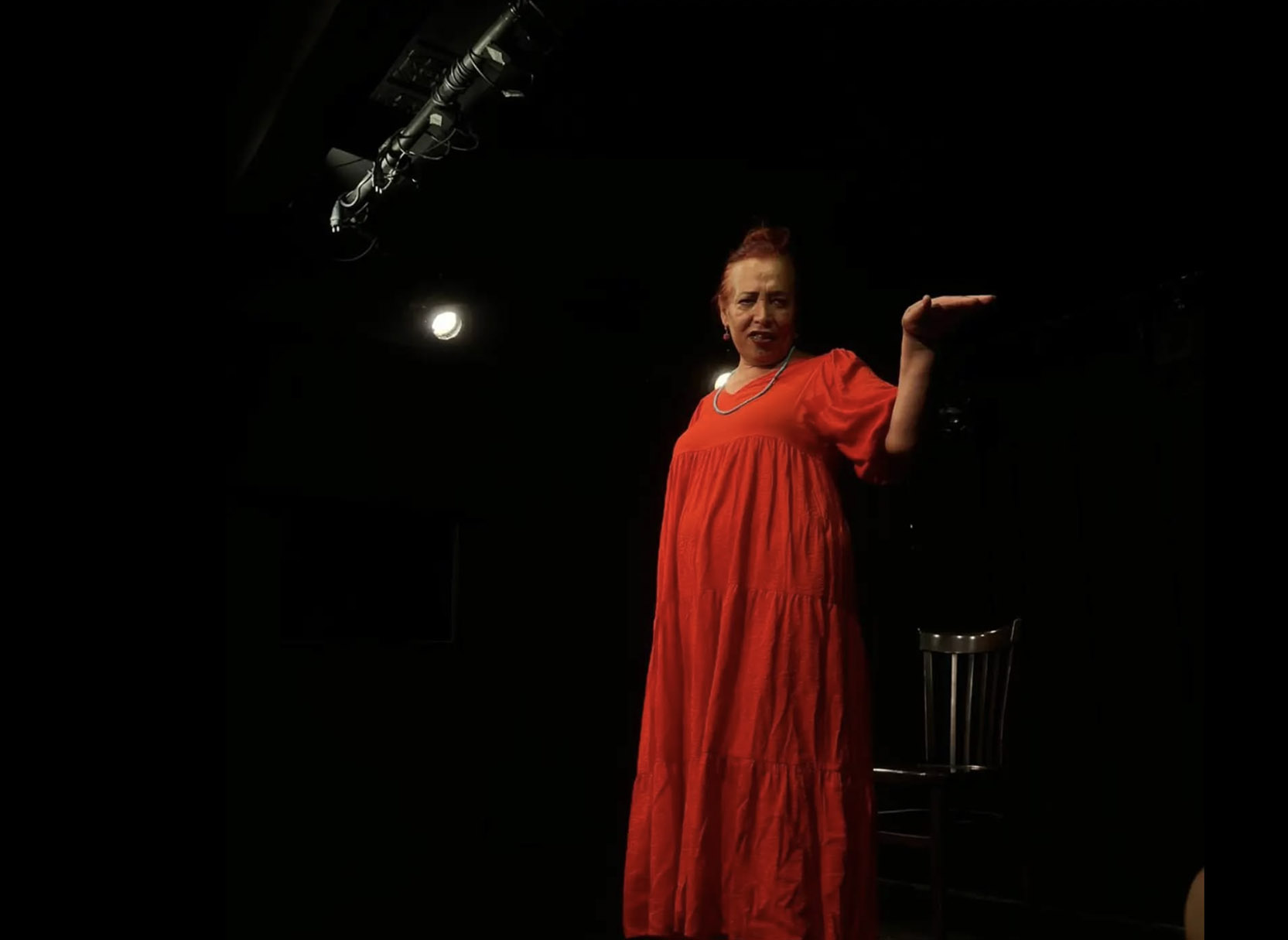
I first saw her perform Cadının Bohçası (The Witch’s Bundle) in Ankara years ago. More recently, I attended Kestirmeden Hikayeler (Cutting Through Stories), staged at Istanbul’s Altkat Sanat Tiyatrosu (Altkat Art Theatre), as part of Trans Pride. In a climate where hostility toward LGBTQI+ people is growing louder, these events are spaces of queer solidarity and visibility, reminders that the community still shows up for itself. That evening the venue was past its capacity, the audience spilling from chairs onto the floor. Everyone was waiting for Esmeray. So was I.
This play, which she wrote and staged herself, centers on gender-affirming care in Turkey — a long and demanding process that requires continuous mental health assessments and medical follow-ups, made more arduous by social, financial, political, and bureaucratic barriers. Kestirmeden Hikayeler speaks to how trans people are controlled, monitored, and regulated by the state, and how this system of surveillance leaves its mark on bodies. In that sense, the play was an act of sharing — and preserving — a memory of transition.
When the applause finally settled, we sat down together at the nearby Mor Mekan, a feminist space. Şeker and Bıdık, Esmeray’s two dogs and companions for the past four years, lay curled in her lap. The following interview was conducted largely in Turkish, and has been condensed and edited for clarity. Halfway through the interview, after I shared that I too had migrated because of my queer identity, from Azerbaijan to Turkey, then within Turkey, we spontaneously began speaking in Azerbaijani.
ZEYNEP ESMERAY: I am a trans woman… How do I define myself? It changes, actually. Years ago, I used to answer this question differently. I had three or four identities I would list: my Kurdish identity, my trans identity, feminist Esmeray, and so on. But as you get older, you step back from some of those labels. We trans women keep resisting wherever we are, that doesn’t change. But I’m not as involved in organizations the way I used to be. So now, Esmeray the theatre-maker. That is who I am. My resistance continues, but through art. Through the stage.
TMR: That’s actually what I wanted to ask you next. Are there spaces where your identities intersect, and spaces where they pull apart? Right now, does “theatre-maker” feel like the identity that weighs the most?
ESMERAY: Yes, theatre-maker. And I write, too. If I had to give it a name, I would call myself a memory carrier. I pour out memories.
TMR: In a previous interview, you described your life as a kind of wandering. From family to the streets, from the streets to sex work, from there to theatre, each stop connected to the one before by a search for “a place where I can breathe.” That image stayed with me. How did you find your way to theatre within that journey?
ESMERAY: Exactly as you said: I am nomadic. My nomadism began before my LGBT identity became visible. [When you’re a Kurd in Turkey], you migrate, you go to Istanbul. I moved there before my family did. Then my family moved. And then, I moved away from my family. As you just said, [I turned to] sex work: I found myself in Harbiye, where I stayed for years. And even there, I was constantly changing houses, changing streets, moving from Bayram Sokak (Street) to Ülker Sokak (Street), carrying Ülker Sokak[1] into the political arena, and from there moving into theatre.
The theatre felt like a utopia, something so far out of reach that I eventually stopped even dreaming about it.
TMR: Let’s talk about Ülker Sokak, which was essentially a state-forced displacement of trans people, in 1996. What was that experience like for you, as a Kurdish trans woman?
ESMERAY: Because the attack there was directed specifically at trans identity, the Kurdish part gets pushed to the background. The attack comes through visibility, but the method is the same. What they did in Ülker Sokak was identical to what I had already lived through as a Kurdish person: raids, burning homes, burning villages. Same method, same language, same practice. They come and burn your village, force you out, make you a displaced person. Then they go on television and say “terrorists burned the villages, people fled because of the terrorists.” But that’s not what happened. The truth is something else entirely.
When they’re talking about Kurds, they say “we cleansed the region of terrorism.” On Ülker Sokak, after driving us all out, they wrote on the windows: “Let those who are not homosexual wave the flag.” They said, “we cleaned up the street; we got rid of the filth.” Same method, same language. I lived through it twice: once because I am Kurdish, and once because I am a trans woman.
And it is still happening. Now religion has been added to the list. In this country, you must be white, you must be Turkish, you must love the flag, you must be Sunni. And Sunni is not even enough; you must be Hanafi, not Shafi’i. If you are all of those things, they leave you alone. Everyone outside that definition can go through exactly what I just described, and they do. We’re watching them do the same thing to the CHP [Turkey’s largest opposition party] right now. They’ve torn it apart.
TMR: At one point in your journey, you found the theatre. Or did it find you? And did anyone support you throughout that process?
ESMERAY: I’ve been drawn to theatre since childhood. When I started school, I encountered something called a play, and I loved it immediately. But my father wouldn’t let me continue my education. I never went to university. So, the theatre felt like a utopia, something so far out of reach that I eventually stopped even dreaming about it.
Then one day I stumbled upon a street children’s workshop that included Pınar Selek, trans women, and other people who did not fit the mold. A theatre group formed though none of us had any experience. We were going to make street theatre. Meaning the body does most of the work. Not words, but movement, body, masks. As we were learning that, we also started reading about the history of theatre. We found that it goes all the way back to before settled civilization, to the hunting and gathering era.
After that experience, I didn’t let go. I went to the Mesopotamia Cultural Center and enrolled in a Kurdish and Turkish theatre course. At first, they hesitated; there was prejudice. I pushed my way in. Over two years, different teachers came and went, reading, movement, physical work, Kurdish theatre. It was an incredible experience.
When the two years were up, the Mesopotamia Cultural Center offered me a spot in one of their groups. But I chose the feminist and LGBTQI+ movement instead. Amargi Women’s Academy was being founded at the time. We worked with a theatre group from ETÜ. We created an improvised play with eleven women, each telling her own story. I played a Kurdish woman, and I performed in Kurdish.
Then I wanted to take everything I had built and bring it in front of an audience. I talked it through with a friend one night, and the skeleton of the show came together: Cadının Bohçası. The next day I called Ayşe Damgacı and we started working together. I didn’t want anything crude or vulgar, or male-dominated language. I found Tiyatro Boyalı Kuş, a feminist theatre, and worked with them too. I started small. Five people, ten people.
Eventually there was a premiere. Eight hundred people came to a three-hundred-seat hall. Standing room only. The show was incredibly well received. And it was the first time a trans woman had done something like this, so the applause was something else. But then Mehmet Ali Alabora came up to me and said: “If you are ending this here today, fine. But if you are going to perform this elsewhere, there is a lot missing. Work on it.” He told me the issues one by one, and I took notes. Because it was narrative theatre, he also added: “The more you perform it in front of audiences, the more it will settle.” And that is exactly what happened.
TMR: There is also a story of resistance and solidarity running through all of this.
ESMERAY: The solidarity was incredible.
A dengbêj is a storyteller, a poet. But I see myself more on the side of the dengbêj that carries stories.
TMR: Being a trans woman on stage, being Kurdish, being LGBTQI+ and feminist, you bring all these together and offer them as a practice of empowerment. How do you experience all these identities present on stage at once? Because in today’s political climate, they are becoming increasingly dangerous and performance is one of the most visible things you can do. Taking the stage today, as part of Trans Pride Week, is itself an act of resistance. How does this climate affect you and your work?
ESMERAY: That heaviness has always been there. But it also drives me forward. I have thought about it concretely. I am on stage. The police come. They try to take me in. The show is still going. I think: I will keep performing until they put me in that car. They are taking me off the stage, fine. I will perform for them then.
TMR: This is something you have genuinely thought through.
ESMERAY: Of course. I think about what might happen. But I also know it is coming, I expect it. I have spent years doing politics that criticize the system. I am an LGBTQI+ activist, and at this point in my life, I cannot become an AKP [Justice and Development Party, Turkey’s ruling party] supporter. Nobody would expect that. And I know that everything I have done could one day be used against me as a criminal act. They could come for any of us at any moment. I am prepared. That is just the reality of our existence, anything can happen at any time.
But what I see now is that they are doing it more brazenly, more openly, directly through the state actions. [The threat] existed before too, but they used to work through a police commissioner. There was still a prosecutor I could go to with a complaint. Now there is not, which is terrifying. If you report that you were beaten for being LGBTQI+, they will tell you that you are the one at fault.
What frightens me most is this: there are medications I cannot go a single day without. Will they give me those medications? What I am hearing is that they will not.
TMR: Another part of the political agenda right now is the peace process.[2] As a Kurdish trans woman, what do you think about this peace process? Do you think it has any real meaning?
ESMERAY: We all want it. Everyone wants it, because no one wants anyone to die. Children should not die. And young people are dying on both sides. So, it is a good step toward stopping the violence.
But uncertainty remains; neither side clearly reflects what is going on. There is a lack of information, a lack of clarity. But we are not losing hope; we are waiting. I am waiting. I want to be hopeful, we need that. For this to happen, everyone needs to strengthen the language of peace, everyone needs to take responsibility. There needs to be participation.
On the other hand, there are incredibly anti-democratic practices. [The government] is tearing apart the largest party. So how is someone who does that going to establish peace here? Will they do it to them and not do it to us? They are already doing it to us. And it is precisely because they are already doing it that we want peace.
TMR: When you look back at your journey — being both Kurdish and a trans woman, existing on this land, being on stage and on the street — how has it changed you?
ESMERAY: It gives you courage, first of all. And it strengthens you. You move beyond your own story. Which is an incredible thing. Right now, I am preparing to carry a different kind of memory, the testimony of a non-trans woman. That alone shows how much I have changed and grown. It speaks for itself.
TMR: I want to end with memory carrying. I think it is a beautiful way to describe what you do. What exactly is memory carrying, and why does it matter to you?
ESMERAY: I come from a tradition: Kurdish dengbêj. A dengbêj is a storyteller, a poet. But I see myself more on the side of the dengbêj that carries stories. Dengbelêjs pass on Kurdish history and memory through the spoken word, not through writing. When you listen to Şakiro, there is an incredible depth of memory there. Şakiro carried all of those Kurdish stories into the present. In that kind of culture, storytelling both renews memory and carries it forward. Writing things down for history is important, but there is also this other thing: oral memory carrying. That is what art is. That is what theatre is. That is dengbêj, that is being a poet.
There are many reasons why it matters, but the most important one is this: the Kurdish identity has been suppressed, and so you carry that memory to stop it from being assimilated, to keep reproducing it. Being a trans woman is the same, being LGBTQI+ is the same. They try to erase a memory, and someone has to carry it forward. I cannot say I am doing it alone. But being one of those carriers brings me incredible joy. It is a beautiful thing.
[1] Trans people were violently expelled from Ülker Sokak to “clean up” the neighborhood prior to the 1996 Habitat II Summit in a stark political demonstration of how trans bodies are targeted through urban transformation, social perceptions of morality, nationalism, and state violence.
[2] At the time of this interview, a new and uncertain peace process was underway, initiated after imprisoned PKK leader Abdullah Öcalan called for a ceasefire and the laying down of arms in early 2025, raising cautious hope but also deep skepticism about whether the government was genuinely committed to a political solution.