...What Will It Look Like?
There is the clean strike. A single massacre executed from above. The murdered could be few or many, depending on the target: a motorcycle, a car, an ambulance, a queue of aid seekers, a building, a field, a tent, a camp. Then there are the double and triple taps — the first strike claims the initial count, the second kills the first rescuers, and the third aims for those who have the temerity to rush in to help.
Amongst themselves, the executioners no doubt call this a windfall.
There are the phone calls that announce a death foretold. The voice on the other side of the line issues instructions to the man who is about to take his daughter to school or the man driving somewhere with his family. Take your daughter to school and then drive away, the voice commands. It is matter-of-fact, neutral, almost mechanical. You can die with your family or alone, the voice tells the other man: your choice.
The two men comply. The first drops off his daughter, drives away, and seconds later is blown up. The second stops the car and runs into the field as fast as he can. A drone follows and guns him down.
The executioners, including the caller, pat each other on the back for the merciful killings, no doubt.
There are the homecoming parties for the troops, days of merrymaking; soaring music and big screens showing the proud soldiers and their families clips of the carnage they have wrought.
There are the nuns walking to church in Jerusalem, escorted by volunteers to protect them against hordes of Israeli settlers dancing around them and chanting hate.
There are the Gaza aid flotillas attacked in international waters, the activists arrested, taken to Israel, beaten, humiliated, all gleefully televised, a performance for the watching world.
There is the rape and torture of Palestinian detainees of every profile, an equal-opportunity war crime.
And then there are the dogs, themselves abused, trained to rape the victims.
There is the noose — in the form of pin lapels or imprinted on birthday cakes — soon for Palestinian necks. “A dream come true” for Minister of National Security Itamar Ben Gvir. His Death Penalty for Terrorists Act passed 62 to 48 in the Knesset on March 30. It is a clever design, this noose, an inversion of the yellow ribbon worn in support of Israelis taken hostage by Hamas on October 7, 2023.

On an impulse, one morning in 2024, I began recording incidents like these as diary entries. The ones I cite, you would recognize as only the latest in the daily harvest of horror. I began recording them because, to their exhausted witnesses, they seemed like sundry details of a region at war. They came at you like a furious sandstorm, deadening emotion and distracting thought.
But they were never merely of the moment. They are essential in the way the rape and murder of the Bedouin girl in Adania Shibli’s Minor Detail is essential. There is nothing random, impulsive, or unmeant about them. They are the particulars of the great tragedy itself. An original sin in four acts. Dispossession of an entire people. Then, in the subsequent “cleansing” of the Negev of its Arab remnants, the capture of a Bedouin girl by the Israeli army unit charged with the task. Her rape by the soldiers and their commander in the hut that was her prison. Finally, the erasure of the crime the only way it could be erased: the murder of the girl and her burial in the desert sand.
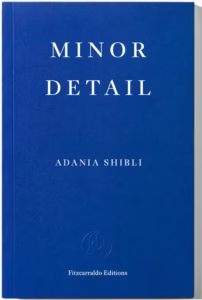
But this sin never escapes into the pitch-dark night. Through the decades, it keeps unfolding in successive reenactments that mimic and innovate upon the primal evil. In the true story that inspired Shibli’s book, which Haaretz uncovered in 2003, the Israeli soldiers gathered on the evening of the capture of the Bedouin girl. Their commander gave them two choices: either assign the girl to the kitchen, or have at her. The majority chanted in unison: “We want to fuck.”
They have been chanting in unison ever since.
The effort to cover up the rape and murder was as sloppy as the burial of the girl in a shallow 30-centimeter grave. There was a secret trial, judgments, and a couple of light convictions, all of which lay silent for decades in a black box. The atrocity was neither novel nor rogue. The soldiers’ sin was Zionism’s writ small: as the larger dispossession of the Palestinians was being buried under a thousand lies, so too was the murder and rape of the Bedouin girl buried deep in Israeli archives.
The case had therefore the appearance of a minor detail. It was anything but. Neither are the entries that fill my diary.
The early generation of Israeli leaders, David Ben-Gurion, Golda Meir et al, understood very well that the Bedouin girl’s fate, if exposed as a pattern, would unravel a fabulous Zionist narrative being painstakingly woven from pure yarn — a narrative central to a historical deception aimed at the outside world as much as directed at the self. For Israel to survive, the unforgivable had to be covered up.
As I flipped through the pages of my journal, I was struck by the ruptures between them and their progeny; between us and our forefathers. Much as the first Israelis studiously entombed their sins, this latest crop recklessly revels in them. Much as our forefathers struggled to unearth these essential details, we struggle to keep up with them.
The truth is, time is a cruel thing. In the early years, the Jewish state could easily spin what the world dearly wanted to believe. But the Zionist project grew more brazen, its deflections more hollow, and the world grew less eager to believe. Now it seems as if Israel itself has become utterly impatient with the subterfuge. It generously furnishes much of the evidence for its war crimes, even as it reflexively condemns the rage it invites.
We hear many explanations for this total sense of abandon on the Israelis’ part. At one extreme stands the schizophrenic Zionist ethos that domination is survival. At the other, the frenzy of a messianic state to establish territorial faits accomplis. Underpinning these rationales and all others in between is the conviction that there will be no reckoning, notwithstanding the outrage.
But this outrage is the first tremor of the reckoning that comes. Only two questions remain: when and what will it look like?
On Another Note
Did you know that 88 percent of the land from which Palestinians were expelled in 1948 remains uninhabited? That means Israelis live on just 12 percent of the land of Israel-Palestine, mostly along the urban coastline.
Dr. Salman Abu Sitta, founder of the Palestine Land Society and himself a 1948 refugee, has spent decades retrieving for Palestinians their place on the map, village by village. The Atlas of the Return Journey, which charts 1,200 villages and compiles 50,000 place names, is his landmark cartographic achievement.
The conversation with Abu Sitta on the Makdisi podcast was an education.
Have a listen!
Amal Ghandour’s biweekly column, “This Arab Life,” appears in The Markaz Review every other Friday, as well as in her Substack, and is syndicated in Arabic in Al Quds Al Arabi.
Opinions published in The Markaz Review reflect the perspective of their authors and do not necessarily represent TMR.