As her Palestinian father approaches death, a pregnant writer is caught between two crushing waits: for a life to begin and another to end.
My father, who had been waiting all his life, was now only waiting to die.
A year before my father passed away, my second daughter, Ciel, was conceived in the Sonoran Desert. It was the fall of 2021, six months after we had left our beloved apartment on Macon Street in Bed-Stuy, Brooklyn, and moved to Phoenix, where my father lived, to spend the rest of our lives—or, more precisely, the rest of his life.
At the time, we had a car and a one-year-old, Aurelia. We had no money. It wasn’t the right moment to have another baby. But I wanted her, Ciel, who in the early days I was convinced was a son, and no one could talk me out of it. After two miscarriages, I nervously searched for blood with every visit to the toilet.
I could hardly look at my father in those days; his death was becoming him. He returned from his chemo appointments at the Mayo Clinic depleted and nauseous; I was nauseous from those first weeks of pregnancy. We were both gagging before and after dinner. The difference was I loved my nausea. My nausea, I had read, signaled a strong pregnancy. Everything smelled so intensely: what smelled good smelled divine, but sickness smelled like rot, and I could smell my father’s sickness everywhere. I was ballooning; he was wasting away.
And I feared it, his cancer, like a contagion.
*
Born in 1943, my father was five years old during the Nakba in ‛48. He had been waiting ever since: for Palestine, for return. And I inherited it from him: this anticipatory grief, anticipatory excitement, anticipatory desire. This persistent feeling of being chased by time.
And that fall, during my first trimester with Ciel, I was waiting for him to die—and waiting for her to live.
Until cruelly, suddenly, that winter, I left Arizona and my father. Columbia had offered me a class, and how could I turn them down? This was before the genocide, and we, as a family, still blindly worshipped that university, my alma mater, the university my father—as a young refugee living in Harlem—had always yearned to attend.
How cold that January was back in New York: the ice rain, the darkness, the blizzards. Amazing to see the city transformed to a desert, the wind emitting the voice of God, that white and sparkling dust covering everything, even the noise.
He really believed that in the end there had to be some great reward. And wasn’t that very stance what allowed him to survive the heartbreak of his life?
We were living in a basement apartment in Greenpoint, a sublet. It was a good deal, a very good deal, and the idea was that we’d return to Arizona in May after the semester ended. I almost believed this, or let my father believe it, and he held onto my words: We’d be back soon. At the end of every phone call, he mentioned May. It helped him live, waiting for this new, little benchmark. It was not the return he had long dreamed of, but it was a return.
In New York, I attended my first routine prenatal appointment at a midwifery that was dressed like a start-up. Despite the techy flare of their website, they were not trained to perform proper ultrasounds, but the practitioner said she could listen in anyway with a Doppler attached to an iPad so that we could hear the baby. At the time, I was nearly into my second trimester. There had been no blood, no cramps, I assured her.
Then, a look crossed her eyes. We were all still wearing masks so I could not see the rest of her face, but at that time, we had already become skilled at reading a person’s gaze. She looked at the fuzzy iPad screen, then not quite at me, and it was like watching someone watch someone else fall from a great height. She was quiet for a long time, and then said she couldn’t be sure, but that she believed there was no heartbeat.
There was a proper ultrasound lab I could go to, though, she said quickly. They would confirm the loss.
There would be no new life; it was all death in the end.
I was already weeping as I walked half of Brooklyn in the cold dark. I felt like smoking, like walking into a bar. Why even go to the lab? I wanted to get fucked up. I wanted to destroy myself. Who could I call?
I called my father.
I don’t remember exactly what my father said. Probably something like, “We, we never stop fighting. We go on and on.” He really believed that in the end there had to be some great reward. And wasn’t that very stance what allowed him to survive the heartbreak of his life?
At the lab, the technician lifted my shirt and rubbed the cold jelly there. “Wait a minute,” she said. I’ll never forget how that woman’s eyes lit up above her mask. Then she turned the dial up on the keyboard. “I’m getting a heartbeat,” she said.
And there it was, that sweet gallop, insistent, undeniable, the soundtrack of new life.
*
I didn’t see my father again until my birthday in New York that year. It was April and the light had begun to last. We hosted a party outdoors, and though I wasn’t drinking, I felt drunk. It was a beautiful afternoon and evening, with temperatures in the 70s, and almost everyone I loved was there. I was so happy until an old friend said to me, “Your father, he looks so thin. So much thinner than he was the last time I saw him.”
I hadn’t seen it. I hadn’t wanted to. I was happy at the shitty Greenpoint sublet and I wanted my life to stay the same. I didn’t want to think of his dying and my waiting for it. But then, a few days later, he walked through the kitchen toward the bathroom and collapsed just past my screen as I was teaching a class on Zoom.
I rushed to him and he chuckled meekly. “Don’t mind me,” he said. “I’m still strong.” But he couldn’t get up. And I was pregnant. I was big with Ciel now. I was not supposed to pull heavy things. But we were alone, so I did it anyway. As I held him up, I felt bones.
On that visit, he asked me if we were still leaving at the end of the semester, like we had said, and if I would have the baby in Arizona. He said we were all he was waiting for.
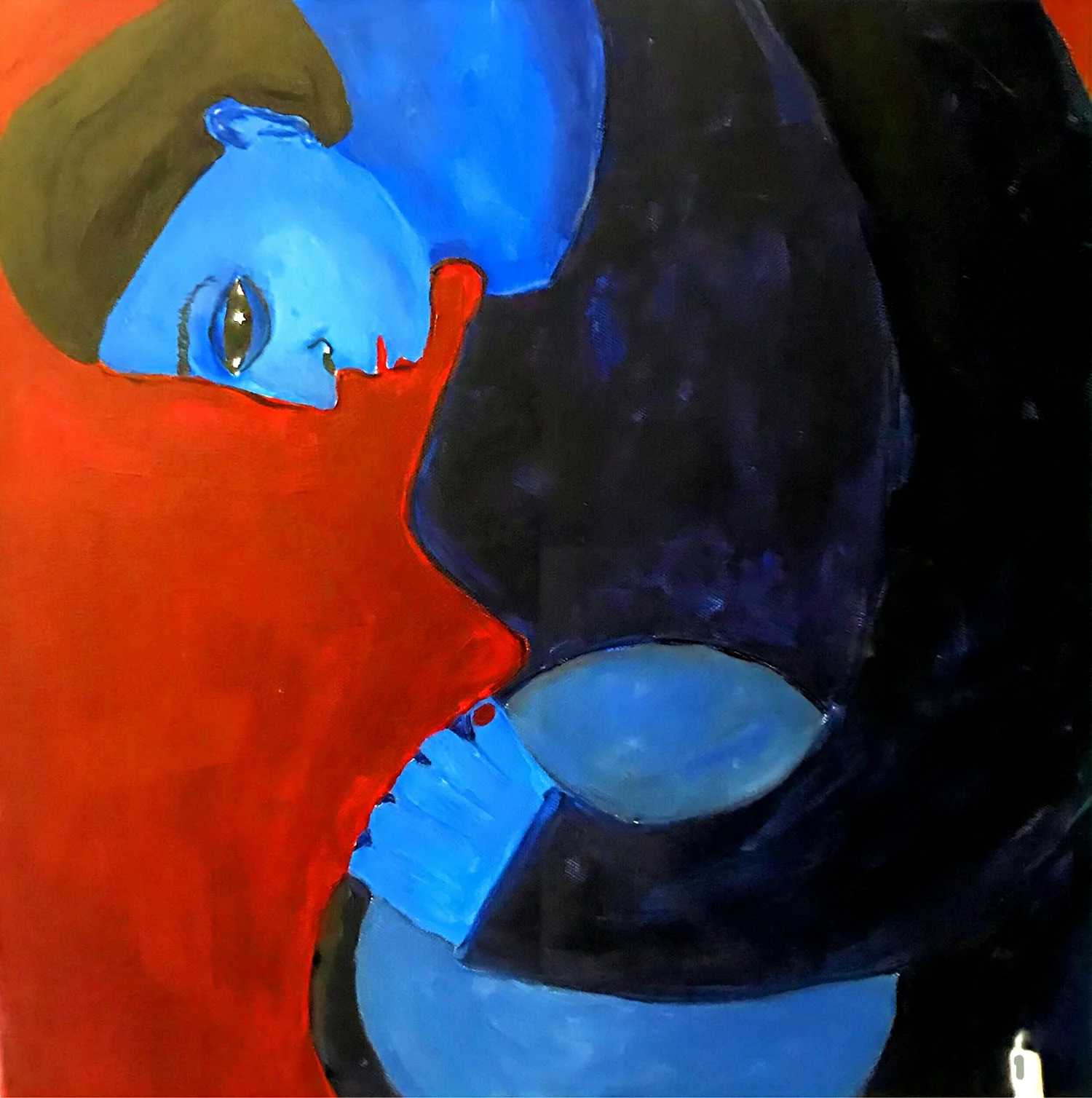
By then I had a good excuse: It might be difficult to switch my healthcare and insurance. After all, I was entering my third trimester. It was too much; this waiting for his death and for her life all at once.
A month later, the ceiling collapsed in the room we had set aside for the nursery. The pipes were now exposed and rotten drywall swung down from the rafters. But we weren’t rich; we couldn’t just leave. It was already June, and the baby was due at the end of July. But then the landlord discovered it—and us. Didn’t we know this was a rent-controlled apartment and that the tenant could not sublet it? We didn’t know and it didn’t matter that I was weeks from birth. We had to leave. I made frantic phone calls to the health insurance department in Arizona, asking if there was any way I’d be able to get coverage on such short notice. There wasn’t. It was too late.
My father said, “You have the curse.”
That’s how he referred to the Nakba, the curse, how it had pursued him throughout his life. No home was ever permanent. He was waiting for return or waiting for the next flood, the next bankruptcy, the next roof to collapse on his head.
Apparently so was I.
*
Mid-summer, we found ourselves back in another sublet in Bed-Stuy for a two-month stint, so close to our old home on Macon. I walked by the old place almost every day, looking up at the shuttered windows of the office where I had written two books. All winsome, affecting exile.
But the sublet was nice, inexplicably reminiscent of Paris: the tin ceilings, the wide kitchen, the deck looking out on the trees, the music in the July nights. I loved the noise in Bed-Stuy, its constant celebration of life. So much heart, always the trace of distant carnival drums. The only fault of the sublet was that it was a duplex, and the stairs to the bedrooms and bathroom were steep.
“Your father won’t be able to climb those steps when he comes for the birth,” my mother said.
“Yes, he will,” I said, annoyed at her pointing to it again, to his dying.
And then I told her that maybe it’d be better if they didn’t come for the birth at all. “I don’t want to be worrying about you,” I said. “I have to think about me. About the baby.” What I didn’t say: I have to think about life.
I had had a C-section with my eldest because she had remained in the breech position past the thirty-ninth week, and I desperately wanted Ciel to come vaginally. The caveat was that I had to go into labor naturally and before forty-one weeks. The clock was ticking. I was reading every twitch in my body like some sign of divination. I prayed for diarrhea (a sign of labor!) I yearned to throw up (a sign of labor!). I was supposed to be relaxing, eating dates, pineapples, spicy food. I was supposed to be meditating, reciting mantras to myself, doing squats, having sex.
“Don’t you understand?” my mother said on the phone. “This is all he is living for now.”
I’ll never forget that humid July evening, waddling toward their Uber as it pulled up. Who was that there? How could my father have turned into this in just the span of three months? What I saw standing there was not my father; it was Death.
I was supposed to be waiting—very anxiously—for a baby to break me in half.
Instead, my father was dying.
*
One night, when it was time for bed, my older daughter crawled ahead of my father up the steep stairs. She said, “I’ll show you, jiddo, I’ll show you how to do it. Uppie Uppie.” She thought it was a game, their crawling together. But the man who had walked between countries could no longer ascend a single flight.
Between Castor oil smoothies, I went up and fixed the blanket over him in bed and I saw that he was the size of a child. I turned my face quickly to my phone and he said, “Wait a minute. Just wait.” But I didn’t want to wait. He placed his bony hands on my belly anyway and began to recite al-fatiha prayer over me and the baby. Vai, he said in his favorite adopted language, Italian, vai. And for a minute, I stopped looking at my phone.
He was there; he was still there.
Five days past my due date, I awoke to a crashing sound, and my mother screaming my father’s name. “Sami!” She called. And I was sure that this was it, he was dead. But he had only collapsed in the bathroom. Was I relieved or not?
How stupid I was, that only once that week I drove my father to Mahmoun’s for one last falafel, and how stupid I was, that only once that week I drove him to the Atlantic Ocean in my ancient Volvo so that he could see the great blue sea one last time. And how stupid I was for resenting it all. What might we have said to one another if I wasn’t so consumed by waiting for what would be rather than what was?
He was there; he was still there.
The night before the onset of the forty-first week, my labor started. As I rolled around on the yoga ball, I remember thinking: This is what it feels like to be the ocean in a storm, wave after ripping wave. Then release. But I became afraid. How can she survive this? I wondered. This catastrophe of weather. What would come after all that waiting? Death or life?
My labor stopped. And Ciel was born the next afternoon by C-section.
*
At the end of August, the two months in Bed-Stuy were up, and thank God. We were, as usual, out of money and had no choice but to go to Arizona. We drove all the way west, and soon after we arrived, my father entered hospice. And then across my fourth trimester, those rawest post-partum months, the cruelest wait began.
I would draw into my father’s final room, my hand on his chest, to see if he still breathed, while at the same time cupping Ciel’s chest as she slept in my arms. His dying went on and on, and there was nothing beautiful about it. He had never gotten what he had spent his life waiting for. Now there was only suffering. And there was no reward. Not here, anyway.
On my father’s last night on Earth, I was the one to lay my head down on his chest after the final groaning breath.
The wait was over.
But what an emptiness I felt, feel. A homeland of mine had gone away forever.
After the undertaker came for my father’s body, I went to my children and kissed their foreheads in their sleep, desperate to quiet the roaring desolation in my soul. I lay my head down on their chests, and there sang that chugging, that churning, that beautiful, blessed music of their hearts, and I remembered that we go on and on.