The play Giant insists on two sides to every story. This Lebanese writer questions what gets lost in the pursuit of such so-called balance.
Sometime in mid-April, after my panicked mother called to tell me Israel had struck Lebanon a hundred times in ten minutes, I read Etel Adnan’s To Be in a Time of War. A pathetic choice, perhaps—more an exercise in sustained attention than an antidote to the depression I had slipped into—but one that soothed me, nonetheless. In her oft-quoted poem, Adnan eloquently articulates the gray that had colored my life since Israel’s escalation in the region began. I had returned to New York jobless, helpless, and edging—as Adnan puts it—“toward nothingness.”
It was during this period that I decided to purchase a ticket to Giant. The city had just absorbed its heaviest snowfall in over a decade, and I found myself tempering my anger at the safe, happy families enjoying it. The West End and Broadway hit dramatizes Roald Dahl’s incendiary review of the book God Cried—a photojournalistic account of Israel’s 1982 invasion of Lebanon—where, in the same breath that he praises the book’s authenticity, Dahl also charges American and European Jewry as accomplices to the Israeli state.
Authored by Australian foreign correspondent Tony Clifton and French photojournalist Catherine LeRoy, God Cried borrows its title from a bleak joke about the prospects for Palestinian liberation: when Yasser Arafat asks when victory will come, God cries. Clifton unpacks that joke to his readers by showing them the severity of Israel’s actions in 1982, and the true motives behind them. His interviews with sources in and around West Beirut—middle-class Lebanese technocrats, eager and seasoned Palestinian fighters, visiting humanitarian volunteers—are juxtaposed with images of Lebanon’s bright blue coast set ablaze and drenched body bags lying out on streets where children played.
But no sooner had I taken my seat in the Music Box Theatre than I realized the play would be a disappointment.
Had it not been for a chance encounter between the book’s publisher—Palestinian British magnate Naim Attallah—and a reluctant Roald Dahl, God Cried might have withered on the bookshelves of historians and fringe activists.
“The attacks came in from every side,” recalled Attallah in a blog post about the public’s response. “Every day something more vicious than the day before appeared somewhere, with accusations of antisemitism becoming more strident and preposterous as the book gained momentum.”
Although I had my doubts about whether Giant would deliver on its promise of nuance in today’s discourse about antisemitism and anti-Zionism, I hoped it would prove me wrong. I wanted the play to reassure me that a better, brighter future was possible—one where, despite the temptation to despair, Israel’s crimes could be reckoned with on a global stage.
But no sooner had I taken my seat in the Music Box Theatre than I realized the play would be a disappointment. Despite what God Cried and Dahl demanded of the public, Giant is committed to establishing two sides where Israel is involved, ultimately hampering its attempt to grapple productively with history and rise to the occasion of our current political climate.
Though Mark Rosenblatt, the debut playwright, has said he had no intention of “canceling” the late children’s author, his depiction of Dahl whittles him down to a petulant, impatient old geezer with an intolerance for Jews that manifests in his politics.
The real-life Dahl’s hostility was widely known within the industry, and parts of his review revealed a dormant antisemitism for which his family publicly apologized decades later. The review is certainly a difficult read, stirring up several competing emotions that confound critics and supporters alike, but Giant proceeds with minimal attention to its broader goal: condemning Israel’s invasion of Lebanon.
Through John Lithgow’s spectacular performance, we watch Dahl fluctuate in temperament and stature—from funny to ghastly, alienating to hospitable, juvenile to menacing—as he dines, debates, and berates his guests over their opinions about Israel. The critic Toby Lichtig described the performance as a portrait of a man(child) “convinced of his rectitude… blind to other points of view.”
By casting Dahl as a boogeyman whose sympathies for the Palestinians and Lebanese could only be traced back to his antisemitism, Rosenblatt manufactures a Trojan horse that promises to facilitate the necessary, uncomfortable conversations diaspora Jews must have, only to reveal the same logic Israel’s Chief Rabbi invokes when justifying illegal settlements in the West Bank: antisemitism is everywhere and, ergo, Jewish safety depends on Israel’s existence.
Instead of exploring the Jewish diaspora’s relationship with Israel, especially as it shapes our political realities today, Giant offers us Israel’s most ardent defenders, whom it would have us believe are so few. (“Someone’s got to stand with the [Israeli] avocados,” argues Dahl’s housekeeper). At the end of the play’s first act, an unshakable Jessie Stone (played by American actress Aya Cash), a fictional American sales director, demands an apology for Dahl’s conflation of Israelis and Jews, only to conflate the two again moments later. She glides through the usual talking points lazily parroted by global leaders and the media today: Israel’s right to self-defense (“the PLO fired hundreds and hundreds of rockets from southern Lebanon”), its international recognition as a state (“it was a vote!”), and the unfairness of reprimanding a military for acting no differently than the British in Dresden or the Americans in Nagasaki. With the gusto of someone setting the record straight on who’s really in charge, Stone airs her most pressing gripe with the author: the review “call[ed] for the destruction of the State of Israel.” Here, the audience implicitly understands that Dahl’s review should be treated as harmful, if not more harmful, than the cumulative weight of the bombs Israel had dropped on Beirut that summer.
But this insistence on impartiality is so antithetical to what the authors of God Cried demanded from their readers that it’s hard to imagine that the cast, crew, or critics read the book at all. If they had, they failed to impart its lessons.
*
“Right at the beginning,” Clifton clarifies on the first page, “it should be said that God Cried is not objective and could never have been.” Shortly after, he drags his readers through the invasion’s bloodiest scenes, forcing us to confront the devastation Israel wrought on the Lebanese and Palestinian populations. By deploying LeRoy’s camera, he leaves us with no doubt that Sharon and “his kids” were “simply punishing west Beirut for not giving in”—the same doctrine that informs Israel’s actions in southern Lebanon and Gaza today.
Throughout the book, Clifton contrasts Beirut’s “perfect summer days” with the absurdity of climbing to his roof to watch explosions over Ramlet El Baida, Bir Hassan, and Jnah, as Israeli jets roved overhead, dropping bombs on residential neighborhoods, news agencies—including Newsweek, Clifton’s employer—Red Cross stations, and hospitals.
“It got to the point where it seemed, not that the Israelis were trying to miss the hospitals,” Clifton observed, “but that they had been made prime targets.”
Child or fighter, British embassy or clothing store, Syrian bunker or emergency room, Clifton had understood that everything and everyone was fair game in Israel’s war against the PLO, whose fighters fought back with measly guns and a steadfast determination to see Palestine again—or for the first time in their lives.
Relay these atrocities aloud today, and it would be as though the conjured images were coming out of Gaza.
To prove Israel’s motives, Clifton summons the most reliable witnesses. We hear from Claire Constant, a French nurse with Médecins Sans Frontières, about her time working at makeshift and underground hospitals because “we didn’t want to attract the attention of Israeli guns and pilots.” There’s Jean Calder, an Australian physiotherapist, who spent her workdays running from one stricken hospital to the next, “like the target in a TV video game,” lugging blind and quadriplegic children who could not understand what, or whom, they were running from or toward. We’re even transported back to Hamra—where journalists and their ilk gathered at the iconic Commodore Hotel—to hear the maddening reverberations of Israel’s one-thousand-pound bombs disrupting the day’s plans and everyone’s sleep.
The most harrowing chapter takes us to the psychiatric ward at Beirut’s Gaza Hospital, where naked children stare at Clifton and the resident doctor in awe, “their heads shaved, their limbs shrunken by starvation.” Many are missing limbs. The adults, men in “long striped flannel nightgowns,” grab for his arms, demanding food. In a separate room, corpses rot alongside those preparing to take their last breaths as bombs fall outside their shattered window. Relay these atrocities aloud today, and it would be as though the conjured images were coming out of Gaza. But rather than linger over his own emotions as he leaves the hospital, Clifton only imagines showing Prime Minister Sharon “what Operation Peace for Galilee came to mean.”
Rosenblatt’s revision of this history, much like the deafening controversy around the book review, undermines Dahl’s visceral anger and dismisses Clifton’s calls for accountability or, at the very least, for the public’s attention. In the review, Dahl directs his anger at the international community for allowing Israel’s “fiendish barbarism” to bomb an entire population indiscriminately without so much as a slap on the wrist.
“Where were the sanctions?” Dahl cried, “and where was the total cancellation of all trade with Israel by Germany, France, Italy, Spain, Scandinavia, and the United Kingdom?”
Did the 30,000 Palestinians and Lebanese killed not warrant such extreme and immediate measures? The answer, to Dahl’s surprise, was a world-shattering no.
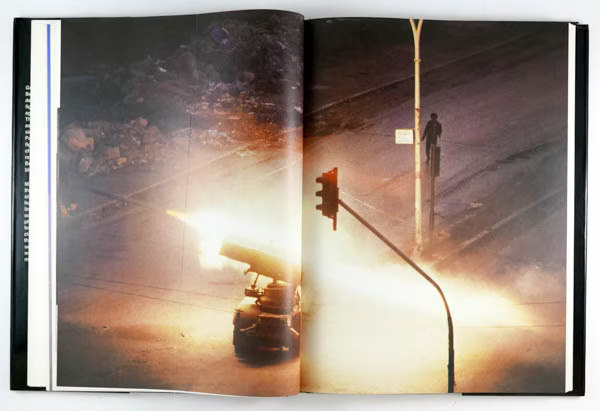
by Catherine Leroy and Tony Clifton (courtesy Protestinphotobook)
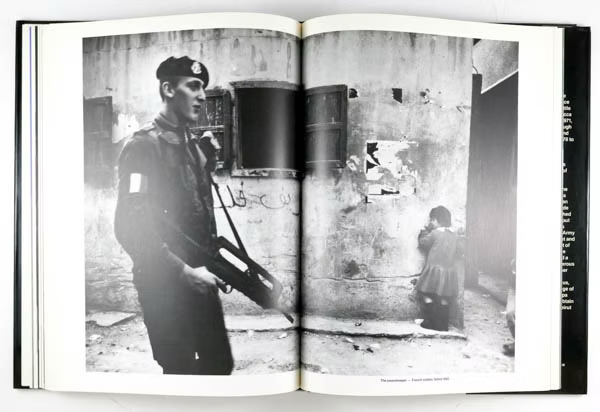
by Catherine Leroy and Tony Clifton (courtesy Protestinphotobook)
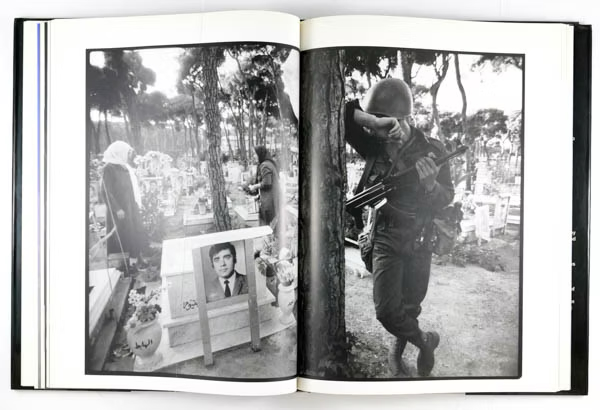
by Catherine Leroy and Tony Clifton (courtesy Protestinphotobook)
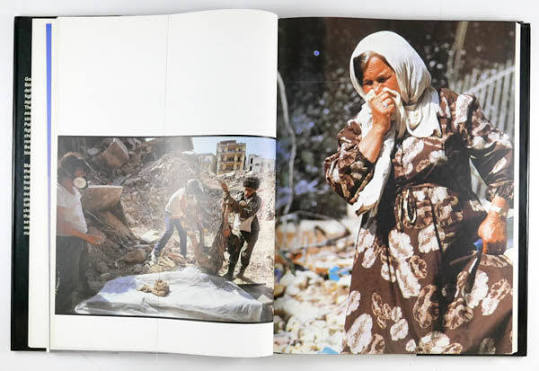
by Catherine Leroy and Tony Clifton (courtesy Protestinphotobook)
Critics who attempt to make sense of Dahl’s politics without truly contending with them could either dismiss or belittle his calls for justice. Had Rosenblatt dismissed them, Giant would not exist. Instead, the furthest he permits Giant to go is to acknowledge Israel’s crimes while ultimately reaffirming its right to commit them. Any argument beyond those parameters can only spring from a secret hatred of Jews or from one’s own unprocessed pain. Oftentimes, the implication is that the culprit, like Dahl, is simply projecting their torment onto a meek underdog. We’re left with a hollow intellectual exercise where only one outcome is allowed: Israel’s exoneration. It’s no surprise, then, that Giant was co-produced by Shari Redstone, chair of Sipur, an entertainment company with a stated mission of “telling stories that authentically portray Israel.”
Giant’s stubborn belief that the so-called “two sides” of the story deserve equal consideration is a subtle maneuver that Israel’s apologists resort to in the face of mounting public scrutiny and undeniable evidence. Dahl’s review offered Rosenblatt delicious layers to peel back and investigate how Israel’s crimes perpetuate antisemitism, a remarkable entry point into broader, harder conversations about the boomerang effect of Israeli impunity on Jewish safety—a plot twist no other play has ventured into.
“If Rosenblatt could genuinely explore how a callous, self-righteous, often retaliatory culture of diaspora support for Israel’s genocidal actions has affected Jewish reception,” writes Jessica Goldschmidt for Jewish Currents, “and if he could truly interest himself in the very real and urgent political necessity for people of conscience to criticize those genocidal actions—then Giant might have offered a cogent meditation on the intersections of bigotry and political ethics where Israel is concerned.”
Halfway through God Cried, it became clear to me that the book was not merely spillover from Clifton’s dispatches, but a meticulous record of events that could be used in an international tribunal. Both a warning and proof of Israel’s capacity for violence, God Cried is a historical document that presents us with a moral and political impasse: knowing what Israel did and why, and understanding that there would be no justice. If Israel could proceed with its carnage in Beirut, what was to stop it from annexing more Palestinian land next? If its wars could begin, end, and resume after a single call with the president of the United States, how can we rely on the double standards of the postwar international order?
Clifton and LeRoy don’t have all the answers, but they give us a solid place to start. For that reason, God Cried resists literary or political categorization. After what the authors had seen in Lebanon, there was no room for nuance or neutrality about what had occurred that fateful summer.
*
In recent years, a new genre of theater has cropped up: a riveting, feel-good story about Jewish confusion, guilt, and betrayal over Israel that sidelines or expels Palestinians, its primary victims. The Zionists, Birthright, and Giant have all the ingredients of a high-stakes plot, promising to confront Jewish complicity, the occupation’s history, and communal responsibility toward Palestinian freedom today—only to look away at the sight of our graves.
Since 2023, we have watched Jewish settlers claim Palestinian homes, Israeli soldiers demolish Palestinian neighborhoods, and Jewish Americans sell off land before the rubble of its past lives has been cleared. We’ve watched protests, arrests, encampments, and self-immolations, while thousands of us around the world have reorganized our daily lives around the incomprehensible fact of a livestreamed genocide. In Lebanon, Israel has decimated entire villages and displaced over a million people under the watchful eye of ever-present drones that strike at a moment’s notice. And yet, these plays follow the trail of Arab blood, circle the crime scene, and meander through the evidence, ignoring the signs pointing them toward our liberation. That’s why their synopses are marketed as explorations—of identity, of political ideologies and allegiances, of the moment’s so-called blurred lines. But for audiences who know better and have seen enough, these plays are a waste of time.
After the audience’s final gasp—directed at Dahl, not Israel—I left the theater and merged into the parade of Knicks fans celebrating in Times Square; the team had beaten the San Antonio Spurs in a record comeback. Desperate as I was to share their joy, I couldn’t shake off that anger, aimed at everybody and nobody at once. There was that grayness waiting for me by the exit. I carried it with me on my way back home as I read the latest updates from home: a targeted ambulance, a dead Risala scout, a satellite image of my colleague’s hometown in the South, a death toll surpassing 3,000 killed, an Instagram story of a girl impaled by last fall’s pager attacks, a double tap on paramedics.
This information lashed at me, quickly and repeatedly every morning, every afternoon, every night; information my mind could not process in real time.
“To regret that evil exists,” wrote Adnan. “To blame oneself for the existence of evil.”
To ask—no, beg—artists, writers, playwrights, and producers to recognize the existence of that evil and act on it.
Giant’s proshot will premiere for global audiences this November, three years after Israel launched its genocide in Gaza and its bloodiest offensive in southern Lebanon, again carrying out a war of attrition against the Palestinian and Lebanese people. Though the play was conceived and written at the turn of the decade—when Israel’s well-oiled democracy and LGBTQ-friendly beaches could be lauded online by supporters and paid bots—it is difficult to picture Rosenblatt consulting God Cried for any guidance on where Giant could have led us, or with whom we should have embarked on the journey.
For all its moral posturing, its audiences may leave wondering what friction the play really achieved in its two-and-a-half-hour runtime, beyond reciting old arguments and flashing a dead man’s antisemitism so sharply that we’re blinded to the invasion that exposed it. By convincing its audience that, contrary to the evidence, there are always two sides, Giant absolves them of any responsibility to pick a side and do something.
“Lebanon broke him,” Liccy, Dahl’s soon-to-be-wife, explains to the audience, seeking their sympathies. But there is an eerie silence, a blip in the sequence, before the obvious, underlying question: why?
Despite Clifton’s and LeRoy’s efforts at its disposal, Giant doesn’t care to explain.