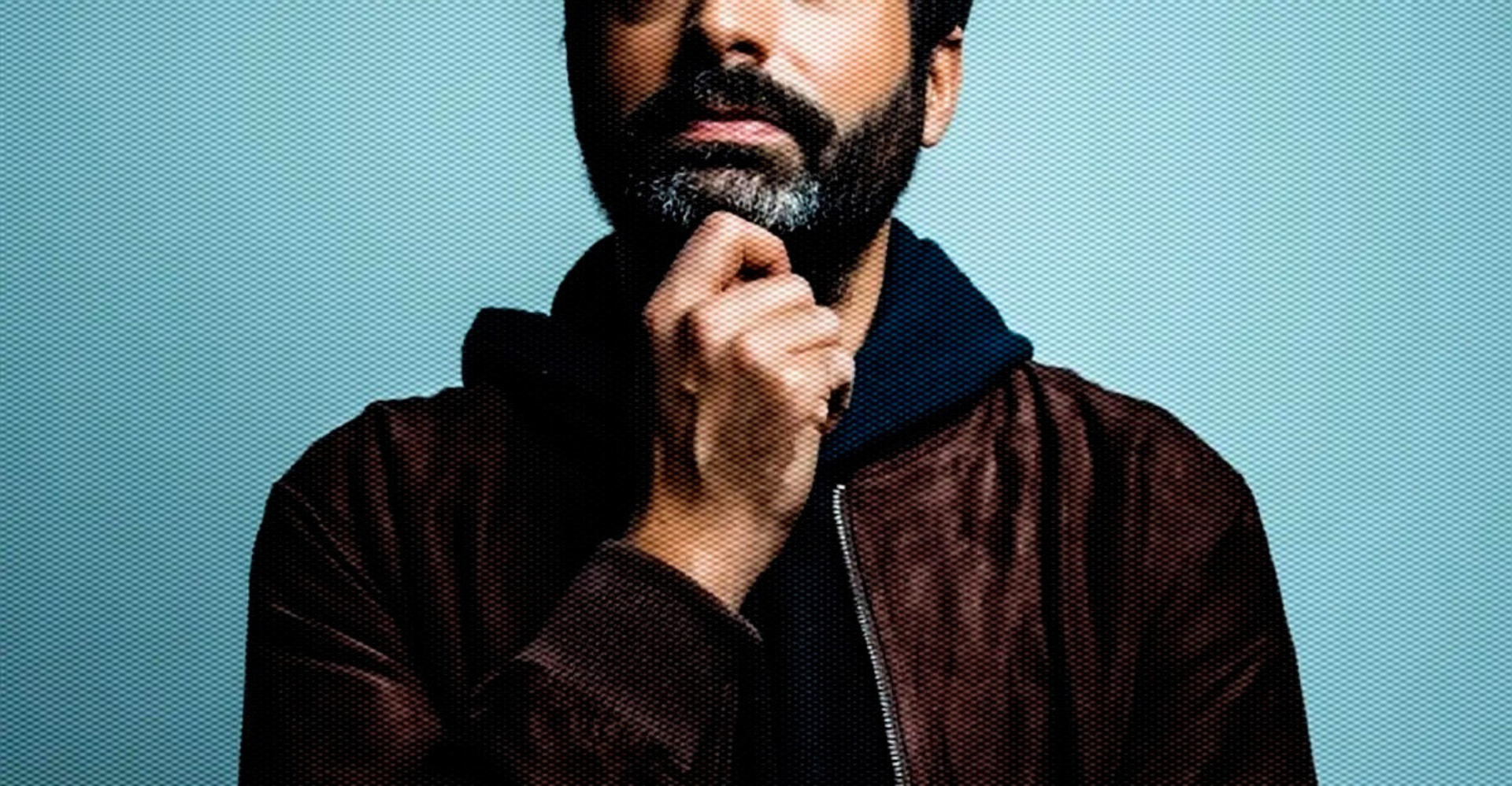
Audience expectations are changing, notes Nichen, whose multilingual stand-up covers a range of topics: nothing is "taboo."
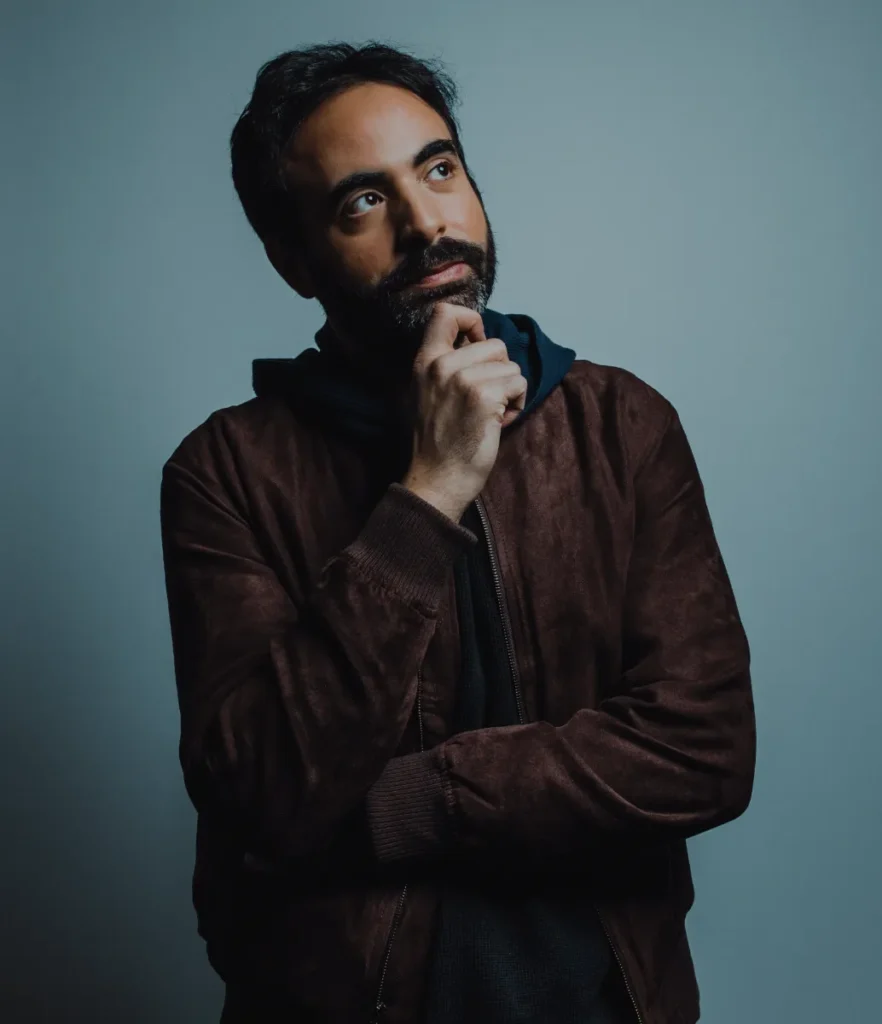
Wary Nichen, a French Algerian comedian and sometime commentator for the France Inter radio station, is funny in an impressive four languages: Arabic, French, English, and Spanish. His humor is wry and self-deprecating, a far cry from the more theatrical and physicality-based comedy that characterized early French stand-up (and is still practiced by many of his contemporaries).
Part of what makes Nichen endearing, and therefore comical, is his underdog status. For all his years in the business, for his impressive linguistic flexibility, he has not achieved the fame, at least in France, of some of his counterparts. In proper comedian form, he leans into this—his website displays the following joke in both French and English: A lot of people do not know Wary and he’s ok with that, because he doesn’t know them either.
Wary and I spoke over Zoom last month, in a mix of French and English. I expected, rather unfairly in hindsight, a roaringly funny conversation. But a comedian on stage does not translate to a jokester in real life; the contrary actually. Like the other comedians I interviewed for this issue, Nichen was serious, reflective, and at times critical, notably about the expectations placed on comedians to be both entertainers and political commentators, and to respond to events as soon as they happen. Nichen also spoke about what compels him to do stand-up in so many languages, the role of activism on the stage, and where stand-up is heading.
This conversation has been condensed and edited for clarity.
—Lara Vergnaud, Managing Editor
LARA VERGNAUD for TMR: I wanted to start by mentioning that a publicist recently cautioned me that stand-up comedians tend to be reticent in interviews.
WARY NICHEN: Yes…
TMR: Why is that the case, in your opinion?
WN: Well, there are a few reasons. I personally refuse to do articles now, because there have been many, let’s say misunderstandings, for lack of a better word. I know that not all journalists are the same but there are some who will deliberately not tell you why they’re writing an article, to get information, while already planning to write something else. A typical example would be someone saying yes, we’re going to run an article about what you do in your comedy, but in fact the “article,” you realize, is just a quote in another piece that isn’t comedy at all but about immigration or something […] If we’re talking about politics, I have no problem with that—I’ll talk about anything, I don’t have any taboos. But what I don’t like is when there’s a puzzle basically: they take this, they take that, this sentence here, put in this thing, and then it resonates differently.
TMR: I know exactly what you mean. But I’m not a journalist, I’m a managing editor… What I’m interested in, as I told you previously, is the emergence in France, beginning in the 1990s, of an incredibly diverse stand-up scene, primarily of comedians from immigrant communities, that came out of and departed from the tradition of café theatre. And in particular, I’m interested in how these stand-up comedians, who were primarily of Arab and African origin, had to play into the cliches and stereotypes of their own communities. So my question to you is: how do you see the evolution of French stand-up from those early comedians starting with [Jamel] Debbouze to where French stand-up is today?
WN: The starting point you’re looking for, I think, is the Jamel Comedy Club, which put a spotlight on the French version of stand-up. The same thing happened with rap, when there was an explosion of rap with IAM and NTM and so on, which was heavily inspired by American rap, of course. And the same was true of stand-up and the Jamel Comedy Club.
There was a culture of “this is how we are.”
The person who basically set it up knew American stand-up very well. He had seen Def Comedy Jam at the Apollo Theater, where there were lots of, well not immigrants, but kind of the equivalent in France [in the sense that] there were lots of African Americans and Latinos [performing] in front of a predominantly non-white audience. And so the Jamel Comedy Club did basically the same thing with Arab, Black, Asian comedians. There was a culture of “this is how we are.” Then came the next wave, which had access to Netflix and YouTube. And people started to see real shows, real roasts, stuff like that.
Plus you have the French media, kind of à la Trump, with CNews and all that. [Editor’s note: CNews is a privately owned television channel similar to Fox News in the United States]. That is why comedy is so political: lots of comedians are commenting on politics, on what politicians are doing. That’s also why, in my opinion, there are more and more immigrants in comedy. Because comedy is like Uber: a job with no recruitment. Compared to a job where you apply and you get selected, you can start, you can just go do your comedy thing, run your show. In any jobs where you can start on your own, live your life, you’ll see that there are lots of immigrants.
TMR: I wanted to ask you who your influences are, given that you have a multicultural comedy background, up and comers, oldies, anyone…
WN: I get asked this question a lot. I don’t really have a model or anything; it’s more that there were phases [in my comedy career], of course. When I was living in Algeria, the first person to do stand-up was named Fellag.
TMR: Oh yes, I know of him!
WN: Except that we didn’t know it was stand-up [at the time]. He was just a guy who was telling stories. In our culture—meaning Algerian culture or Arab culture in general—there’s always a storyteller. Think of The Thousand and One Nights, Shah, etc. Anyways, we grew up with those stories, and Fellag told stories. He’s the first person I saw performing a comedy show and making people laugh; he would talk about history, too, immigration, everything. After there was Gad [Elmaleh]. There was the phase of DVDs and video cassettes of Gad’s shows. He was the one who spoke most to North Africans. But in general, I was always more seduced by comedy than by the comedian. It’s always been the humor, the angle, the text, the originality, that interest me more than the individual per se.
TMR: I think it’s a good time to ask you how and why you do stand-up in four languages. So personally, I don’t speak Arabic and I don’t speak Spanish. Yet the sketches you’ve done that make me laugh the hardest are the ones in Arabic [Editor’s note: these are glossed or subtitled]. They’re more visceral somehow. But why?
WN: Well, to start because it’s my mother tongue. Meaning that when I speak in Arabic, I have way more references. And also, Arabic is a much funnier language. In general, certain languages are funny. For example, English is easier when you’re doing stand-up. For those who speak English, if it’s your mother tongue, English is made for stand-up. You can leave the verb until the end, and stand-up is all about surprise. If you leave the action at the end, you get the surprise. English is short and action-based. Tuduh tuduh… bam! So you can do setup, punchline. Which is why one-liners work much better in English.
In French, it’s more description, books, poetry; it’s storytelling. If your humor is based on storytelling, French is a much better fit than English. In any case, it’s easier for me to tell a story in French. As for Arabic, first of all, the language is a mix between literary Arabic, Darija, Amazigh, and French. There’s a little bit of English and even Spanish. So already the structure of the language is really rich. In other words, you have a lot more resources. And for me specifically, there are a lot more references, because I lived in Algeria, I grew up in North African culture and so of course, when I’m going to talk about a topic, I might be more passionate, which people can sense.
TMR: And so why do you do stand-up in multiple languages then? Is it kind of a challenge to yourself, to see how far you can push the language? Or is it simply a question of logistics, you’re here in this country, etc.?
WN: In the beginning, it was never my intention. I never thought to myself, “Hmm, I’m going to do that.” It just came gradually. When I started out in Canada, I had a really hard time performing in French. Access was really difficult, there weren’t a lot of opportunities, but in English, it was a lot easier. There was less competition because the French spots were paid most of the time, whereas as in most of the English ones, you played for “hats” [tips]. And I was kind of like Ismo [a Finnish comedian known for making jokes about the English language]—someone different from what audiences were used to seeing. So I started getting more stage time. And I decided to perform in both French and English so that I was effectively doubling my stage time. And little by little I started to see, oh that’s not the same thing, this works here but not there. […] When I got to France, I didn’t want to lose the anglophone side since I was still going to the U.S. a lot, to Canada. And then Spanish came about because I used to work in Spanish-speaking countries, so I spoke some Spanish. Obviously, I could do the same bit in Spanish [as I do in English] about a guy who doesn’t know the language but can comment on it.
And Arabic is natural. In the beginning, nobody wanted to watch stand-up in Arabic but now there are more and more [people who do]. And whenever I get the chance to perform in Arabic, I take it. So it’s more of an adaptation, you could say, to the situation than a desire. But by performing [in all these languages], I realized certain things work in every language, regardless of the situation or the culture, and that’s where things get interesting.
TMR: And presumably there are many things that don’t work in all languages or cultures?
WN: Here is where I played scientist in my head, doing little experiments to see how far a joke could work. There are things where you start to say, “Oh! Look, that works here in the same way,” and other things that don’t work. For example, I had to learn that in France, I’m seen as an immigrant. So when I talk, for example, about other immigrants, it sounds normal. He’s an immigrant talking about other immigrants. But in the U.S., when I said “a Black guy” for example, [the audience] didn’t realize that I was also African. So it could create some tension for some people. They thought it was a white guy talking about a Black guy. And that’s not the same perception. What’s funny is that when the audience included African American people, they got it. They saw that I was African too. It was usually white audience members who got uncomfortable and would tell me, “Don’t talk about that.”
In France, we have a tendency to speak more openly among immigrants, but in the U.S., you’re not necessarily seen as an immigrant. In the U.S., I could be Polish, I could be mixed. They don’t know where I’m from, and that takes a while to understand too: how you come across to the audience, where they place you.
TMR: I’m going to take us in a different direction, because I want to talk politics a little and this idea of “oser plus, parler plus” (dare more, speak more). In preparing “Make ’em Laugh” for this issue, I noted, based on the stand-up I was seeing, that although it would be inaccurate to say that many comedians in France are talking about Palestine, some are, and more so than in the United States, for example. Though, things are changing [there] little by little.
Do you think that French comedians are more daring, first of all? And more specifically, in terms of Palestine, because I’ve seen in your sketches that you don’t make an explicit political stance per se, but you do talk about it and perform sketches that reference it. Yet I get the sense that many comedians wouldn’t dare to do even that.
WN: To start, I’ll respond by saying that the problem with comedy is that people forget that we’re trying to make jokes. Now we live in an era where it feels like they don’t care about the joke; they just want you to take a stand on something. And I get the need [to make a stand]. Ed Sheeran is a great example: “I don’t take sides…” Which doesn’t work. Because not taking a side is taking a side.
But nowadays, lots of people aren’t necessarily looking for the joke, they’re looking for—what do you stand for? And I, for example, would go look for the joke first. So if I find something funny, I will say it, no matter what. Of course, not if it’s racist. But nothing is taboo to me. As long as it’s not harmful, as long as people don’t perceive it as an aggression, if there is something funny about it, that is what I’m looking for before making a political statement. In my mind, it’s not our job to just say “free Palestine” (meaning without jokes). You can do that on your social media of course; that’s something different. But when you are onstage, your job is to find something funny about it. And it’s perfect if your joke is in alignment with what you believe. But some people just go on stage and say “free Palestine.” Okay, yes, but what is the joke? Where is your joke?
Ah! Today, something exploded, now tell us a joke…
And conversely, there are people who are going to say, “Oh, hey you haven’t talked about this” or “you haven’t talked about that,” as if we [comedians] are required to talk about things. For example, something will happen in Iran, and the next day some guy will say, “Hey, you haven’t talked about Iran yet.” I’m not a journalist who has to follow the news and say something. Humor is different; there are certain things that are sad. They’re just sad. You can’t make jokes about them. They’re sad, that’s it. Even just broaching the subject makes people sad. So basically, your role [as a stand-up] is to find a way to make it feel less serious even as you’re talking about something important. And sometimes that takes time. And it’s not just true for us as artists. The same is true of the audience. People need a little distance from the situation to even be able to talk about it.
TMR: Especially for Palestine, I imagine?
WN: After October 7, when people were still in shock, you couldn’t walk in all “hey I’m here to make jokes.” One of the most famous rules in comedy is that for something tragic to become funny, you need a little time. Why a little time? So you have a little more distance, you’re not in the trauma of the news. But now we live in a world where people want a reaction right away. Ah! Today, something exploded, now tell us a joke… Why are you talking about that but not talking about something else?
Nowadays, people have lost sight of the idea of who needs to talk, and when you talk. And even sometimes—and as you’ve seen, I do post things about Palestine—people message me to say, oh you haven’t posted anything about Palestine. To which I sometimes respond, have you checked all my stories? And then they come back, my bad, I hadn’t checked… This happens a lot, be it about Algeria, Palestine, France, plenty of subjects. So basically, it’s not the subject matter that is the problem, it’s whether you have something to say about it—that is funny. When you’re a comedian [I mean]. If I had a podcast and you asked me, “What do you think about that,” we could discuss it, I can talk, you see, I don’t have to make anyone laugh. But when I’m onstage, I have an obligation to find something funny. And sometimes I do, right. I’ve already talked about Palestine, for example, just after October 7. I found something that worked, in the sadness.
But also, people need to know you, they need to understand your intentions, they need to know a little of who you are, because if you come in, doing dark humor, and they don’t know who you are, you might come across as someone who doesn’t care. So it’s very, very delicate today. Though I do talk about it [Palestine], I have a segment about the conflict in my show that’s called “Solutions.”
But the goal of all this is, once again, if I were to provide an actual solution, it’s not going to be in a one-minute joke. You [the stand-up] don’t have time. Your role, in comedy, is to not upset people. To find a funny idea that surprises people. Like you start with something serious and then bam, something completely different. Unexpected. That’s it, that’s the job, really.