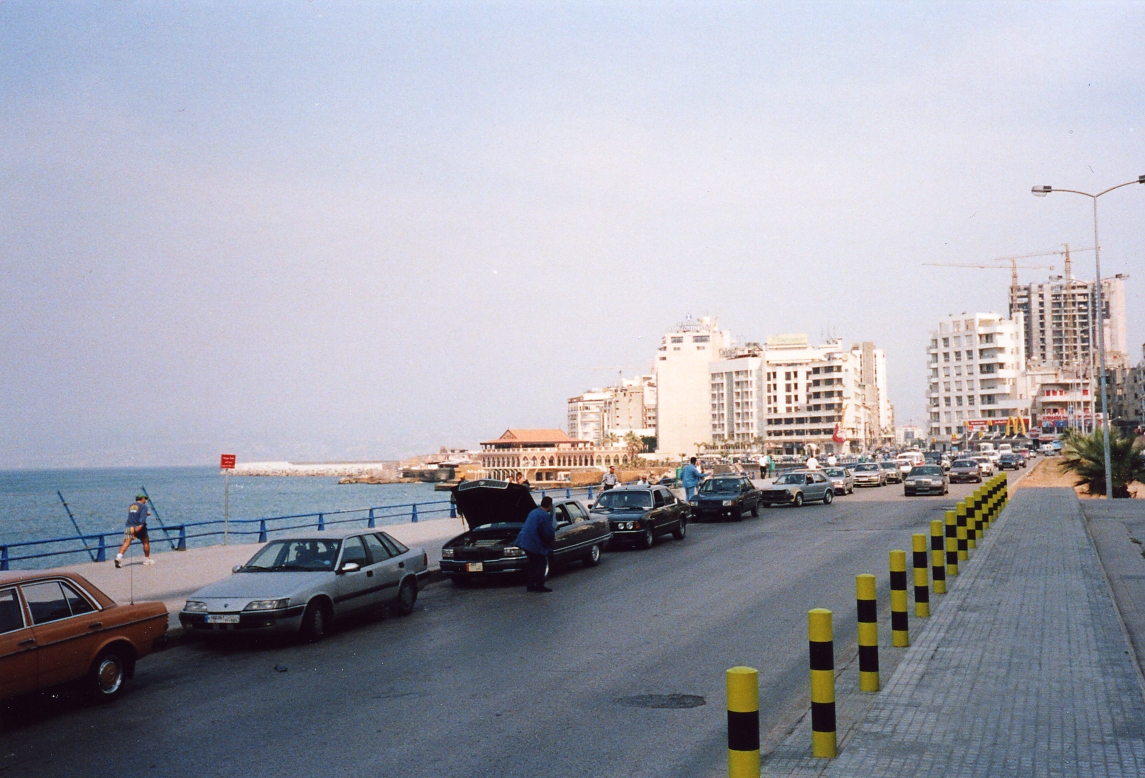
A columnist takes a walk by the sea on an afternoon poised between past catastrophes and an uncertain future.
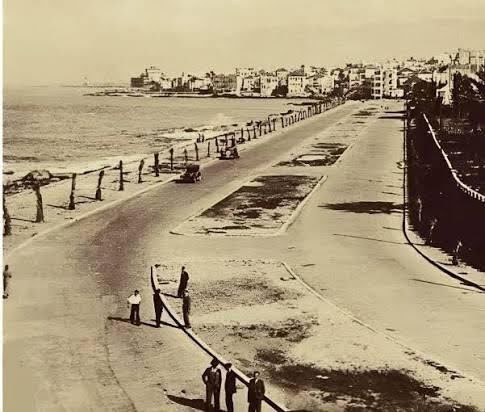
You’re looking at a 1920s photograph of Beirut’s Corniche. I cannot lie. I would have preferred for it never to have changed.
You know the routine. I fool myself every Sunday morning in the fall, winter, and spring. If the skyline is clear, I look towards Beirut’s sea. If the horizon isn’t a deep shade of grey, I deem the air clean enough for my brisk walk. And then I quickly set off for an hour or so along that stretch of the Corniche down from my house in Clemenceau.
I confess I spy and eavesdrop as I march. I spy on every vista that holds an interesting memory for me and listen in on words that caress or perk up my ears. Two Sundays ago, I spotted a man floating effortlessly, arms and legs spread wide, near the shore. He was singing his lungs out as if to expunge the hardships of the week—or perhaps of life. He had a lovely voice. There was trash around him. There is always trash along Beirut’s coast. He didn’t care. I thought, what an Insta reel, and walked on.
The displaced from the south are gone now. They have either returned or found shelter somewhere else. The International Organization for Migration estimates that close to 900,000 have returned to their neighborhoods and towns and villages in Dahiyeh, the Bekaa, and the south; that leaves around 330,000 still stranded on this minuscule patch of God’s earth. I suspect many of them belong to the villages of the border area that have been ungrounded by Israel. Ungrounding! Selma Dabbagh’s definition is so tight, it squeezes like a noose around the heart: “the military defacing of land with mass disorientation as a goal.” To erase, as in to disappear. No return soon—or ever?—for those. As for the others who have trekked back to whatever remains of their homes, they may yet again run for this urban wilderness if these drums of war we hear begin to beat for the south as well.
That’s what an Israel hell-bent on forever wars tells us, in any case. Almost everyone is treating Tamir Hayman’s assessment of Israel’s post-October 7 National Security Concept as actually new. But as I read through the document, I was struck by the continuities between Israel’s strategy before and after that fateful day. Continuities like these: “Defense is established by creating communities and outposts in all areas of friction with the Arab population, in Judea and Samaria, and in security zones in Syria, Lebanon, and the Gaza Strip;” and “rejection of the Independent Existence of Arab States;” and “consequently, undermining their stability is viewed as a natural process, one that Israel can manage more effectively than it can contend with strong nation-states, and one that it should even encourage.” But in view of the ungrounding Gaza and Lebanon’s south are suffering, old and improved might be a more accurate description of Israel’s national security concept.
The people chatting in the Corniche’s makeshift cafés may not be privy to the frightening details of these expert perspectives, but they don’t have to be. They know very well what they entail for all of us on this side of Israel’s frontier. A small consolation is that these cafés are certain to always animate the boardwalk. The amateur fishermen, too. The badminton players, also, are sure to colonize forever the wide spot facing the mosque, their growls of loss and triumph never failing to jolt the toddlers and entertain the old.
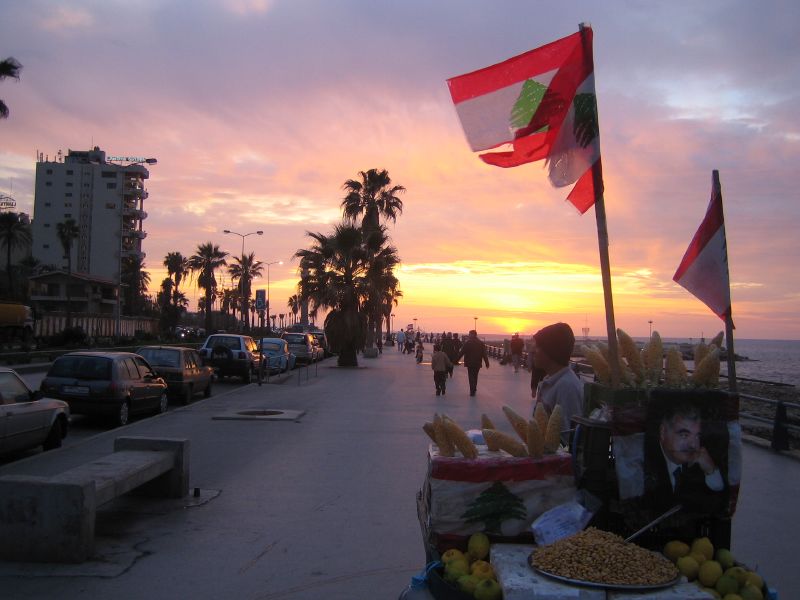
Of course, the poor will remain among the swarms. As well they should. Thankfully, the open- air space on the Corniche is an equalizer of a sort. They may be a minority there, but in Lebanon they are the largest constituency. ESCWA’s Multidimensional Poverty Index estimated them in 2021 at 82 percent. That was after everything had collapsed but before the war with Israel.
Hard to believe. Some critics actually find serious fault in the numbers. But then what’s a few percentage points here or there in the general scheme of Lebanese things?
The Multidimensional Poverty Index has to be unforgiving towards countries like Lebanon; inexorable, since Lebanon is so unforgiving towards its poor. The index encompasses health, education, income and employment, housing, public utilities, and assets and property. These categories pretty much cover every tangible measure of a decent living, where the state’s performance, regrettably, has been especially disappointing.
But Lebanon, as a friend quipped, acts like it’s on steroids. She meant Beirut. The capital looms so large over the country, we often use the two names interchangeably. She is not wrong, though; not about the Beirut we live in. And she was not referring to the packed restaurants and bars, and the traffic jams, but to the food and art scenes, the lectures, poetry readings, and plays, the cultural vibe and creative pulse of the place. Or rather this very small space in this ever-diminishing place. I have a mind to include the strollers and loungers and joggers that throng, every morning and evening, the Corniche.
Is any of this material to a Lebanon that truly reels? To some parts, yes; to the rest, not one tiny bit. You won’t see any tangible trace of it in the national economy, a negligible $35 billion in 2025. For context, it was $55 billion in 2018. Remittances and consumption of imports are better explainers of the steroids that keep us running. But then, beyond the statistics, at least those reliable enough for us to trust, we, collectively, are rather inscrutable, aren’t we? Only in pieces do we become knowable. Not sectarian pieces, as is the wont of certain voices in our midst; in fact, there, we are at our most incomprehensible. But in those haphazard fragments that coalesce into countless varieties of human islands or alcoves or spheres—bubbles is how we commonly refer to them—all swaying to their own beat.
As a Lebanese, that’s how I came to understand us. But to be clear, there is nothing romantic or ingenious about an existence that functions best in splinters because it has to. Some describe it as a stubborn if unusual form of resistance, or that dreaded word: resilience. If anything, it is as much an expression of death as of life. Say, the death of politics. The kind of politics that could forge and sustain mass action, for example. The action required to uproot, root and branch, this rotten ruling elite. Even many among the good folks in the haute bourgeoisie now agree it is a must if Lebanon is to have a chance. Don’t put words in my mouth: not through revolution, God forbid.
I am woolgathering here. And I jest. This is just the chatter you hear at dinner parties and on the Corniche. It’s not nothing, but it’s not new, either. We live in constant bewilderment about them, our overlords, and us, even when there is really no us to speak of, except for the loss of the one thing we all claim to hold dear.
On Another Note
Lebanon’s endemic electricity problems since the end of the civil war in 1990 have come to define the Lebanese state’s gross ineptitude and its total capture by the country’s oligarchy. But once upon a time, Électricité du Liban, established in 1964, was a very promising example of the institutional robustness of the state and the sustained grassroots collective action that helped it break foreign ownership and consolidate state control over this strategic sector. And it didn’t require a revolution.
Mikey Muhanna’s conversation with Professor Ziad Abu-Rish on the Afikra podcast, Lebanon’s Electricity Crisis is Not New — It Started in 1952!, is truly an education about an often-overlooked part of Lebanon’s modern history. Have a listen.
Amal Ghandour’s biweekly column, “This Arab Life,” appears in The Markaz Review every other Friday, as well as in her Substack, and is syndicated in Arabic in Al Quds Al Arabi.
Opinions published in The Markaz Review reflect the perspective of their authors and do not necessarily represent TMR.