Through frottage, film, and more, an artist traces tensions between land and memory, mourning and resistance, destruction and reconstruction.
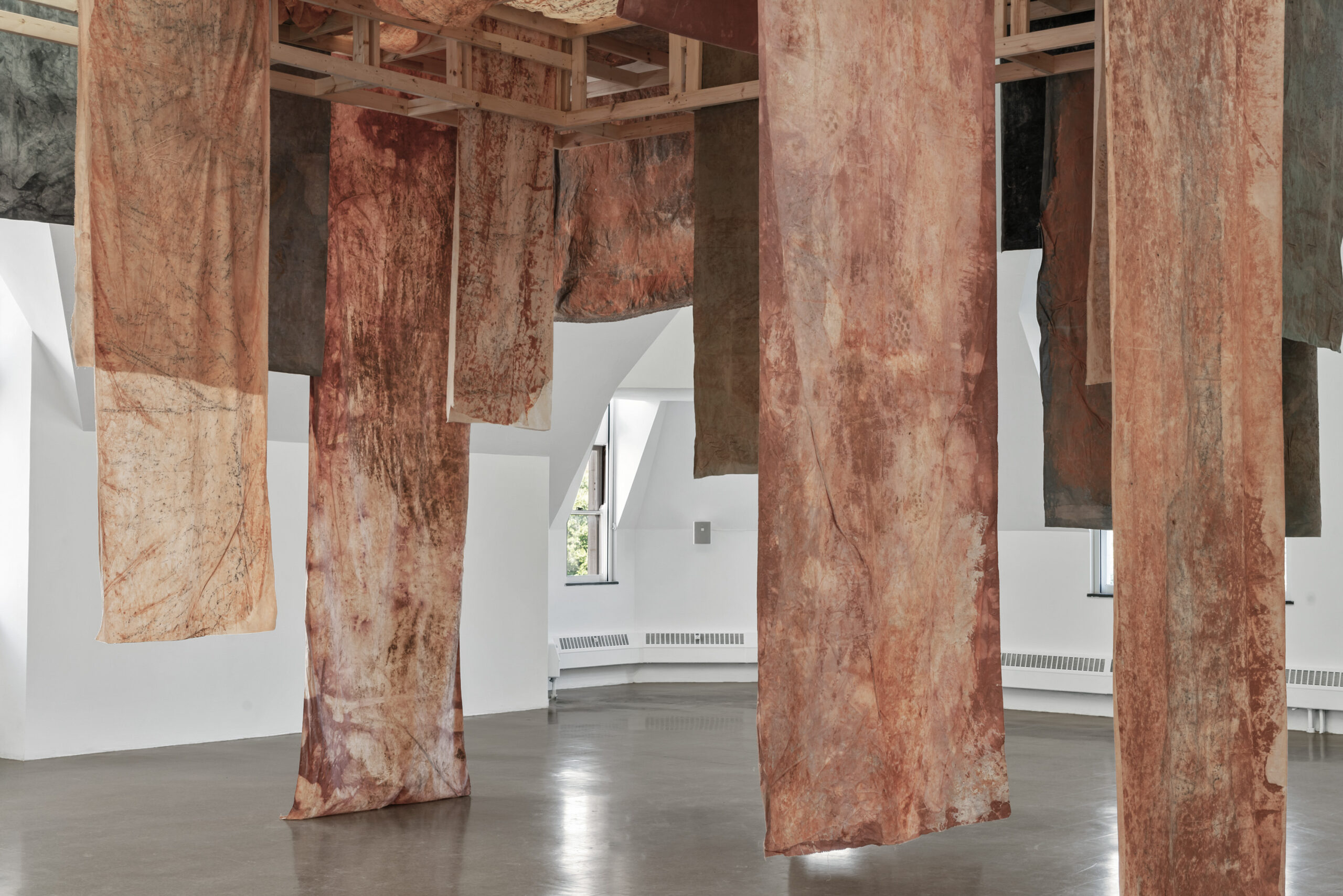
Dala Nasser spent her summer at a brick factory in Mount Lebanon’s Beit Chabab that temporarily became her working space. But mostly, her studio feels at home in the outdoors, between caves, temples, rivers, and mountains. Best known for her frottage installations of historical sites, in which fabric is showcased hanging from wooden structures, Nasser also works with moving images, sound pieces, and performance. For the past decade, she has worked with soil, charcoal, and ash through processes of dyeing, rubbing, and soaking.
I spoke to Nasser about how the materials, techniques, and forms that she employs in her art tie in with the larger conceptual questions that occupy her. We addressed the urgency of the current conjuncture marked by rampant colonial violence in Lebanon and Palestine, which is reshaping lives and landscapes, including places of burial. By probing anthropocentric accounts on witnessing that assume a certain degree of legibility supposedly facilitated by language, we discussed the capacity of what Nasser considers to be “witnessing without testimony.” She also spoke about the bodily toll of artistic production, how the material shaping one’s work imposes its own set of restrictions, and the possibilities that emerge from those limits.
In our conversation, we often returned to the unfathomable loss of life and land to which we continue to be brutally subjected in Lebanon and Palestine, especially over the past three years of the ongoing genocide. However, Nasser maintains that nothing is ever lost, at least not in its entirety. Cultural production, if it is not to sink into total fatalism, must tarry with loss as an act that is “antithetical to forgetting.”
SAMIRA MAKKI for TMR: As colonial violence ceaselessly manufactures deathscapes all around us, with particular intensity in Palestine and Lebanon, my first question is about your most recent exhibition at Nottingham Contemporary titled Cemetery of Martyrs. The exhibition emphasizes mourning, a notion that is central to your practice, and takes figures from the Arab Nahda as its starting point. Nahda itself is a fraught period in Arab history marked by the encounter between the remnants of Ottoman rule and the expanding movement of western imperialism and colonialism, capitalism, and the formation of modern nation-states. Could you walk us through the conceptualization of this exhibition? At a time when cemeteries in Gaza and southern Lebanon have been deliberately targeted and wrecked by the Israeli occupation, and while the bodies of hundreds of martyrs have not yet been recovered from under the rubble, how does the exhibition speak to the current moment, not least in its semantic explicitness?
DALA NASSER: Cemetery of Martyrs came to mind in May 2021 and was thus not conceived as a response to the events we are currently living through, the ongoing genocide in Gaza and the onslaught, invasion, and occupation of southern Lebanon.
Throughout my education, the compounding effects of the disintegration of society and life as we know it in Lebanon started with the collapse of the banking sector, followed by the Covid-19 pandemic, the Beirut port explosion, and the May 2021 bombardment of Gaza post-Sheikh Jarrah. During these events, I was in a very isolated place, unable to form the connections and have the conversations that have always been part and parcel of my work.
When Israel started bombing Gaza in 2021, I decided to do something very simple. I wanted to provide a material history to what was so saliently unacknowledged and historically misunderstood by many of those I showed my work to.
In that process of collectivizing and publicizing knowledge, I first learned about the King-Crane Commission and the United States of Arabia. It was the first time that I encountered a historical moment in which an alternative political reality to the one we know had been imagined, researched, and given constitutional form.
Rather than looking at history through monuments and sites, as I had in my previous works, I decided that this one would look at history through a timeline of figures.
This wasn’t actualized until October 2024, after a year of genocide in Gaza and having to contend with the feeling that cultural production was not only muffled but also rightly scrutinized and contested in the face of such violence.
I sat with Nottingham Contemporary’s director, Salma Tuqan, and told her very honestly that the only thing on my mind at that very moment was that I had never made rubbings of my grandparents’ graves in Souwaneh, my village in the South. It was a month into the Israeli invasion of southern Lebanon, and I could only think of how the loss of my grandparents’ home would feel like losing them all over again.
I told Tuqan, “Let’s put a date on the calendar. I want to produce this work.”
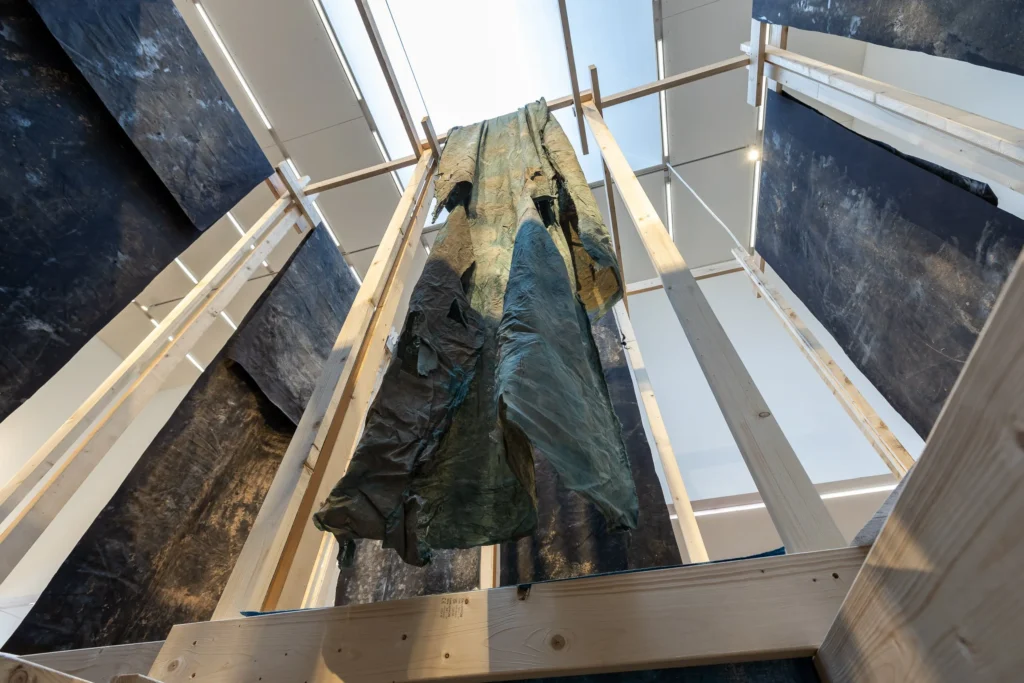
One can find the names of the martyrs included in the work in Beirut’s famous cemetery, مقبرة الشهداء , where some of these figures were buried. The exhibition was driven by the absence of space to mourn or remember, and by the embodied witnessing that urged me to do this work.
I then sat with the legacies of these figures, each of whom lived by these hopes and ideals that we continue to build upon. I did not only want to learn more, but also to look at them together in the same light, because so much of life in Lebanon and Palestine has been fractured by Israel. Much of what concerned these figures, and consequently found its way into their works, has shaped the experience of many of us in exile, especially because many were born in one place and buried in another.
The work came together through conversations with researchers, artists, family members, and historians who shared knowledge of these figures and their personal stories. The push to do this came from my attempt to evade a deep feeling of personal loss. I needed to understand not only the moment we were living through, but also my own labor and the labor of all those upon whom we have been able to build.
For me, the significance lies in looking at the extensive and varied collective efforts towards sovereignty, a sovereignty we never fully realized due to the protraction of colonial violence.
This show was produced before the most recent invasion of southern Lebanon in 2026. Even after sitting so intimately with this work, I find it both difficult and necessary to consider how Khalil Hawi’s death resonates today: why he took his life on the eve of the Israeli invasion in 1982 in protest of the government’s inability to protect innocents from such violent deaths.
TMR: You have often described your practice as extending a kind of witnessing without testimony. This reminded me of a poem by Ursula Le Guin titled “Marrow” published in 1981:
There was a word inside a stone.
I tried to pry it clear,
mallet and chisel, pick and gad,
until the stone was dropping blood,
but still I could not hear
the word the stone had said.
I threw it down beside the road
among a thousand stones
and as I turned away it cried
the word aloud within my ear
and the marrow of my bones
heard, and replied.
Similarly, your practice takes issue with the logic of ecological plunder that this poem protests, especially in that you allow the specificity of the site—and the physical material pertinent to it—to inform the kinds of works that eventually emerge. To what does this idea of witnessing without testimony refer? Are you specifically addressing the limits of language in informing acts of witnessing—and the notions of legibility and transparency associated with it—especially when it comes to more-than-human witnesses?
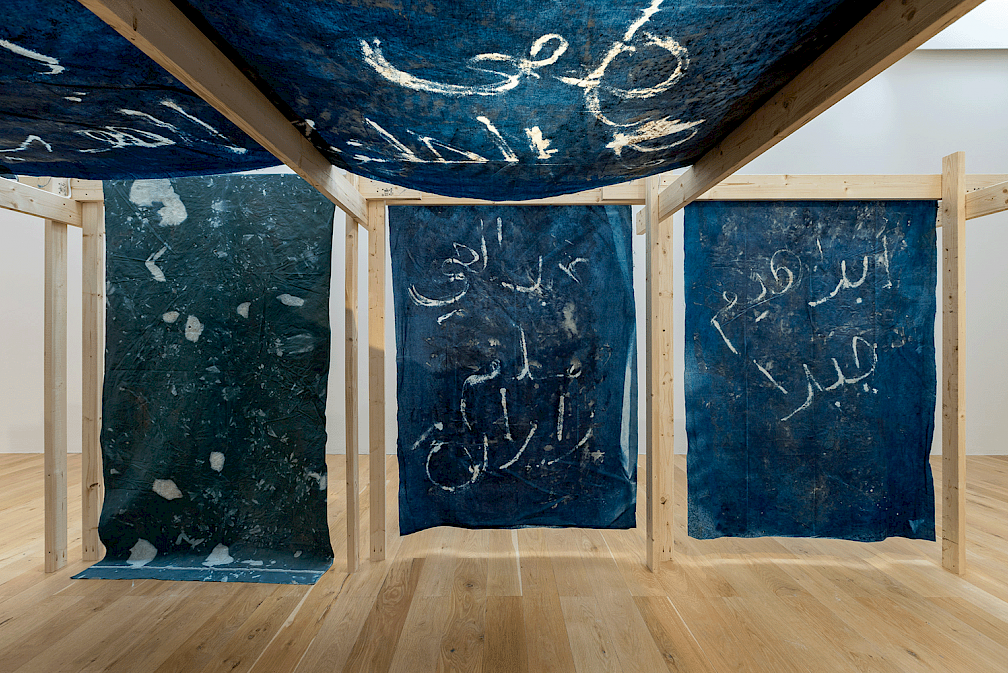
DN: This is a beautiful poem that you shared, thank you. I think the viscerality of marrow in our bones and the way it is linked to stone is pure poiesis. I feel very grateful that I have been able to translate this into the work; the process has taken a direct toll on my body. Working at such a large scale and with material that is hard to manipulate requires a lot of physical strength I do not possess, but I still try to draw from my body. This itself speaks to the act of witnessing violence against history, place, space, and territory.
The proposition of witnessing without testimony refers to the notion that the physical and psychological effects of this historical violence, this crushing colonial and capitalist experience so present here in Lebanon, is very much etched onto a citizen’s body, an animal’s body, the trees and stones. It is so extreme that its trace always remains.
This ties into my understanding of mourning, which always feels incomplete. I lost my village in the South, my own family’s personal history there, my grandparents’ graves. They were erased when the village came to sit on the edge of the “yellow line” that Israel has fabricated.
Even as I speak now, I am not sure I fully understand what I am feeling. The loss is so great that it surfaces in miniscule moments or objects: a childhood notebook, for instance, that I had left behind. This loss that is born out of a particular dispossession is to me, and I’m sure to many others, a source of great sadness, one that I feel I can never truly hold or place. It is rather ironic how a loss of place can generate a type of mourning that you can never really hold, almost as if the missing space where your joy once was has become the space you also seek to contain your mourning.
As I think of this loss, I can tell you about every single item that was once in our house. Even as I organize, list, categorize, break open, and verbalize, there remains a sadness in me that is beyond language, one that lingers in the body. Yet these things are not separate. These types of mourning are never without one another, and neither are the body or the place.
In the case of southern Lebanon and Palestine, the people, the land, and the animals, every crop from tobacco to olive, every rock, everything that is left behind constitutes a larger testimony. My understanding of art and representation comes from an intuitive process: the need to put my body through this labor to hold what might be too heavy for my legs to carry.
TMR: As a painter, frottage has figured repeatedly in the body of works you have produced. How has your interest in this technique come about and to what extent do you think it retains an affinity to the medium of painting; that is, if you consider them to be separate at all?
DN: With frottage, I have always experimented with painting by creating works whose outcome I can’t fully control. The satisfaction of this form of labor comes from that process, and from knowing my limits. There is nothing more humbling than making art that emphasizes the labor of its own making.
Material itself is never something I can control, I can just borrow from its essence. Frottage came as a response to surface through my encounter with stone.
The first time I used frottage was in the U.S. while doing my MFA. There were many secret society buildings around my university. There was one that had an orientalist architecture—they were called tombs. I couldn’t remove the “Islamic stars” from the surface of the marble facade. The architect used them as symbols to create an air of mystery around these strange structures in this isolated East Coast town. So, I made rubbings of them, then put these rubbings through hell in my studio.
Frottage started there, as a way to tear these symbols down. It informed my approach to mark-making and to translating Lebanon’s large limestone structures, such as the tomb of King Hiram, and the cave and temple of Adonis, spaces that I wanted to physically rebuild.
These structures create the line in what you experience as an expanded painting. I collaborate closely with two very talented architects, Adrian Muller and Arnie Aprahamian, on developing a structural-line language in the works. Their skills as trained architects allow us to retrace the original historical outlines that these limestone structures possessed before their current state of erosion as ruins. Creating these solid pieces from fabric and wood alone, able to support not only themselves but the weight of twenty people.
TMR: Still on the subject of frottage, I am thinking of how this technique is based on covering as the first step towards revealing: the act of rubbing against an object, whereby the draped fabric is the intermediary in your case, creates a coarse impression, and I think it is the coarseness that is captivating insofar as it exposes the materiality of mediation. What kind of affect do you seek to convey through the haptic quality of rubbings beyond mimesis? For example, in the case of the rubbings that you produced at the temple and cave of Adonis as well as at Hiram’s tomb.
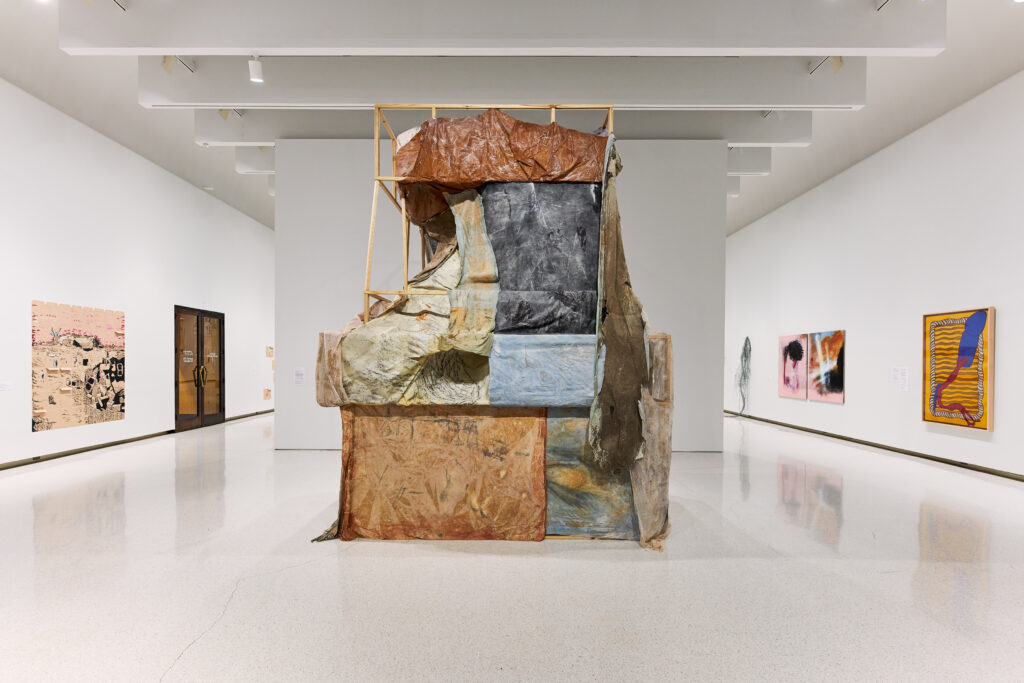
DN: There is no particular affect. For me, it is a process through which I can directly conceptualize material without completely abstracting it. It is a literal, embedded, and material translation of the solid mass in front of me. I use the word translation because the process takes the surface and transforms it, but the essence of the solid rock structures is imbued within the flecks, not immediately visible but appearing when you press the charcoal forcefully onto the fabric.
Often, the coarseness of the surface creates an image that looks very different from what I see before me, because the method flattens the shape into a drawing. So, if we think of fabric as a grid, then all of the methods in my practice are ways of breaking down pictorial translation to achieve something deeper—something, I hope, more honest.
TMR: From what I understand, you work with fabric partly because it is adaptable and relatively undemanding when it comes to moving it around or moving with it. What stands out in your use of fabric is that it is always borrowed from a domestic setting: bed sheets, pillowcases, tablecloths, curtains, and so on. Why this continuous trace of the private? And how do you grapple with the tension between the private and the public which ultimately materializes in the installation?
DN: This is an interesting question, the tension between the private and the public. This is the nice thing about being able to grow with your art. I can say that this tension between the private and the public is central to how my work has developed. I remember when working on the structure of King Hiram’s tomb, my mother had fabric saved from when her grandmother got married and her great-grandparents gave her a chest full of fabric to decorate her home. She never used it, and there was a piece of yellow silk that my mom showed me. I asked if I could turn this piece into an artwork, and she said, “Only if it goes in a museum.”
What she meant was that placing it at a museum will allow it to live forever, and that the work would be cared for better than I could care for it myself. What a sweet gesture I could gift my mom. The fabric sat as the front panel of the work.
Whenever I produce new art, I procure something from my internal life, my home, my friends’ homes. For example, a tablecloth from my grandparents’ house that was packed away; curtains from my best friend’s house; bedsheets from different beds I slept on in different cities. All these moments leave a trace of who I am, a very personal trace; threads that link all these works, so that I don’t forget why I make art.
TMR: While listening to your online exchange with WJT Mitchell in 2021, following the opening of your show at the Renaissance Society, one of the participants left a comment that stayed with me. To paraphrase, they stated that in the 1800s, a pseudoscientific theory claimed that the memory of what the eye saw last was etched onto its retina and consequently, efforts were put into extracting this final image to solve crimes. The participant later described the land in your work as an allegory for the eye that has registered the violence it has endured. Here, I can’t help but think of the history of the camera as a technology that developed in the nineteenth century alongside colonial attempts at founding the documentary image as a means for surveillance and survey. Could you speak about your documentary approach in the film produced as part of your exhibition Red in Tooth (2021) and the employment of antispectacular visual and sonic configurations, that is, images and sounds that do not reduce the violence of the Israeli occupation to mere gore?
DN: I feel grateful that I made this film as it became a kind of document.
While working on Red in Tooth, I kept in mind a very clear approach that I also apply to my painting: abstracting and reconstructing a vast archive of material piece by piece.
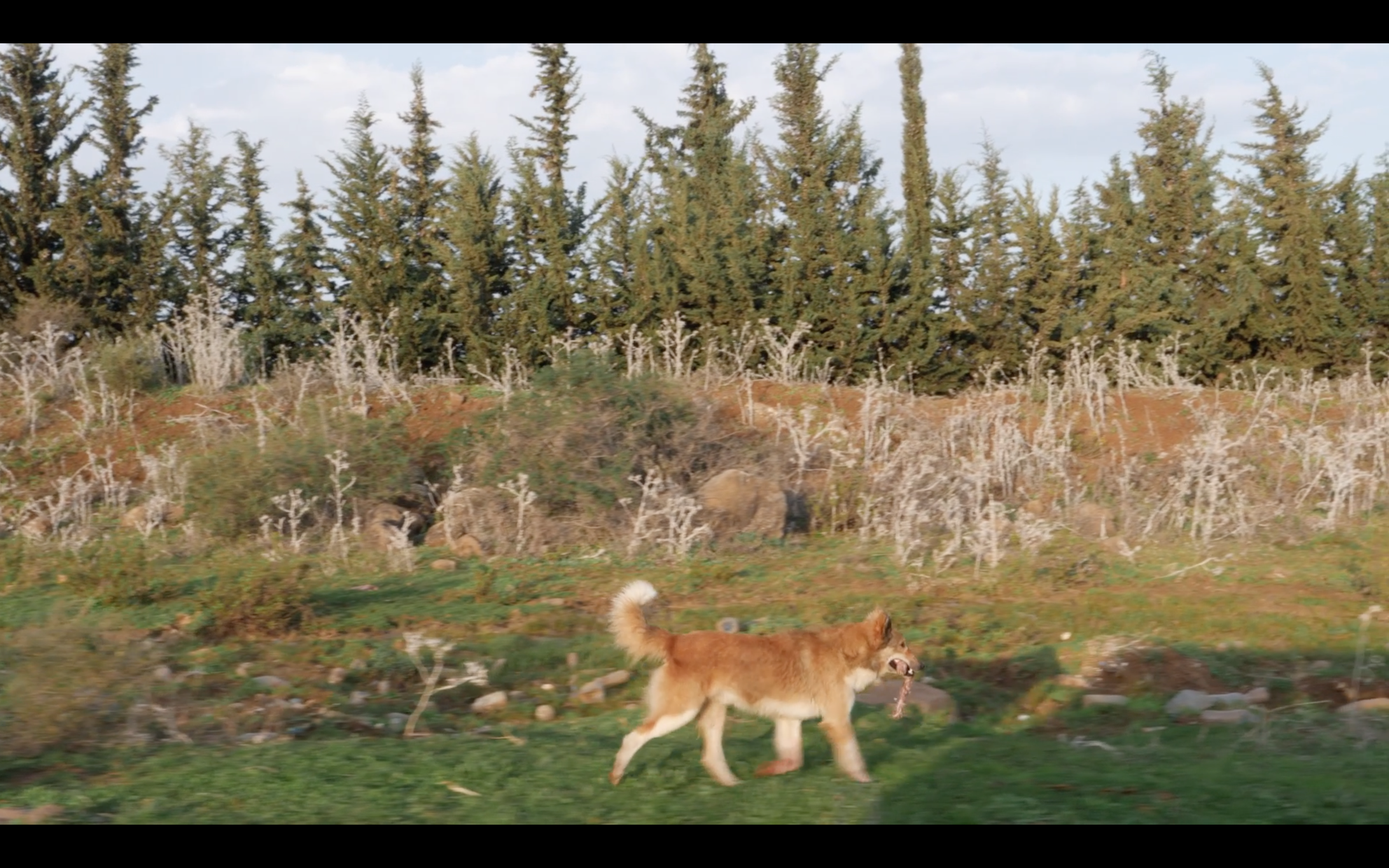
All I would hear is that Israel occupied the South for its water, so I wanted to go and see the route to the Wazzani River. It was the only space that looked like an open landscape, without a militarized border wall. We went to the Wazzani and repeated the same journey over four weekends, building this huge archive. While filming, we saw all these wild animals. This is where the work started to come together. The protagonist in this was not the passenger, but the animals that traversed the border, more freely than one ever could. This allowed me to portray the South in ways that go beyond destruction and to look at the life that it harbors, the life that endures within it, and the taxonomy of borders.
We also recorded from the point where water flows from the Wazzani spring, using it as a blueprint for the sound. The moment in the film where you finally see the Wazzani River, the sound is deliberately cut so that the viewer is made aware of the inability to access it due to the violence inflicted by Israel. You see the river, but you can’t hear it. You become so aware of your current locality because of the introspection the silence induces. I wanted this moment to snap the viewer out of the journey.
The outro accompanies the viewer through the valleys of the South. It is in those valleys, under these trees that one experiences a particular freedom and opacity. It is these valleys that make it so hard to conquer. I hope the film’s current viewing does not render it as a documentary in the classic sense, in that it is not supposed to show what you think you already know about the South. I would hope that whenever one experiences my art, it does not reaffirm certain preconceptions about Lebanon or Palestine but rather allows the viewer to confront how much they don’t know, and how much work you need to do as a viewer, as a witness.
TMR: The twentieth century, as a critical period in the putative timeline of the Anthropocene, has been inundated by the language of apparitions, ghosts, and specters that still finds resonance today. The devastating effects that much of human activity has had on earth over the past two centuries—and, by extension, on the politics of inhabitation—has reinforced readings of forlorn futurity and fatalism. Do you think that the engagement of cultural production with the vocabulary of haunting, which dovetails with the vocabulary of loss yet cannot be reduced to that of loss, can offer something other than passive nihilism?
DN: When making art within the vocabulary of haunting, I would hope it does more than express loss. I hope that I am building something with the work through the act of recreating. To recreate is to rebuild in a sphere that keeps moving, that expresses a way to hold, to embed, to look toward a wider history. I don’t think that anything can be lost. It can be destroyed; it keeps being destroyed. But it is never lost. This is the essence of resistance, I suppose, within cultural production.
A life can be extinguished, so much has been destroyed, taken, reframed, and absorbed. The hope in art is that one can engage in world building. The artists from whom I learn the most have engaged in this act.
Dealing with ghosts and memory isn’t just about expressing loss but also about what is brought together. We are looking at this current moment through these histories and landscapes so that something is actualized. These to me are acts of love and care.
I think that when a work deals with loss and mourning, it posits something that is antithetical to forgetting. This creates a space for cultural production that speaks to the urgency of this moment. Contending with the loss of my grandparents’ graves and its haunting eventually led me to the collectivizing process in Cemetery of Martyrs.