The director of Forensic Architecture produces a meticulous documentation of the mechanics behind Israel's genocide in Gaza.
Ungrounding: The Architecture of Genocide, by Eyal Weizman
Fern Press, Penguin Random House 2026
ISBN 9780593835029

The titles of the three sections of Eyal Weizman’s latest book—“Soil,” “Subsoil,” and “Ungrounding”—might give the impression that this is a study of the earth, a geological account of some sort, devoid of people. Soil, the earth, the land, the substrata, do feature in Ungrounding, but it is people who center these elements and give them their power. At the heart of the book’s inquiry is the question of how people both manipulate and are manipulated by their environments, organic and manmade, in the most extreme of conditions; that is, during the perpetration of a genocide. The work provides a “deep cartography” of Gaza, from its tunnels and militarized topography to its unique soil, settlements, and barriers.
Weizman is primarily known as the founder and director of Forensic Architecture (FA), an organization which uses situated testimony to conduct investigations—frequently, but not always, into potential war crimes and human rights abuses. Independently or with others, he has published nine books to date, many of which focus on the destructive nature of the Israeli occupation of Palestine and the apartheid system under which Palestinians live. These include A Civilian Occupation: the Politics of Israeli Architecture (2002); Hollow Land: Israel’s Architecture of Occupation (2007); and Investigative Aesthetics: Conflicts and Commons in the Aesthetics of Truth (2021).
The term “ungrounding” incorporates but goes beyond the concept of ecocide and environmental crimes. If the perpetrators make land uncultivable and uninhabitable, ungrounding deliberately alters it beyond recognition; it constitutes the military defacing of land with mass disorientation as a goal. The research contained in Ungrounding provides evidence of the genocide we have been witnessing in Gaza from the literal and figurative ground up. It synthesizes the work undertaken by the Forensic Architecture team in recent years, highlighting the work of its dedicated staff, most notably Shourideh Molavi, Nour AbuZaid, and Samaneh Moafi, and it works on as many levels as the substrata. Ungrounding spans millennia. It places the genocide front and center, but draws on archeological evidence, historical accounts, and documentation of the Nakba in 1948, all of which together serve to underscore not just how the erasure of genocide occurs, but how much destruction it actually entails.
Few readers—regardless of how cognizant they are of the decimation of one of the world’s most populous areas—will not be staggered by the levels of theoretical reasoning and practical steps that Israel has employed with the goal of systematically exterminating the Palestinians of Gaza and seizing as much of their land as possible.
The book is also a history of people. An account of how cruel and murderous humanity can be to a people it has designated as “other,” setting out to deliberately, intentionally, and systematically destroy them, but also, and conversely, how defiant and self-sacrificing some people—in this case the Palestinians of Gaza—can be in situations of siege, deprivation, and bombardment. The economy, craft, and diplomacy required for tunnel-making being a case in point. Weizman is careful to point out early on in the book that the work’s intention is in no way to help reveal the location or architecture of the tunnels, but to destroy some of the myths propounded by Israeli propaganda—for example, that of a vast network of interconnected tunnels—which are then used to justify the mass killing of an enclosed population.
The fluency of Weizman’s writing style inclines me to say that the book is an easy read: it is compelling, it tells stories, channels voices, and captures the personality of both Palestinian witnesses and the team at Forensic Architecture. But there is nothing easy about the content, which unsettles to the core. Those familiar with the extensive, detailed, and critical investigations carried out by FA in recent years, especially since the assault on Gaza began in October 2023, might be better prepared for the type of information revealed. Past investigations conducted by FA include those into the bombing of Ahli Baptist Hospital in November 2023; the massacre of fifteen aid workers in Tel-el-Sultan in March 2025; the comprehensive, bureaucratically enforced use of starvation as a weapon of genocide beginning in 2023; the movement of and attacks on the Global Sumud Flotillas that have tried to reach Gaza to provide humanitarian aid in September 2025, April 2026 and before; and the “cartography” of genocide in Gaza that FA work broadly maps out. Still, few readers—regardless of how cognizant they are of the decimation of one of the world’s most populous areas—will not be staggered by the levels of theoretical reasoning and practical steps that Israel has employed with the goal of systematically exterminating the Palestinians of Gaza and seizing as much of their land as possible.
Forensic Architecture has worked to produce evidence for the International Court of Justice’s genocide case against Israel, and Ungrounding summarizes that evidence for the reader. It shows in part how Israeli architecture has worked in tandem with the military to systematically map out lines in the sand and militarize them, so that anyone who crosses those lines is shot. The book’s examination of Wadi Gaza, for example—the Naqab’s “last gush of fertility, south of which plant life slowly fades into the deserts of the Sinai,” and which, during the genocide, has become another invisible border line—provides a good overview of how Ungrounding considers the multiple strata of spaces across purpose and time. Before 1948, the tributaries of Wadi Gaza were settled by farmers, who “installed small dams, canals and terraces to channel the winter run-off into fields and walled gardens where they cultivated orchards of almonds, apricots, figs and grapes.” The farmers also grew wheat and barley.
Referring to photographs from the period of the British Mandate, Weizman describes how modern Palestinian housing infrastructure coexisted and at times merged with ancient archeological sites, with “some structures, damns and wells… in continuous use since the Romans,” remaining useful to the Palestinians, who built among and between them “stone houses, clusters of tents, livestock pens and cemeteries.” This harmony, however, was disrupted with the beginning of Israeli occupation in 1948 and only grew worse over time. During the genocide, the Wadi Gaza line “became the first element of Israel’s architecture of genocide—separating ‘forbidden’ and ‘concentration’ areas,” writes Weizman.
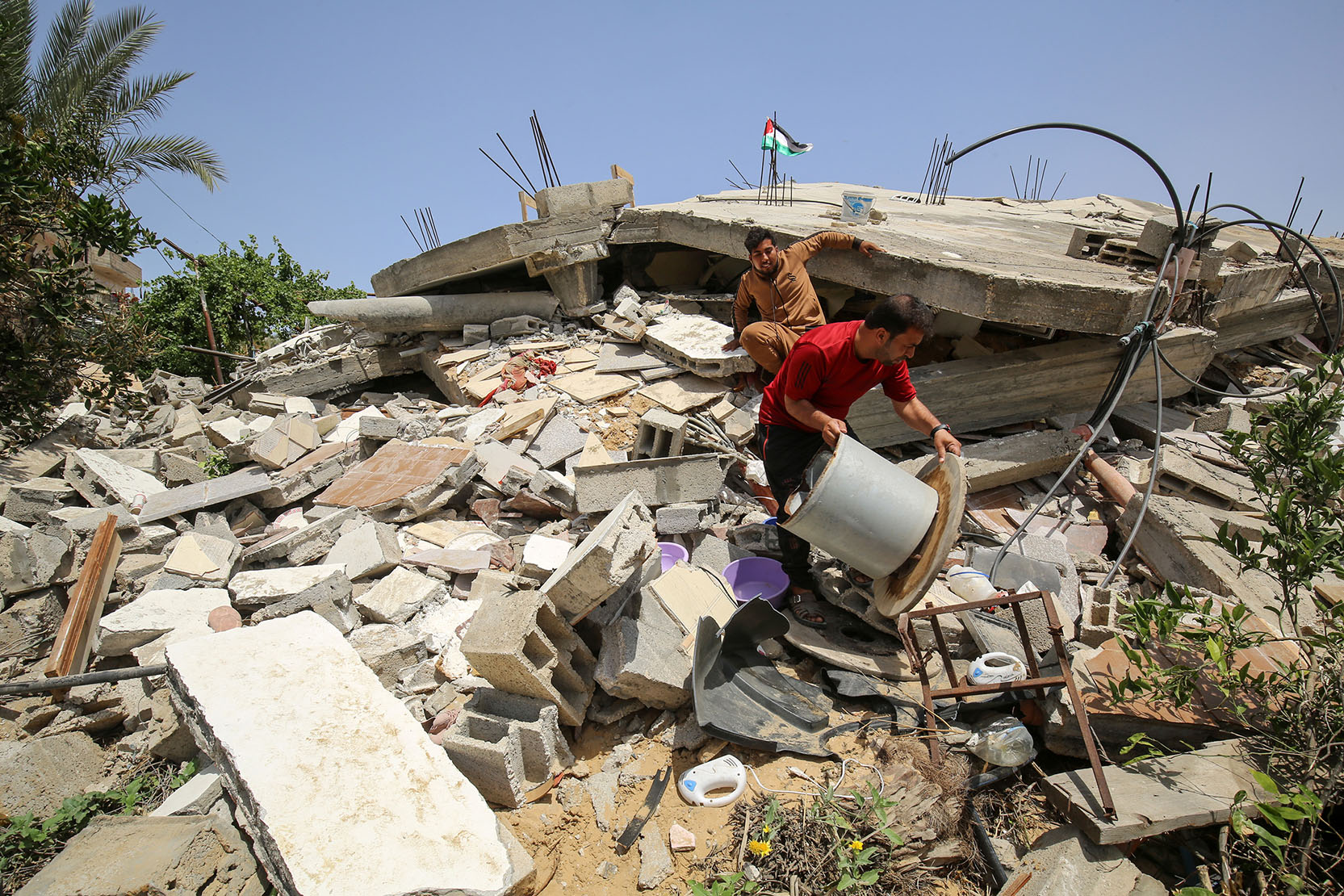
The Israeli military now works in cahoots with the settlers, recruited for the zealotry they apply to the appropriation of land from Palestinians. They drive bulldozers, effacing all recognizable signs of past Palestinian lives from Gaza, working “to carve new routes through Palestinian neighborhoods, destroying homes and farms in a wide margin on both sides. The bulldozers are also tasked with creating fortified enclosures.” These enclosures, we are told, sometimes consist of “several contiguous compounds, made out of the reshuffled soil and rubble of destroyed neighborhoods.”
Weizman describes how an entire military architecture emerged from this destruction, “growing within and gradually replacing Gaza’s cities from whose rubble they were made.” He continues:
At the edge of the encampments, the bulldozers piled rubble into a topography of artificial hills crowned with sniper positions. Other mounds enclosed detention centers where officers of the Shin Bet interrogated Palestinian detainees using various types of torture.
Since 1948, military training has become so enshrined in Israeli architects’ backgrounds and education that it has become instinctive for them to approach the construction of a home with the same considerations as they would a military barracks. The towns and kibbutzim on the edge of the Gaza Strip are part of a security framework, with kibbutzniks trained to lay mines and traps to keep out potential returnees. One of the most affecting case studies in Ungrounding is the account by Dr. Salman Abu Sitta, who worked with FA to reconstruct his home, village, and school in Ma’in, closer to Beersheva and Gaza. Now inside Israel, the former village has been replaced, like most of the Israeli constructions that surround Gaza, with a military structure. Where Ma’in once stood is the pentagon-shaped enclosure of kibbutz Nirim. “After erasing the traces of their previous existence, Israel could claim that Palestinians had never inhabited these places,” Weizman writes.
The stripping of a land of its agriculture, its arable soil, and its ability to sustain a population is part of the quest to starve them, forcing them to either leave or die. The argument Weizman makes as to how this is done is cogent, well-evidenced, and forceful, often referencing FA investigations into genocides in Namibia and Guatemala to make his points.
In the introduction to the book, Weizman quotes philosopher Jean-François Lyotard. “Suppose,” Lyotard wrote in The Differend (1989), “that an earthquake destroys not only lives, buildings, and objects but also the instruments used to measure earthquakes directly and indirectly.” Genocide denial, Weizman writes, is such an earthquake. Strong enough to destroy not only the environment but also the instruments designed to record its magnitude. And the instruments designed to record the magnitude of a genocide are multilateral organizations like the United Nations, democratic institutions like a free press, and a right to protest. Never has the force of genocide denial been as strong as it is today over Gaza. Never has the evidence of it been so hefty. Nor, I would argue, will the earthquake that destroys the environment and the instruments that measure its magnitude be as absolute if it continues to be denied.
Ungrounding is a vital testimonial, a history for the unacquainted, a methodology for the future that encourages us all to do what we can to alter the current course of destruction.