Select Other Languages Français.
A new anthology from Saqi Books explores LGBTQ+ Arabs and their families from ten points of view.
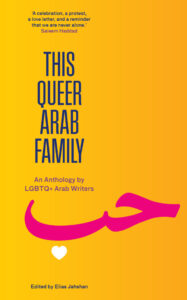
This Queer Arab Family: An Anthology by LGBTQ+ Arab Writers, edited by Elias Jahshan
Saqi Books 2025
ISBN 9781849250887
“I’m not just one thing. I’m queer. I’m Arab. I’m an engineer. I’m a dancer. I refuse to cut myself into pieces just to fit. Because it’s in our full, complicated selves that real strength lives. That’s what makes a family resilient. That’s what makes a story worth hearing,” writes Shrouk El-Attar in the opening essay of the recent anthology This Queer Arab Family, edited by Elias Jahshan. A follow-up to Jahshan’s 2022 volume, This Arab is Queer, the new book convenes ten writers located in the SWANA region or the broader diaspora for an extended meditation on the most important social, economic, and political unit in the Arab world (and beyond): the family.
In particular, the authors brought together by Jahshan push back against the well-worn trope of Arabs and Muslims as uniquely patriarchal and homophobic, versus a western world that is a landscape of modernity, progress, and state-sanctioned acceptance for women, gay men, lesbians, bisexuals, and transgender people. This is a valuable intervention. The instrumental framing of the Arab world as dangerous for both women and queer people, one that plays on an endless and exhausting loop in Western media, gives ideological cover to the fallacy that to be queer in the United States and Western Europe is to enjoy the full embrace of the state. These portrayals endure, strangely, even while transgender and queer people increasingly find themselves in the crosshairs in these places. For those of us paying attention, the lesson seems to be that the very rights that the state gives — to get married, to parent jointly — are the same ones the state can take away.
In contrast, the theorizations of queerness put forward by the authors in This Queer Arab Family sever the presumed links that bind sexuality, gender, and identity to arrive at an expansive and liberatory understanding of sexuality and gender that exceeds state recognition. Queerness in these accounts is not an identification that an individual holds despite being Arab; rather, queerness for these authors is inextricable with what it means to be Arab. Family is instrumental to this reimagining. Jahshan’s introduction describes the rethinking of family that takes place in the ten pieces convened in the volume at length. “Here, readers learn how queer Arabs forge kinships and celebrate culture on their own terms and hold space for one another through activism and community solidarity, navigating their place within their existing family or building their own. Together, these narratives embrace the many ways LGBTQ+ Arabs find — and keep close — relatives and the friends we choose to become our families, in the Arab world and in the diaspora, today.”
It is a well-worn trope that Arabs and Muslims are uniquely patriarchal and homophobic, while the western world is a landscape of modernity, progress, and state-sanctioned acceptance for women, gay men, lesbians, bisexuals, and transgender people.
Whereas the liberalism at the core of western democracies conditions acceptance upon the often-confrontational embrace of one’s sexual and gender identity in the process of “coming out” — even if it costs one their family — the authors in Jahshan’s edited volume assert that space for sexual and gender variations within Arab families is achieved through respect for one’s family ties. Several of the authors highlight this dynamic. Zeid Al-Nasr’s chapter, “One Way Trip to the Moon: My Journey with Onlyfans,” illustrates a nuance of family that queer and transgender people with Arab backgrounds know all-too-well, specifically the unspoken understanding that one does not ask questions to which one does not want answers. This “blissful ignorance,” in Al-Nasr’s words, allows his family in Syria to accept the money he raises for them as a sex worker in Canada while simultaneously honoring their values and not challenging their beliefs.
Al-Nasr’s essay, in particular, resonated for me as a queer and trans Lebanese person in the diaspora whose conversations with family are accurately characterized by the instrumental obliqueness he describes. The daily practice of what is known but remains unsaid allows me and various authors in the edited volume to preserve family relationships; the end result is the maintenance of necessary lifelines that secure queer and trans people’s sense of safety and belonging as Arab, in a world that normalizes anti-Arab animus. Lamiae Bouqentar names the stakes of these lifelines explicitly in their chapter. “But what happens when exile, post-colonial legacies, and racial violence transform the biological family into a refuge, as much as an anchor as a burden?” The answer, for Bouqentar, transcends both the family and the state. “[I]t’s also the place you go to after navigating a hostile world. It’s the place where arms open to tend the wounds caused by the violence of the outside world. The family then becomes a porous border. A territory in which tensions coexist with care practices.”
Family for both Arabs and queer people often exceeds blood ties. It is equally common in Arabic to create a situational family bond to an elder by referring to him or her as amo or tante as it is for queer people to describe their closest friends as chosen family. The intersection of these linguistic and relational practices demonstrated by the authors in This Queer Arab Family underscores how this more capacious view of family serves as a mode of resistance against both Orientalist and homophobic forces that seek the erasure of Arabs, queers, and Arab queers.
Randa Jarrar’s chapter, for example, describes how she has been able to effectively organize queer friends across the US and Egypt to get aid to Palestinians fleeing Gaza. She does this by leveraging the shared experience of “borderland existence” outside the state that queer people and Palestinians occupy. “[T]here’s something powerful about people who have been told they don’t belong creating belonging for each other. You practice care as revolution.” This compelling observation explains why so many queer spaces are often festooned in equal measure with rainbow, trans, and Palestinian flags. In the words of the Palestinian activist collective, alQaws, “Queer liberation is fundamentally tied to the dreams of Palestinian liberation: self-determination, dignity, and the end of all systems of oppression.” Focusing one’s understanding of family in opposition to oppressive ideologies of settler colonialism, white supremacy, and homonationalism in the ten pieces that make up this edited volume creates on-ramps to political action that brings people together, regardless of identity. The visions put forward by the authors are therefore inherently coalitional and shot through with an ethos of solidarity around political action.
Ultimately, while disparate in tone, style, and the writer’s origin, each piece in Jahshan’s edited volume invites readers to reconsider the same thing — the pervasive construction of the Arab world as inherently and culturally anti-queer and therefore unsafe for LGBTQ+ people — notably by interrogating how, exactly, safety is defined. Is safety found by individuals in the shelter of the state? Or is safety something collective that emerges out of the endless work of creating ways to connect and foster kinship based on mutual respect and an ethos of care? If the rightward lurch that seeks the rollback of rights for racial, religious, sexual, and gender minorities underway in the US, UK, Germany, Italy, Russia, Israel, Argentina, El Salvador, and Hungary is any indication, then it logically follows that turning to the state for protection can also entail disastrous consequences for the safety of minoritized groups. In this view, LGBTQ+ people worldwide stand to learn from Arab queers who offer models of family, safety, and care that have always existed beyond the borders and legal frameworks of the state.
In the concluding words of Abu Leila’s chapter: “There is space for queerness in the Levant because all our normal does is break apart. Our displacement, our ramshackle lives, are opening cracks for us to fill. I continue to stumble upon families, looking for the stitch that can hold them together.”
The pages of Jahshan’s skillfully edited volume reveal that one potential stitch Abu Leila searches for to bind the Arab world together is queerness and, with it, its fruitful reimagining of “normal.”
Select Other Languages Français.