Three men find camaraderie and release on Beirut's Corniche in Dima El-Horr's latest documentary.
In his 1969 song “A Bunch of Lonesome Heroes,” Leonard Cohen sings of a group of men whose refrain is a wish to tell their stories before it’s too late. In the third stanza, Cohen tenderly croaks out the line: “Well, I guess that these heroes must always live there; Where you and I have only been.”
It’s hard to tell how urgently the lonesome heroes in Dima El-Horr’s latest documentary And the Fish Fly Above our Heads wish to tell their stories. They seem content quietly whiling away the days on Beirut’s Corniche, their hours unfolding with the same methodical rhythm as the sea they spend so much time around.
And while Reda, Qassem, and Adel don’t literally live there—unlike the thousands of people displaced to this strip along Beirut’s northern coast by Israel’s ruthless bombing campaign this spring—they do dwell in a reality that other people have only seen in passing. As such, their stories allow us to see Beirut the way so few people do.
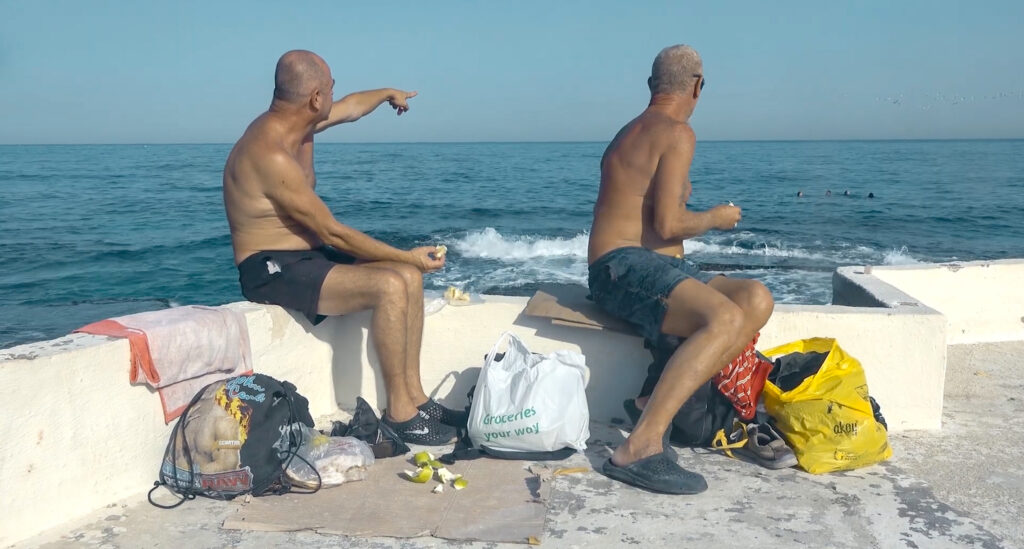
And the Fish Fly Above our Heads takes us to the place these three men occupy at the edge of the city and into the laid back, intimate camaraderie that has developed between them over the years. They each come from a different place and different background, brought together by the same urge: to be by the sea.
Reda is a tall, shy 60-something bachelor living in Dahieh, in Beirut’s southern suburbs. Every day, at sunrise and sunset, he walks two hours to and from the Corniche, the sea like an addiction to which he has succumbed, eventually leaving his job for it. Qassem, who is older and cannot work, comes because he needs a place to go during the day. He lives in Basta with his brother and sister-in-law, and as religious doctrine has it that he shouldn’t be alone in the house with a woman not his relative or wife, he leaves when his brother goes to work to wait out the long hours on the Corniche. He’s a secret poet who scribbles verses down in his spare time and doesn’t like to swim; he seems to love the sea almost begrudgingly, simply because it’s the only place he is free to go for quiet contemplation, where no one can tell him to leave.
Adel is the youngest of the men. A worn-down father of three, he comes on weekends when he’s not cleaning up blood and other medical refuse at his hospital job. Even though he’s at the Corniche less often than the other two, it holds similar importance for him, being the one place where he can unwind from the suffering he witnesses all week long.
One can imagine the solace each man finds at the sea’s edge: one from a job that wrings him dry, another from a home that isn’t his, and the third from the isolation of singlehood in a family-oriented country.
El-Horr approaches their biographies first through the marks and traces that have been left on their bodies. It was, in fact, the image of the male body—specifically the aging and scarred male body—that in 2022 drew El-Horr to the Corniche, one of Beirut’s few public spaces. Several of her previous films, including 2009’s Every Day is a Holiday, 2019’s Zainab al-Moto and 2021’s Conversations with Siro, immersed her in the world of women, and she sought a pivot—one that would bring her to a place where women are almost completely absent and where the male body rules, tanned and on full display.
“I missed filming men, Lebanese men,” she says. “But I wasn’t interested in youth anymore. I was more interested in the body that bears the weight of history, the weight of violence, the weight of how we live here. Not broken bodies, but damaged bodies. Physically or psychologically.”
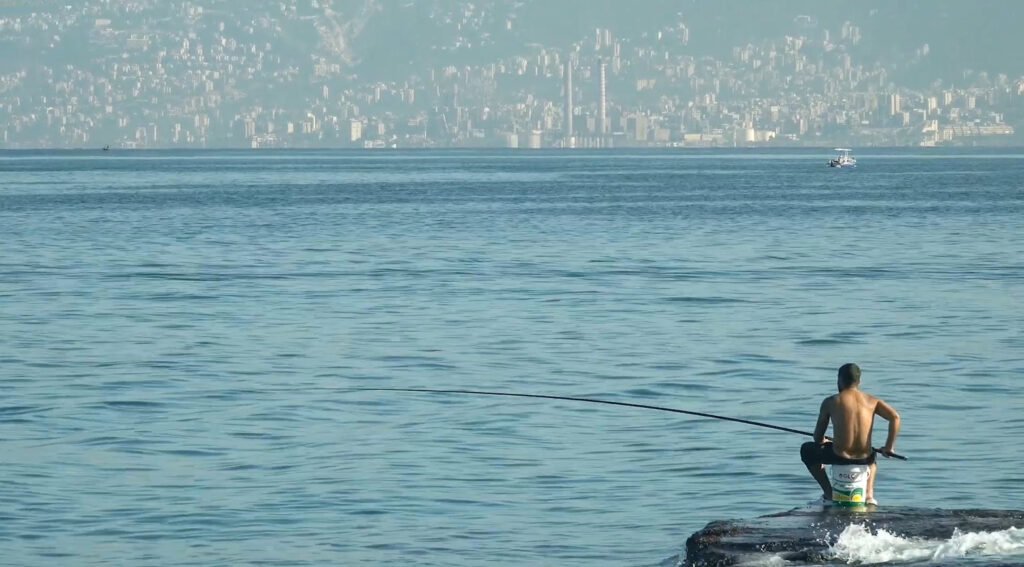
Qassem’s leg is twisted from persistent health issues and a broad scar spans his stomach where it was ripped open by bullets during an attack on the Port, where he used to work, during the Lebanese civil war. He relies on a cane and dutifully does exercises in the water every day to loosen his stiff joints.
Reda seems so healthy and fit, his skin bronzed from the sun, his steps sure and measured. But his daily four-hour walk isn’t for exercise—it’s because he can’t afford the $2 bus from his place to the water. His inner disquiet reveals itself through the cigarette pinched permanently between his fingers. The only time he’s not smoking is when he’s in the water—in that narrow strip off the Corniche which miraculously remains fit for swimming according to the National Centre for Scientific Research’s annual report, though surrounded by waters designated as contaminated.
It is Reda who taught Adel how to swim. Adel’s body, like Reda’s, doesn’t seem at first glance to bear any visible scars. But as he sits by the sea under El-Horr’s unblinking camera lens, it becomes obvious his body is saturated with a profound fatigue. Adel can afford the bus to and from the Corniche but, exhausted from endless hours at the hospital, he falls asleep in the seats, and, the narration tells us, dreams of being a fish whose eyes do not close, forced endlessly to witness the violence brought upon his people.
Their lives are precarious. Some might label their plight as simple marginalization—for they exist literally on the margins of Beirut—but El-Horr doesn’t allow for such a surface reading. In her film, the Corniche is neither refuge or prison; the opening lines emphasize the sea’s duality, acknowledging how for some it is salvation, but it is also the unmarked grave of thousands of migrants in search of freedom and thousands of civil war victims whose bodies were tossed into the salty waves and disappeared.
El-Horr’s sea retains its chaotic-neutral nature throughout the film. She shot over a one-year period, through all four seasons, but later, during a close editing collaboration with the film’s editor Sandra Fatté (of Tea with Adonis and Tadur), she decided to dedicate the larger portion of the film to footage from the winter, when Beirut is grey, a permanent rain fills the air, and it’s hard to imagine wanting to be by the sea.
“I like the grey Beirut in the winter,” El-Horr says. “Beirut in the sun is very ‘here,’ you can’t read it any other way. But in the grey, there is space for ghosts, there is space for subtext, there is less definition.”
The grey also makes room for complexity in the men’s relationships to the Corniche: part escape, part purgatory. Their attitude toward it can be described as a sort of unconventional asceticism, at least as far as their stripped-down discipline and spiritual-like dedication to the sea, through sun and through fog.
In a 1982 interview, Paul Rabinow asked Michel Foucault if there were particular architectural projects he considered conducive to liberation or resistance. “I do not think that there is anything that is functionally—by its very nature—absolutely liberating,” Foucault replies. “Liberty is a practice.”
And it is through the very bodies that drew El-Horr to her subjects—damaged but not broken—that said subjects found their liberating practice. Foucault’s chapter “Docile Bodies” from the seminal 1975 Discipline and Punish, describes how institutions harvest power from people by controlling their bodies—their productivity, their movement through space, and their time. The underlying idea of the timetable, he writes, “was the principle of non-idleness: it was forbidden to waste time, which was counted by God and paid for by men; the timetable was to eliminate the danger of wasting it—a moral offense and economic dishonesty.”
Within this framework, the endless hours these men spend by the sea—swimming, staring at the water, sharing whatever fruit is in season, engaged in lilting chatter—become a kind of resistance. Their “wasted time” becomes a subversive act, their own liberating practice. Their bodies, which have been used, abused, and discarded by industry and history, offer nothing productive to the market while they’re at the Corniche. And yet despite that, perhaps even because of it, Reda, Qassem, and Adel have managed to find a purpose and a place for them outside of the grind of society’s machinery.
In form, And the Fish Fly Above our Heads reflects both subversive idleness and the creation of the “docile body.” And El-Horr found her own liberating practice in the making of the film, using a Sony HDR-AS300 camera that allowed her to shoot entirely alone. “This is my method. I cannot work with anyone, because I need my freedom. I need time. Time to process—the place, it’s not easy. It’s a beautiful place, but I didn’t want to fall into the beauty of the place.”
On the Corniche, El-Horr creates a contemplative study of texture, light, rhythm. The shots are long and meandering, luxuriating in the reflections on the water, the lounging bodies, the deep silences, but they are also purposely grainy, fluid, and listless.
On land, when the camera follows Reda, Qassem, and Adel away from the water, El-Horr uses the energetic abstraction she honed during her time at the experimental film school at the University of Chicago to bring the city itself to life. It’s her first time returning to abstraction since switching from fiction to documentary work after Every Day is a Holiday. These shots—some of the film’s most interesting—are guttural, raw, and instinctual. The three men are swallowed up by the lights and the landscapes, their bodies made “docile” by the lilting bus or the bullet-riddled walls.
And yet in all, Reda, Qassem, and Adel don’t speak that much on camera and seem almost shy under El-Horr’s steady gaze. Their most vulnerable and personal anecdotes are told through her voiceover, which she says was intended as a tool for shaping time, pulling the past into the present in an attempt to encapsulate the hours and hours spent in this place. It also works to establish her own presence in the film, both as a character and as the filmmaker. “I’m looking at them,” she explains. “I wanted to have my view of them [in the film]. I become one of the characters… it’s not just about them and their story.”
However, it does come at the cost of a deeper understanding of the characters themselves, creating a distance where their voices have been cut out. And in fact, some of the tenderest moments are those that do not include El-Horr, such as Reda and Adel’s quiet conversations with each other as they look out at the water, and when they swim together in the fading daylight.
And so the bathers below are at once on display before the city and protected from its harshness.
Foucault’s dear friend Gilles Deleuze (with whom his famous falling out, according to Edward Said, had a lot to do with Foucault’s support for Israel and Deleuze’s for Palestine) might have watched El-Horr’s documentary and come away feeling she had filmed his “deterritorialization” theory in action, capturing men in the process of rejecting repressive fixations and “reterritorializing” in a new space and to a new freedom.
In their third book together, A Thousand Plateaus, Deleuze and Felix Guattari elaborate on deterritorialization by deepening their spatial metaphors. They introduce “nomadism” as an antidote to capitalism and oppressive institutional power—not literal nomadic life per se, but a fluidity in being that overcomes restrictive social codes, laws of property and the worship of infinite productivity. And for them, the sea is the perfect embodiment of nomadism, what they call a “smooth space.”
“The sea became the place of ‘the fleet in being,’ where one no longer goes from one point to another, but rather holds space beginning from any point,” they write. “Instead of striating space, one occupies it with a vector of deterritorialization in perpetual motion.”
As far as the three men’s own process of deterritorialization goes, their Corniche is, in fact, twice removed from the city. There is first the actual Corniche boardwalk, where many Beirutis go to escape the urban sprawl. In good weather, this sidewalk streams with promenaders, joggers, bikers, fishermen, wanderers, and loiterers. It’s edged by a railing that curves outward, against which people lean, observing the Mediterranean. Below this promenade, in view of everyone above, are the rocks, lighthouse, and concrete piers where Reda, Qassem and Adel spend so much of their time. To access this lower sea-level area, one must scale the wall down onto the concrete via a metal ladder—which Qassem slowly and somewhat miraculously navigates every day—an uninviting entrance that creates an additional barrier with the outside world.
And so the bathers below are at once on display before the city and protected from its harshness. They occupy their own turf in the shadow of the bustling metropolis and the fancy high-rises pressed up against the seashore. Here, on the frontier between the urban landscape and the open sea, Qassem, Reda, and Adel have found a way to resist the city’s oppressive geographies. They are not so much isolated from it but choosing, for a while, to turn their backs on it and look out instead at the open, endless horizon at their feet.