Three American physicians volunteer at one of Gaza's last functioning hospitals—proof that showing up and doing the work can still be its own act of defiance.
American Doctor opens with a scene in which Dr. Mark Perlmutter, one of the feature documentary’s three primary subjects, discusses with director Poh Si Teng whether to show a series of photographs of dead children in Gaza. “Their bodies tell the story of this trauma, of this genocide,” he says. “You’re not doing them a service by not showing that… They have the right to know the truth.” It’s the film’s thesis statement right at the start. The “they” in this case is us, the public, and anyone seeing the film, which chronicles three American volunteer doctors’ unflinching effort to treat a flood of Gaza’s wounded.
The 93-minute film is fly-on-the-wall—director Poh Si Teng has described her approach simply as “everything is in scene, everything is in vérité”—no narrator, no talking heads brought in after the fact to explain what we just saw. Just three American doctors, volunteering in rotation through Gaza’s hospitals, filmed as it happens. Teng, a former New York Times and Al Jazeera journalist making her feature directorial debut, couldn’t get into Gaza herself; she built the film instead from what her doctors and a Gaza-based crew shot inside it, and from what she caught of the doctors’ lives back home.
The camera starts rolling in late 2024, when Gaza is still recognizably a place—streets and buildings and a skyline, under bombardment but standing. By the film’s end, roughly a year later, it’s mostly a haunting pile of rubble and ghosts. Gnarled, twisted metal from what used to be cars before they were bombed, as well as an ambulance riddled with bullet holes, are strewn across a reputed mass grave behind Nasser Hospital, the setting for most of the film and one of the few hospitals still functioning in Gaza at all. By May 2025, 94 percent of Gaza’s 37 hospitals had been damaged or destroyed, with about half of those no longer operational at all.
It’s worth placing American Doctor next to last year’s Gaza: Doctors Under Attack, the Basement Films documentary the BBC commissioned, cleared for broadcast, and then shelved in June 2025 over what it called “impartiality concerns.” Channel 4 picked up the film within weeks, and it won a BAFTA award the following spring. Accepting the award, journalist Ramita Navai, the film’s on-camera presenter, stated: “These are the findings of our investigation that the BBC paid for but refused to show. But we refuse to be silenced and censored.”
Gaza: Doctors Under Attack built its case almost entirely on Palestinian testimony and paid for that choice in institutional suppression. Its makers went to conspicuous lengths to inoculate the film against the charge of bias, flagging in voiceover any interviewee who’d expressed sympathy for Hamas or October 7, weighing Palestinian accounts against Israeli statements wherever one existed to weigh. None of that rigor got it on the air on its own merits. It took 600 signatories, noted British filmmaker Mike Leigh among them, and a public shaming campaign, to force it into the light.
American Doctor didn’t run into that wall, and the reason why is the uncomfortable part of the story it’s telling without quite saying so out loud. Its witnesses are American. They’re credentialed—an orthopedic surgeon, an emergency physician, a trauma surgeon—and two of the three carry identities that make the footage harder to wave off as native grievance dressed up as journalism. Perlmutter functions almost as a security clearance for the material: if a Jewish physician from North Carolina says this is what he saw, an audience primed to discount a Palestinian doctor saying the identical thing is asked, at minimum, to sit with it a beat longer. Call it what it is: documentary that is trying to not only show the work of these heroic physicians but also attempting to galvanize audiences who have not yet been moved by casualty counts alone.
The film follows three American physicians—orthopedic surgeon Perlmutter, trauma surgeon Dr. Feroze Sidhwa, and emergency physician Dr. Thaer Ahmad—who volunteer to treat war casualties at Gaza’s Nasser Hospital, though only Perlmutter and Sidhwa actually make it in. Ahmad’s entry is revoked by Israeli authorities the night before his flight, leaving him grounded in Jordan. A Palestinian American emergency physician from Chicago and a veteran of five prior medical missions to the territory, he is pulled aside and questioned by the Department of Homeland Security when he finally does arrive back home.
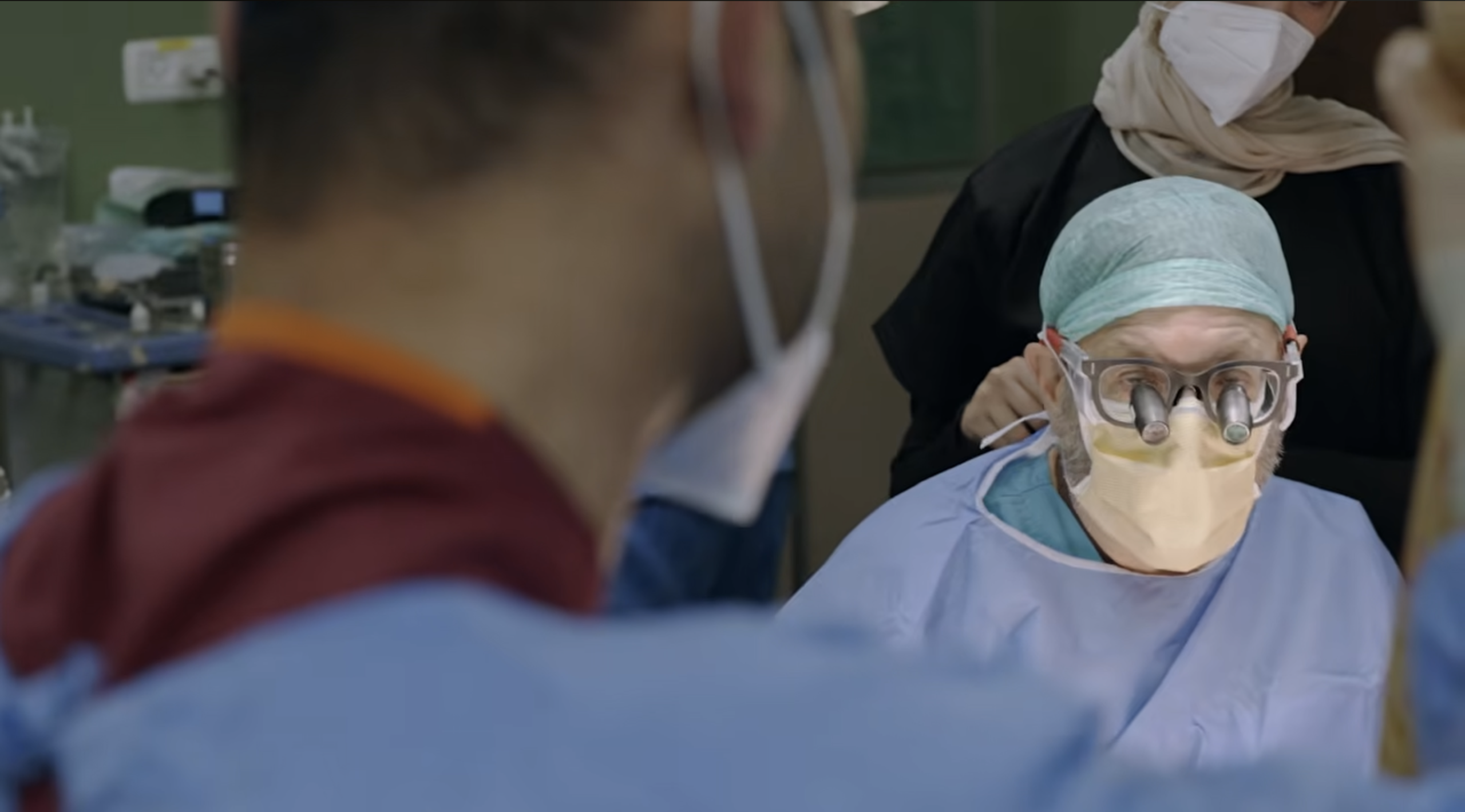
Most of the running time is spent inside the hospitals themselves, alongside Perlmutter and Sidhwa and the teams of native Gazan first responders and physicians. Nasser Medical Complex in Khan Younis, the film’s home base, has two operating rooms. Two, for a city center’s worth of casualties. There’s no pain medicine to speak of; Perlmutter says at one point that in more than thirty years of overseas mission work, he’s amputated hundreds of legs, but he’d never had to do it without anesthesia before Gaza. (He also has to hide antibiotics in the lining of his suitcase so that it isn’t confiscated by authorities when he crosses the border.) A broken X-ray machine stays broken because a replacement for its worn-out part isn’t allowed across the border. A haze of smoke and dust hangs in half the film’s frames. It is, visually, a film about resourceless exhaustion—despair with dust in it—and the doctors moving through it all with a kind of stubborn, practiced calm that is remarkable in the face of the chaos and panic all around them.
It’s Perlmutter, the orthopedist, who gives the film its most combustible energy and is startlingly candid about his own before-and-after. “As a Jewish physician, I knew nothing about Gaza,” he admits on camera. “I thought everybody out here were nothing but terrorists.” What he sees inside the Nasser wards curdles that ignorance into fury; he’s the one willing, on air, to say it’s entirely possible to “love Israel and despise the right-wing fascist government that runs it.” His passionate advocacy comes at a price. The film shows him reading an email ripping him for being a Jewish doctor helping in Gaza. In one scene, we see him talking with his wife about how he came back from his first deployment and didn’t know how to talk to her about what he’d seen, so he simply shut down.
Dr. Sidhwa is the film’s third pole. His family’s Pakistani Zoroastrian roots taught him to help others. “As an American,” he says, “I just don’t want to see my country involved in crimes.” He’s also the one who puts a number on it, on camera: children in Gaza, he says, are being killed at a rate roughly 600 times that of children in the Ukraine war. In one of the film’s few moments of levity, he jokes that it would be very easy to blame his single status on the Palestinian Israeli conflict, but if he’s to be honest with himself, it’s probably just that he’s really hard to get along with.
The film’s structural spine is the idea—stated more than once, by more than one doctor—that a hospital is supposed to be the one place war doesn’t reach.
Outside the hospitals, the film follows the doctors into the parts of the war fought with cable news hits and congressional meetings. They go on CNN, on Israeli outlets, anywhere that will book them, and more than once the format itself becomes part of the story—segments staged to put them in visible tension with each other on air. Much of what they’re asked to do on air turns out to be rebuttal, not advocacy. No, they say, again and again, there are no tunnels running beneath the hospitals they’ve operated in. Ahmad, visibly out of patience, points out that the only footage anyone has ever produced of the so-called tunnels is CGI. At a news conference, a journalist brings up Donald Trump’s claim that his administration had “identified and stopped $50 million being sent to Gaza to buy condoms for Hamas” that were, in his telling, “used… as a method of making bombs.” It’s a ludicrous, thoroughly debunked claim that obviously exasperates Ahmad, who answers, “It’s totally unacceptable to be focusing on these sorts of things… we want hungry kids to be fed, hospitals to be able to operate without fear of being attacked, and we want the Palestinians to have a chance at life.”
We also see him lead a delegation of doctors lobbying for support for Gaza in Washington, D.C., which is akin to Sisyphus pushing a figurative boulder up, in this case, Capitol Hill. They visit the offices of Sens. Thom Tillis and Ted Cruz, and there’s no pretending, on the doctors’ end or the film’s, that anyone in those meetings is going to change a single vote. Teng has called it “such a lonely experience” to film—”so many doors were shut for the doctors.”
The film’s structural spine is the idea—stated more than once, by more than one doctor—that a hospital is supposed to be the one place war doesn’t reach. The Geneva Conventions have protected battlefield medical personnel since 1864, and by 1949 that protection had been extended to the hospitals themselves, which “may in no circumstances be the object of attack”—no exceptions carved in since. Those same conventions single children out for “special respect,” entitled to the same protection from attack as any other civilian. Yet in the back half of American Doctor we see Nasser Hospital bombed, with the first bombing incinerating a 15-year-old boy who was being prepped for discharge. In one of the film’s most harrowing sequences, wounded children—victims of an Israeli Apache helicopter attack—arrive faster than the doctors can triage them.
The operating-room footage doesn’t cut away from the difficult parts: a girl who arrives with three of her limbs barely attached and then loses her pulse on the table after the doctors have worked on her for two and a half hours. We don’t know if she made it, but that’s not the point. The point is that these doctors, running on fumes, did everything they could to save her. She was not a terrorist, or a soldier, but simply a young girl. Multiple independent estimates put the number of children killed in this conflict at more than 20,000, with more than double that number injured.
There’s a harder question sitting underneath all of this, one American Doctor doesn’t resolve because it structurally can’t: what does it mean to make a documentary about a medical emergency while that emergency is still accelerating? A historical documentary gets to organize atrocity into a shape—beginning, middle, aftermath, a survivor looking back from some distance of safety. Teng’s film premiered at Sundance in January 2026 with its subject still wide open; Perlmutter and Sidhwa were still fielding calls to go back while audiences watched them in a dark theater thousands of miles away. The film can’t offer the usual comfort of retrospect. It is a wound that is still open. It can only offer urgency. The film isn’t just a document of what we see happening. It’s a document of what is still happening, handed to an audience with no ending supplied because there isn’t one yet.
The film closes on Nasser Hospital taking a direct hit—an outside stairwell in flames, half a dozen first responders in their vests working to free the people trapped inside. And then, suddenly and shockingly, a second strike lands on them without warning, blasting them apart as the camera rolls. Still reeling from that footage, we get a closing title card: roughly 1,700 Gaza health care workers have been killed. The number that hits like a direct strike to the viewer after what we’ve just seen.
American Doctor focuses on whether three men who took an oath to treat patients and do no harm can do so in a place that tries to make that impossible. The dignity Perlmutter promised in the film’s opening seconds, Teng delivers by refusing, for the full running time, to look away. But looking away was never the hardest part. Nobody has yet answered the harder question: Will anybody save the lives of the innocent in Gaza?