NAZA is a film entirely overtaken and reshaped by its context: an ongoing genocide.
“A settler in Palestine will make a film about other, worse settlers” Mohammed El-Kurd wrote in Perfect Victims. “Remorse takes them to the confession booth… [they] come clean, under legal immunity about all the heinous acts [they have] committed.” Released two years after El-Kurd published these words, Rachel Szor and Yuval Abraham’s second documentary since Al-Aqsa Flood, NAZA, offers, as its subtitle denotes, “a window into systems of mass killings.” Neither the victims nor the perpetrators are mentioned in the title. They are also not shown. Told over a series of anonymous nighttime conversations with twenty-four former and active Israeli military intelligence personnel who served in various divisions over the last three years, the film aims to uncover what has long been known: The Zionist entity’s genocide in Gaza is killing civilians.
I hated NAZA before I saw it but I felt I had to see it anyway, or that I had to assuage those who insisted that everyone go see it. I hated it because while its conversations are about the past, the violence they describe is still being enacted in the present—and into the future. Some of the soldiers interviewed are active-duty: They tell Abraham what they’ve done only to return to work the next day and continue their atrocities. Here is a film inextricably linked to the conditions under which it was produced. The crimes it documents are ongoing; the audience is keenly aware that they are not watching a retrospective, but the admissions of agents actively perpetuating a genocide. It is therefore impossible to separate the film from the footage we’ve seen on our phones.
What is the point of the movie and why does it exist? We know that Israel is targeting civilians. Palestinian journalists in Gaza have documented the bombings of hospitals and schools, churches and mosques; the beheaded babies and fathers carrying their children in plastic bags; the Palestinians digging martyrs out of 10-foot craters left in the wake of 2,000 pound bombs. And yet here is a film told from the perspective of those who pull the trigger telling us what most of us already know. NAZA has been called “required viewing” and receiving standing ovations, reactions that one can only reason stem from ignorance of the crimes Palestinian journalists have meticulously documented, or from the fact that they are being described by an Israeli. And as the audiences applaud and the praise comes in, it becomes clear that the testimony of anonymous war criminals who belong in the Hague carry more weight than their victims.
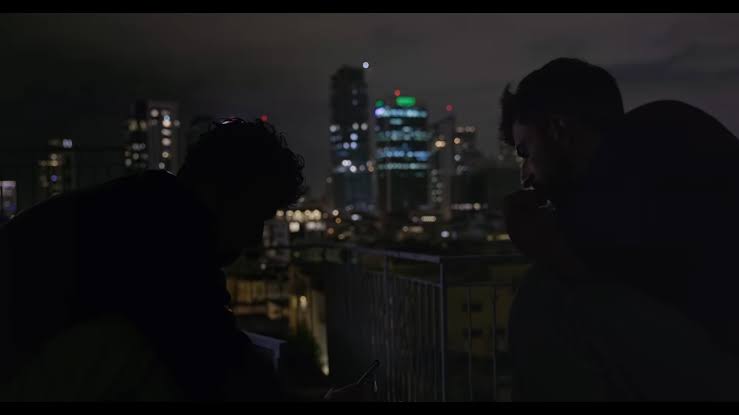
The soldiers are shrouded in darkness, only their shadowed profiles visible…
As El-Kurd prophesied, anonymity is the film’s form of legal immunity, the condition under which these soldiers speak. “Israel will put me in jail,” one of the subjects tells Abraham. This, as Abdeljawad Omar notes, is not because of the crimes he committed, but because he is confessing to them publicly. The effect is to position the soldier as the victim and the object of admiration; they tell the truth despite this hypothetical punishment, which has yet to be doled out and maybe never will.
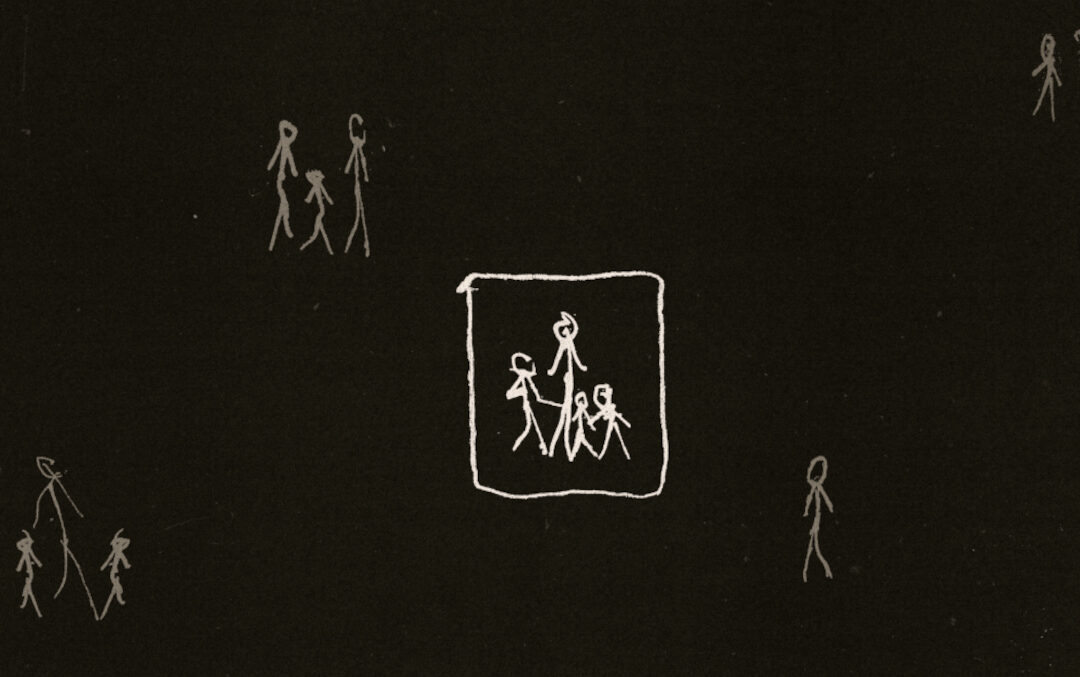
The soldiers are shrouded in darkness, only their shadowed profiles visible, while Abraham himself is dimly lit. Their voices are slightly altered so that they cannot be identified, but not so robotized that they lose any semblance of humanity. Only their hands are visible as they sketch the computer systems they operate, the interface of artificial intelligence that they use to kill Palestinians from miles away. The interviewees are human because they have the agency to speak out about their crimes, but they are not independently culpable because they only follow commands.
What follows are despicable, gut-churning testimonies about how the Zionist military is using artificial intelligence and mass surveillance to identify targets in Gaza. Using arithmetic equations, the military calculates the number of Naza—not a portmanteau of Nazi and Gaza as many assumed—but an abbreviation of the Hebrew phrase “nezek agavi” or “collateral damage.” Among the crimes of which we learn: A baker and his entire family are killed because he sold a loaf of bread to a Hamas member. An entire building is leveled to the ground because a militant resides there, killing thirteen. There is no maximum number of “Naza” for the Israeli military: some say fifteen is the limit, others say five hundred.
Individual accountability is never assumed, only deflected: first to the commander, then to Prime Minister Benjamin Netanyahu, then to Hamas, then to the logic of artificial intelligence, then to the entire military system. One interviewee claims: “If I wasn’t there, someone else would do it.” An echo of what Jewish New Yorker, Yakub, infamously tells a Palestinian family whose house he’s occupying: “if I don’t steal it, someone else will.” As if to say Gaza was always going to be reduced to rubble, that genocide was an inevitability, that it could have been any one of us, that there’s no shortage of trigger-happy genocidaires. While this might be a condemnation of Israeli society at large, its effect is opposite. Recently, in a discussion about the film, a senior news editor at Jewish Currents confessed his hesitation about attributing blame and asked his colleagues whether the soldiers could be considered individually culpable if they were in fact taking orders. The slain Palestinian is incidental to the question; flattened to make space for the perpetrator. Front and center is the soldier who kills him.
Only two Israeli faces are shown throughout the film: Yuval Abraham’s and Benjamin Netanyahu’s. The rest are reduced to their anatomy; passing shots of Israelis in their homes are not complete—an arm doing yoga, hands kneading dough, legs on a sofa. Even the news anchors on television sharing Zionist propaganda are blocked from view, their faces severed from the racist hasbara they espouse. For some, this is Arendt’s banality of evil; the documentary counterpart to the film’s executive producer Jonathan Glazer’s lauded Zone of Interest (2023). Life continues apace, despite the genocide unfolding next door. But Glazer’s film worked because it had history on its side. Any film about Nazis begins from the basic premise that the Nazis cannot be redeemed. Whether their conscience compelled them to confess to gassing Jews in Auschwitz or not, whether they accept accountability or not, we have reiterated time and time again that they are people beyond saving. But because the genocide in Gaza is still ongoing, the film’s testimonies can be confused as acts of moral courage.
The anonymity the directors afford their subjects establishes a binary—a Schrödinger’s Israeli—in which anyone being interviewed could be the man doing yoga in his apartment as bombs drop over Gaza, or, equally, the man driven mad by guilt, who admits to bombing an apartment complex because a baker who lives there once sold a Hamas member a loaf of bread. We never learn why the Israeli is speaking to Abraham. Are they doing it to assuage their guilt? Are they doing it to brag? There is no remorse in their voices. No tears in their confessions. The onus is on the audience to fill in these gaps of what we don’t know. To extrapolate a complex humanity for the soldiers based on the fact that they chose to speak at all. We might say, they’re speaking out because their conscience compels them to, even when they admit to having killed hundreds, sometimes thousands, of Palestinians, even when one of the soldiers reminisces about how fun it all was. For every soldier who commits a war crime, there is a soldier whose conscience will force him to come clean. For every government official who calls for genocide, there’s a filmmaker willing to stand against him. The Israeli is only visible in these two distinct ways, either calling to exterminate Palestinians or receiving a twenty-five-minute standing ovation for their bravery.
Anonymity was never the Israelis’ concern when they raided homes in Gaza and southern Lebanon and posed in a woman’s underwear, nor when they stood in front of a building in Jabalia before they rigged and exploded it for a gender reveal. Anonymity was not their concern when they posed in front of the burning library in Gaza City or when they smiled with Palestinian prisoners who were blindfolded, tied up, beaten, and assaulted. Not only is the war on Gaza the most livestreamed genocide, it is also the most shameless. By forcing the subjects into the shadows, Abraham and Szor—intentionally or not—confer shame onto them despite there being no tremor of remorse in their voices.
The film is quiet, entirely diegetic. Testimonies are not accompanied by music. There is no noise except for the sound of a jet flying by, perhaps a drone strike in Gaza. It is this quiet that is the most disconcerting and alienating. The normalcy of sparkling high rises, people in athletic wear running on the beach, night’s silence while the bombing in Gaza amplifies. A condominium is being built in Israel while the one in Gaza is leveled. The Israeli speaks on a rooftop for privacy while the Palestinian is crushed under the rubble.
NAZA does not begin with an acknowledgement of genocide. It only mentions the word once in its eighty-minute runtime, when Abraham asks a soldier to acquiesce to the term, which he does. In contrast, it takes only five minutes for a film ostensibly about the systematic killing of Palestinian people to dub the Hamas operation of October 7th as a “horrible massacre,” minus any context whatsoever: the decades of living under an apartheid regime; the total siege of Gaza; and the tradition, necessity, and legality of armed resistance against oppressors. The film begins instead with a Palestinian missile in Tel Aviv. The missile makes impact. The walls shake. The windows in the high rises are devoid of people—presumably they have fled to the safety of their shelters. One of the subjects asks Abraham, “Is there a shelter in this building?”
Why begin with this narrative equivocation if not to level the playing field? Perhaps this is done to appease an imagined liberal viewer who is still on the fence as to whether a mass extermination campaign is ethically wrong. Perhaps it functions to offer the Zionist justification a semblance of legitimacy. To say that October 7th was the provocation for war and that every war crime committed by Israel was preceded by the prison break. Later, when he announced on X that the film would be available for free online beginning in November, Abraham said that people in Gaza breaking out of their concentration camp had “no justification whatsoever.”
Naza becomes a Hebrew word to evaluate the Palestinian’s grievability.
Given the film’s immediate and unequivocal condemnation of armed resistance, it makes sense that Abraham and Szor’s focus is Naza, or the civilian collateral of the genocide. The Palestinian militant is already condemned to death in the liberal Zionist imagination—ejected from humanity, irredeemable. Thus the audience’s concern is redirected to the only place it can go within such an understanding—to the feeble, helpless Palestinian victim. One is only permitted to mourn when the dismembered body belongs to a civilian, not to the one who fights the invader. Of course, the directors do not make the same distinction between civilian and soldier when referencing October 7th. There is no mention of the Hannibal Directive, no mention of how many civilians versus military were killed, no reference to forced conscription or the Zionist assault on Gaza in 2014, 2018, 2021. No mention of 1967, or the massacres in Tantura or Deir Yassin. The last words on the screen claim that “Israel’s killing of Palestinian civilians is ongoing,” as if the last three years are nothing more than a dark blip in their history, rather than the lifeblood that sustains the settler colony. Naza becomes a Hebrew word to evaluate the Palestinian’s grievability. In Israel, all the dead are accorded the status of victim.
Palestinians are almost entirely absent in the film, shown only in the last five minutes when a Palestinian man is seen yelling for his children crushed under a leveled home. Throughout NAZA, Palestinians exist only theoretically. We never hear from them, never get to look them in the eyes. They are only collateral damage or else militants, canaries in the coal mine of military technologies soon to be exported to other parts of the world. The film and the discussion around it move in circles. We must watch the film to know what we already know because it might change one person’s mind who remained unaffected by three years of genocide. Abraham, who said the film would not have been possible without the heroism of Palestinian journalists, does not feature a single one in the film.
The film has been the source of much controversy, the reality of its production as much a source of discourse as the content of its testimonies—not just from Palestinians demanding the right to tell their own stories but by the Israeli far right as well. Since its release, Netanyahu has threatened to strip the directors of their citizenship, Israeli mobs have rallied in front of the directors’ parents’ houses, and the Israeli government has demanded an investigation into the film. While it is not the fault of the film, the discourse that surrounds it has become the central focus rather than the crimes it (re-)exposes.
Who is this film for? It is not for the Palestinian or the Arab who has seen firsthand the destruction of their country and the erasure of their people at the hands of Zionism. Nor is it really for anyone who has followed journalists on the ground in Gaza. It is geared towards a racist audience that is aware of the horrors of the last three years but can only find the courage to condemn it if given permission from those that perpetrate it, can only acknowledge the crime once they are assured they will not be accused of antisemitism. In short, who will denounce genocide only when there is nothing left to lose.
Abraham and Szor have said that the film is the means through which they hope to reach an Israeli audience to start a conversation. But Gaza is next door. It is only 60 kilometers away. The Israeli that they are speaking to was conscripted into the army for two years after coming of age, knows of the checkpoints that separates him from the Palestinian, pulled up a chair on a hill overlooking Gaza to see it be bombed, has made TikToks parodying the Palestinian’s suffering. The film begins with the Israelis’ presumed unknowing: but the Israelis know what is being done in their name, and have in fact done what is being done in their name.
If this film makes one Israeli refuse to join the army or denounce their citizenship or hate their country, that is undeniably good; but three years later, it is far too little of an action. I was deeply disturbed by the footage of an audience decked out in suits and ties and beautiful dresses, giving two Israeli directors a twenty-five-minute standing ovation to celebrate them and their act of bravery. It would have been braver to forgo journalistic ethics and submit the names of war criminals to the Hind Rajab Foundation or the ICC. When the credits rolled, I was not overtaken by the urge to applaud. I was sick to my stomach. I stormed out with my hands in fists. They killed without mercy and now the killers expected not just mercy but also our commendations.
In a New York Times interview, Yuval Abraham, responding to a question about the mass hysteria caused by the film, explains that he “wants to go back home to Israel… But we can’t.” Where does he wish to return? To the sparkling high rises, to running on the beach next to the last-standing Jaffa home, to sitting on a rooftop on a serene night where sixty kilometers away a father is frantically looking for the remains of his children? While NAZA reveals Zionism’s individual, institutional, and military crimes, it stops short of condemning the entire settler-colonial project. It is this that ultimately undercuts the film in my eyes. NAZA is the product of people who still think of Israel as their home, as a place worthy of that status, not an illegitimate entity built on genocide. If the last three years can’t force Abraham and Szor to see the soldiers’ admissions as the true nature of Zionism, then what is the conclusion they hope the audience draws from this film? A more logical conclusion would be for the directors to denounce their home, forgo their citizenship, and stand in solidarity with the resistance. Anything less is of no interest to me.