A selection of bold, thought-provoking books about changing landscapes, environmental crisis, and new ways to survive and thrive.
An Anthropocene reading isn’t just about climate change and environmental destruction; it also examines how humans have radically reorganized the planet through political borders, settlement, resource extraction, and systems of ownership. However, the idea that all humans influence the Anthropocene equally is increasingly being challenged. In truth, those who uphold powerful systems such as colonialism, capitalism, industrialization, and empire are responsible for most of the devastating consequences.
This booklist offers a richly layered and SWANA-specific Anthropocene reading experience. Despite the various genres and themes represented, each book on this list raises a fundamental question: How have humans transformed land, bodies, ecosystems, and the conditions of life—and who holds the power to shape these changes?
Although Cities of Salt by Abdelrahman Munif and The Bleeding of the Stone by Ibrahim al-Koni are both set in the desert, they approach environmental crisis from different directions. Al-Koni’s Libyan desert is a living ecological and spiritual world in which humans, animals, rocks, and water are interconnected. It breaks down because humans assume they can stand above nature as its masters. Munif, by contrast, shows what happens when that assumption becomes an applied economic and political system in which industrialization, foreign interests, mechanization, and the pursuit of wealth displace traditional ways of life.
The Solar Grid by Ganzeer, Using Life by Ahmed Naji, and Heaven on Earth by Fadi Zaghmout make a compelling speculative trio for a SWANA Anthropocene reading, each envisioning futures shaped by the consequences of environmental, technological, and social transformation. Ganzeer foregrounds climate crisis and inequality, while Naji and Zaghmout explore the commodification of bodies through technology—Zaghmout extends the conversation to the possibility of a society completely controlled by technology. These speculative works demonstrate how resource scarcity, rapid urbanization, exported technology, and political power are deeply entangled in the SWANA region.
–Rana Asfour, Executive Editor
FICTION

A Mask the Color of the Sky by Bassem Khandaqji, translated by Addie Leak, Europa Editions, 2026
Palestinian novelist, poet, and journalist Bassem Khandaqji was arrested in 2004 by Israeli forces. His novel (reviewed in TMR here) won the 2024 International Prize for Arabic Fiction and was written entirely in prison, making its engagement with confinement, territory, and freedom particularly resonant. The novel is a compelling choice for an Anthropocene reading list because it explores the ways human-made political systems reshape land, identity, and belonging. Nur, a Palestinian refugee and archaeologist who discovers an Israeli identity card and takes on its owner’s identity, is granted access to places normally off-limits to Palestinians. Joining an archaeological dig, Nur uses the excavation to confront competing claims to the same land, raising questions about how people inscribe narratives onto landscapes—and then use those stories to construct histories, justify ownership, and assert control over bodies and populations.
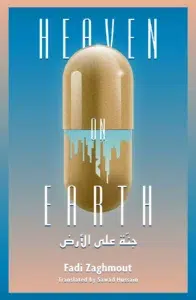 Heaven on Earth by Fadi Zaghmout, translated by Sawad Hussain, Rebel Satori Press, 2025
Set in Jordan in the 2090s, this speculative novel imagines a future in which biotechnology and nanotechnology have advanced so far that the boundaries of human life are completely redefined. Inspired by an article about the possibility of people living for centuries, or even millennia, Zaghmout explores how such a world would upend our ideas about life, morality, and society. The story thoughtfully considers how extending human lifespan would reshape reproduction, population, resource distribution, and the passing of generations. Rather than focusing on environmental disaster, the novel recasts the Anthropocene as a time of profound human intervention in the fabric of life, shifting the conversation to whether technological mastery is necessarily progress.
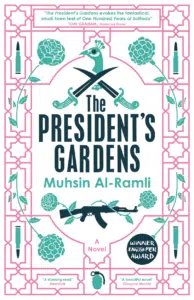
The President’s Gardens by Muhsin Al-Ramli, MacLehose Press, translated by Luke Leafgren, 2018
Spanning the Iran-Iraq War, the invasion of Kuwait, the Gulf War, and the U.S. invasion of Iraq, The President’s Gardens, longlisted for the International Prize for Arabic Fiction in 2013, reveals how the desert landscape itself becomes a victim of military conflict, transformed into “a sea of fire and iron.” The narrative centers on a small Iraqi village, which wakes to the horrific discovery of nine severed heads—one belonging to the notorious Ibrahim the Fated—stacked in banana crates at the bus stop. As the mystery behind this horror unravels, the novel challenges readers to consider the Anthropocene through the lenses of war, toxicity, politics, and environmental destruction. As war and power ravage the land, turning the environment into a tool of violence, those in authority decide who is allowed to live in a paradise and who is left with a barren wasteland.

This novel by Libyan writer Ibrahim al-Koni is especially interesting for an Anthropocene-themed reading because it challenges the assumption that humans are separate from nature (or its masters). Many academics have identified the novel as an ecological philosophical tale in which Tuareg traditions, Sufi mysticism, and myth are paramount to sustaining the desert ecosystem. At the center of the novel is Asouf, a solitary Bedouin intent on safeguarding the wild sheep under threat from hunters. The clash between his devotion to the land and the hunters’ greed creates powerful tension that disrupts the ecosystem’s delicate balance. The novel exposes the destructive consequences of extractive and colonial attitudes toward nature, and suggests that people and nature should rely on each other to live well on earth.

The first in a trilogy, Munif’s novel is set in an unnamed Gulf kingdom in the early twentieth century. Cities of Salt (referring, according to the author, to cities that offer no sustainable existence) follows the devastating transformation of a traditional desert community after the discovery of oil against the backdrop of oppressive political structures in Arab societies. The novel highlights environmental erosion, the cultural distortion of the Bedouin environment, and subsequent industrial exploitation as the traditional inhabitants of the city find themselves increasingly marginalized when values and structures transform overnight. It was first published in Lebanon in 1984 and was immediately recognized as a major work of Arab literature.
GRAPHIC NOVELS
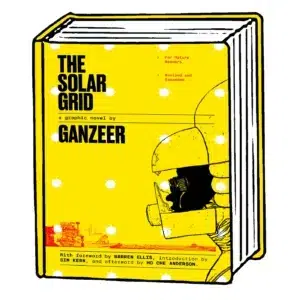
The Solar Grid by Ganzeer, Radix Co-op, 2022
This ambitious and visually intricate science-fiction graphic novel won the Society of Illustrators’ MoCCA Award of Excellence in 2023 and earned Ganzeer a Global Thinker Award from Foreign Policy in 2016 upon the digital release of its first chapter. Inspired by Egypt’s water crisis and the author’s escape from the country in 2014, the series was developed over ten years, blending dystopia, political commentary, and elaborate world-building. Set centuries after a catastrophic flood, it imagines a future Earth powered by a sprawling grid of solar panels. Residents endure perpetual daylight, while access to clean water is confined to a network of water towers monopolized by the world’s richest man. Through a nonlinear, multi-generational story of scavengers, rebels, and rulers, alongside a subplot involving a Snowden-like whistleblower, Ganzeer explores colonialism, capitalism, ecological collapse, and resistance. The ten-edition series is available as a complete e-book here. You can also access a pay-what-you-want version here.

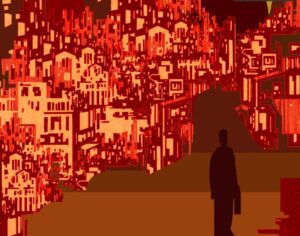
Set in a future Egypt decimated by a tsunami of desert earthquakes and unbreathable humid air, the novel focuses on climate change survival and urban decay in post-apocalyptic Cairo. The novel’s plot, which unfolds in a unique mix of text and black-and-white illustrations, involves Bassam Bahgat, a young filmmaker employed by The Society of Urbanists, a secret society responsible for centuries of worldwide conspiracies that have shaped political regimes, geographical boundaries, reigning ideologies, and religions in Egypt and beyond.
NONFICTION
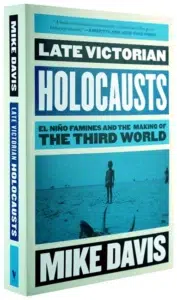
Late Victorian Holocausts: El Niño Famines and the Making of the Third World by Mike Davis, Verso, 2017
Examining devastating famines across India, China, Africa, and other regions during the late nineteenth century, Davis challenges the idea that these disasters were simply the result of natural climate fluctuations. He demonstrates how El Niño events became catastrophes through the combined effects of colonial rule, economic exploitation, forced integration into global markets, and the extraction and exploitation of local resources. The book foregrounds the unequal distribution of environmental vulnerability shaped by systems of power, wealth, and political control, and how “the seeds of underdevelopment in what later became known as the Third World were sown in this era of High Imperialism, as the price for capitalist modernization was paid in the currency of millions of peasants’ lives.”
POETRY
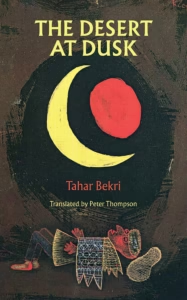
The Desert at Dusk by Tahar Bekri, translated by Peter Thompson, Contra Mundum Press, 2025
Tahar Bekri’s The Desert at Dusk reimagines the desert as both a physical ecosystem and a repository of cultural memory. Drawing on the tradition of the classical Arabic ode, in which the desert is often a space of beauty, solitude, movement, and contemplation, Bekri presents a contemporary landscape profoundly altered by human violence and political upheaval. The desert is no longer untouched or timeless expanse: it bears the marks of conflict, destruction, and ideological struggle, becomes a witness to the consequences of human meddling. Bekri’s poetry invites readers to consider how landscapes are transformed not only materially but imaginatively, and how environmental damage becomes inseparable from histories of war, displacement, and political violence.
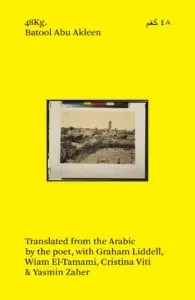
48Kg by Batool Abu Akleen, self-translated, with Graham Liddell, Wiam El-Tamami, Cristina Viti, and Yasmin Zaher, Tenement Press, 2025
This bilingual collection has 48 poems, each standing for one kilogram of the poet’s body, counting down from 48kg. Akleen uses the poems to show how big world problems—like war, hunger, displacement, and environmental destruction—affect a single body. In Gaza, everything is touched by human-made violence, and the body becomes the last place where these disasters are felt.