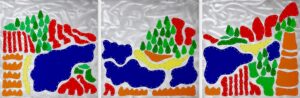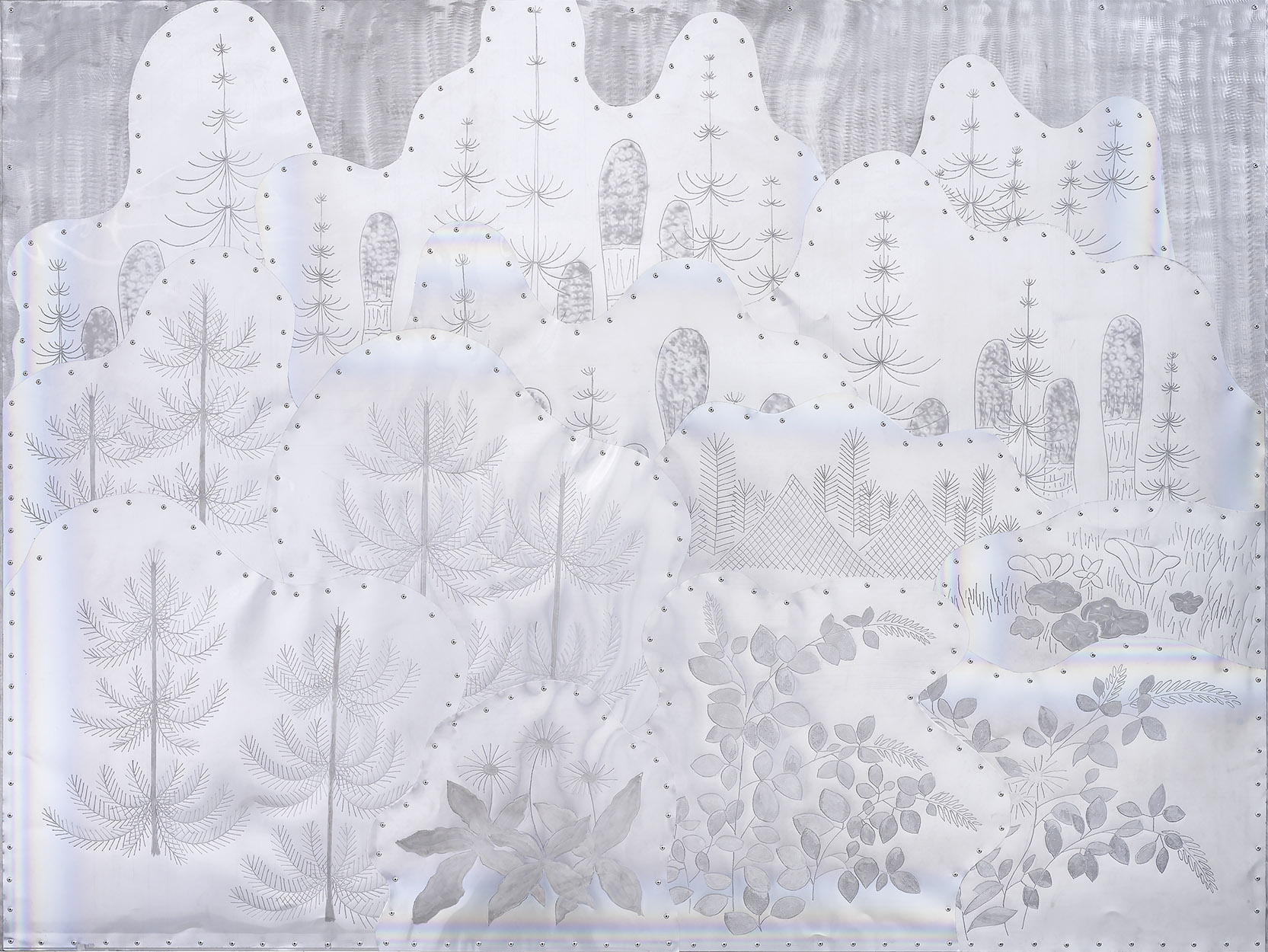
Dhifi’s sculptural pieces reflect a balance between control and spontaneity, embracing imperfection, chance, and the history embedded in materials. In this interview Dhifi talks about his latest concept, an inverted Mediterranean.
Bhar Lazreg. Blue Sea. There is nothing blue about the “Blue Sea” neighborhood of Tunis, and most importantly, there is no sea. It’s a strange mix: the Phosphor art and design district not far, in the La Marsa zone, a nicer part of the area, which doesn’t hinder occasional flocks of sheep from tidily tramping across the up-and-coming designer street, rue du Phosphate, which includes art stops such as Yosr Ben Ammar Gallery. A few blocks away, there is the art residency program run by Selma Feriani, who says that they have chosen this specific neighborhood so that artists will be exposed to the “real Tunis.”
On the way to interview Kaïs Dhifi one passes through the rue du Phosphate, a seeming unlikely place for art. As the sun goes down, there is something unsettling about driving through the narrow street, past half-built houses already occupied by squatters. Unruly children stand at the corner of the street to hinder the car from turning. “They don’t want to move, eh?” I tell the driver, who sighs, showing a little nervousness. Stray dogs howl in the street, while families and individuals from different parts of Sub-Saharan Africa go about their day undisturbed. Further ahead, in Bhar Lazreg, the curly head of Kaïs Dhifi pops out of a warehouse. As I step out of the car, the driver hastily makes a turn, shouting “I must go, bye!” and disappears.
“When I first took this space, I had just returned to Tunisia after having lived in Lyon, Berlin, Tokyo, and there was nothing around [here],” explains the artist, letting me into the studio. “Then they started building, and a lot of people from different parts of Africa began settling here.”
“I learned a lot from having conversations with my neighbors and hearing their stories. Some are suffering, but others are not. Being here is like being at the epicenter of the world’s movements. I get to be exposed to all of that, without having to set foot out of my studio.”
And yet, the artist still travels often. Dhifi has just come home from a few art fairs, and from mounting a monumental installation in Lyon, a totem that created light and music. “People made la teuf, they partied! Isn’t that awesome?” he says, clearly elated.
Entirely self-taught, Dhifi has taken up photography, music, graphic design, and publishing independently over the years. For a long time, he did not consider himself an artist. Instead, he operated within creative ecosystems, designing flyers, producing music, collaborating with emerging scenes, absorbing knowledge, observing others, and internalizing both their processes and their struggles.
This period of immersion, particularly within DIY and punk-influenced communities, would later inform not only his methods but also his philosophy: create with what you have, trust your instincts, and build your own structures where none exist.
His shift toward a fully committed artistic practice came relatively late. At around forty, after returning to Tunisia, Dhifi found himself starting over, materially and mentally. This return marked a decisive turning point.
During the pandemic, faced with stillness and a sense of dislocation, he returned to photography as a way of re-engaging with his environment. Traveling through the Tunisian landscape, particularly its desert and rocky regions, he began documenting what he already knew, but from a radically different perspective.
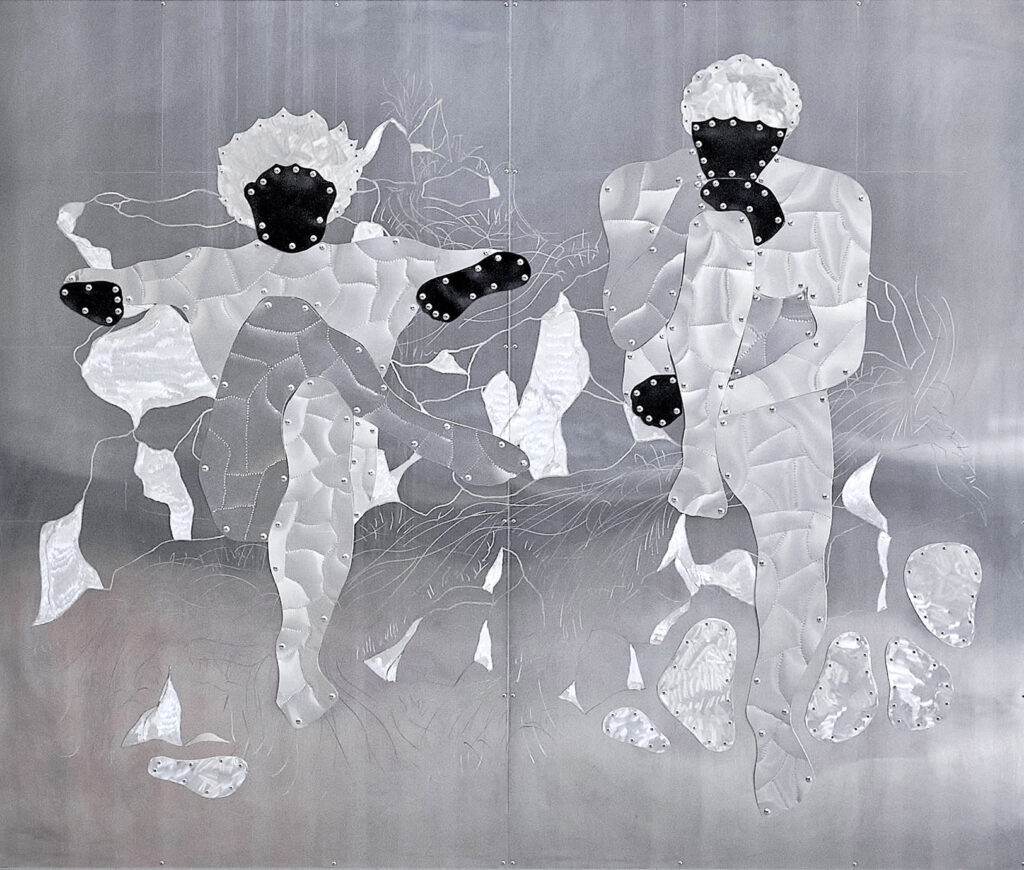
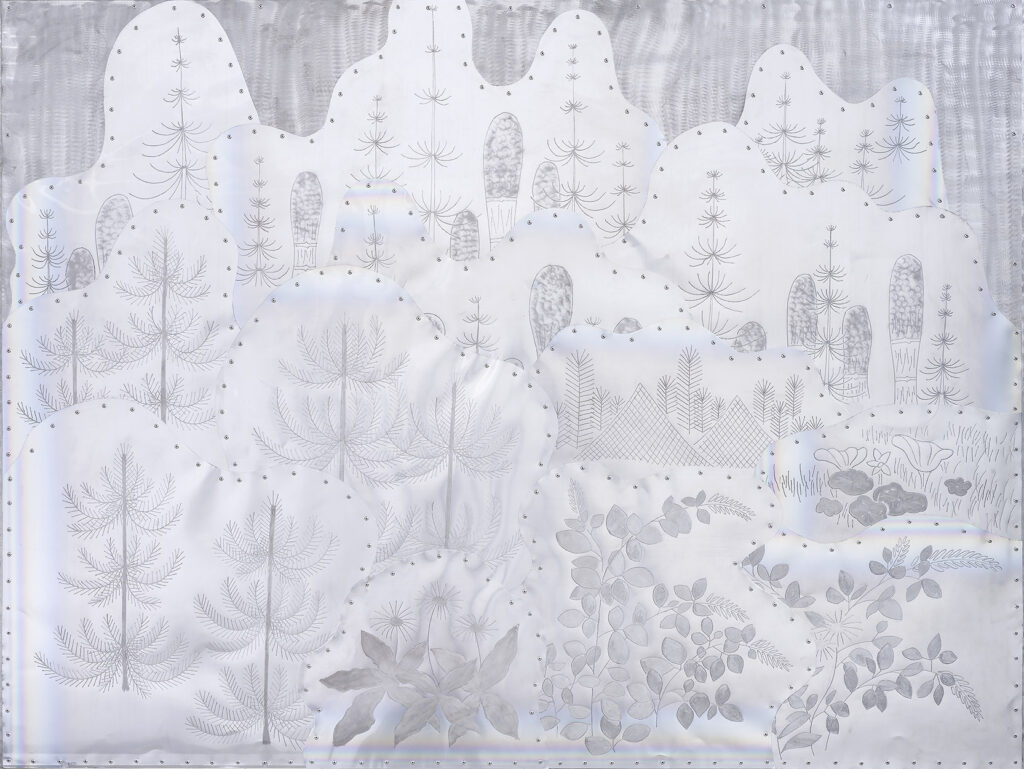
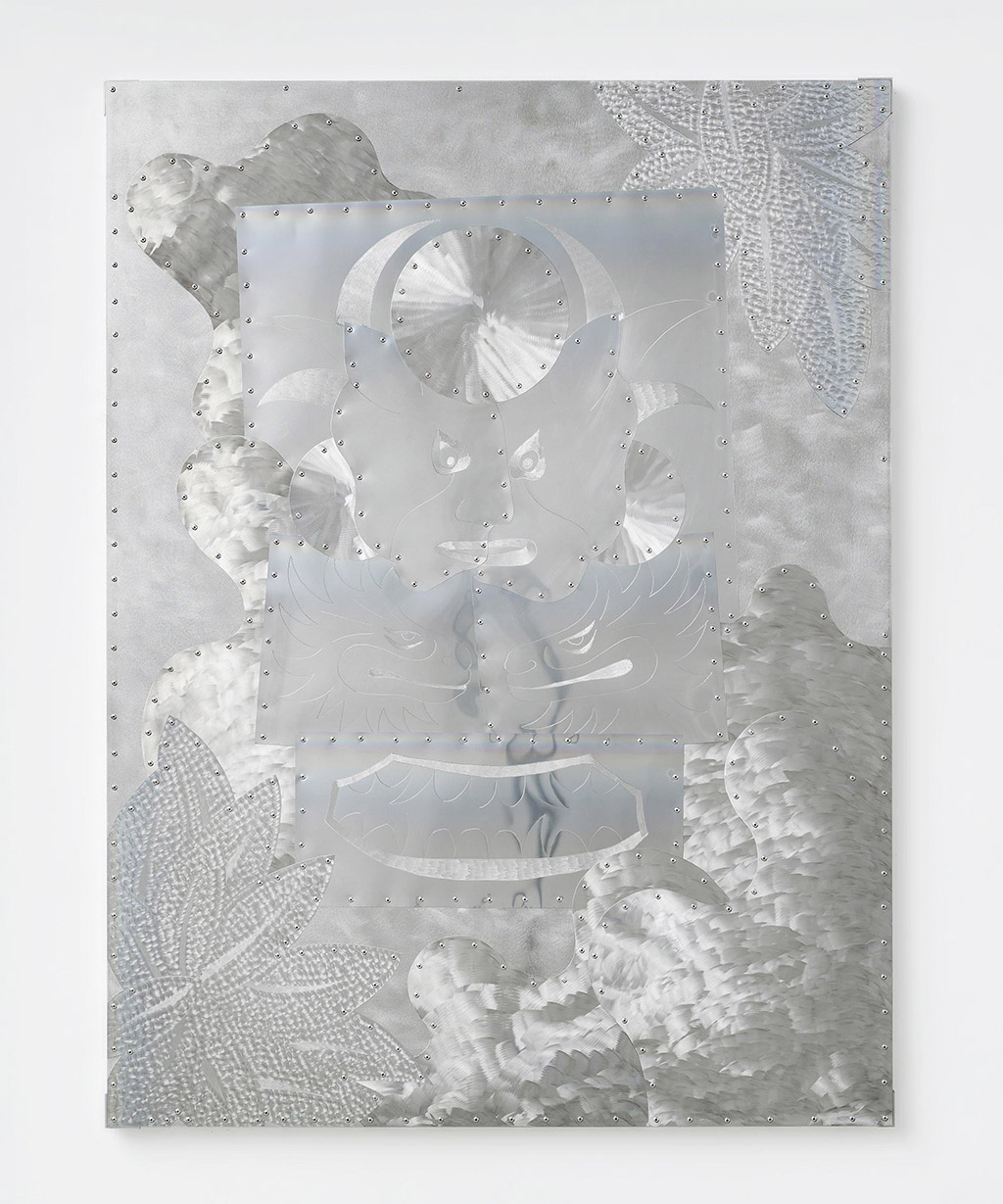
From there, his practice evolved organically. Dhifi’s sculptural pieces, often made from reclaimed aluminum printing plates, reflect a balance between control and spontaneity. He embraces imperfection, chance, and the history embedded in materials. Scratches, distortions, and irregularities are not flaws but integral elements that carry energy and narrative. His process is intuitive: there is little premeditation, and much is left open to what he describes as “feeling” or “energy.” Each work becomes a negotiation between intention and accident.
This October, the artist will embark on a very different project, called ThunderGolf, a major immersive installation at the Biennale Chroniques in Marseille, one of France’s leading digital arts festivals. I spoke with him about world-building, speculative fiction, the politics of mobility, and why he believes the Mediterranean is not a sea but an island.
You are mostly known for your artworks made of recycled metal and monumental installations, but you have also spent the last six years building an entire universe called Metalia. When did you realize that’s what you were doing?
It wasn’t planned. When you make a sculpture, you feel something; there’s an energy in the material, something that hasn’t been said yet. In the beginning, I started writing a short text alongside each metal piece I created, something a little magical, poetic.
After 200 texts, I looked back and realized I had an entire cosmology. Characters were appearing. Events were happening between them. I was essentially writing lore… the way a video game builds its world over time! So I formalized it. Metalia now has a kind of Wikipedia, a full internal logic. Every sculpture is a snapshot of that world, a fragment of a larger history that already exists, even if I’m still discovering parts of it myself.
You’ve described Metalia as a “poetic counter-mythology.” What does mythology give you that a more conventional political or artistic statement cannot?
Mythology operates differently from politics. It doesn’t divide. It doesn’t demand that you take a side before you’re willing to listen. When I work with myth, and I have plenty of raw material, you know, being Carthaginian, with thousands of years of stories at my disposal, I can transpose a contemporary problem into a space where people’s defenses are down.
The future does that too. If I tell you that in 2072, African nations launched the only surviving space program on Earth, and that Europeans must now cross illegal borders to reach the launchpads… suddenly the question of mobility, of who gets to move freely, hits you in a completely different place! It’s the same problem we’re living with today in the Mediterranean, but the emotional charge is redistributed. That redistribution is what interests me.
How do you look at this fictional Mediterranean you are building?
For me, the Mediterranean is not a sea or a border… It’s an island. I’ve traveled to most of the countries that border the Mediterranean on both the European and North African sides. What struck me deeply is how much the cultures share: the food, the light, the rhythm of daily life, the relationship to time, the importance of hospitality, and the ancient layers beneath every city. These societies have been in conversation for three thousand years. That continuity doesn’t disappear because a nation-state draws a line on water.
So I started thinking: what if we described the Mediterranean not as a boundary separating “us” from “them,” but as an island that contains all of us? An island has a shoreline, but it’s also a single landmass in spirit. The people who live on it are connected by a shared environment, a shared cuisine, and a shared history of catastrophe and resilience. When my friends in Marseille or Palermo or Algiers hear me say this, something changes in the room. Because suddenly we’re not divided by a sea… we’re neighbors on the same island. That small shift in language does something.
So Metalia, your fictional world, is also an island?
Metalia is an island, yes, but I deliberately never define its exact geography. There are no satellite images of it. The maps I’m creating for future works are drawn like portolans, the medieval navigational charts made before anyone had precise coordinates. Those old cartographers drew what they believed they saw, and sometimes they were wrong, or they were right about the essence but wrong about the shape. I find that approach much more honest than pretending we have perfect knowledge of anything. Metalia’s contours shift. That uncertainty is part of the world’s truth.
One of the iterations in which this world will take shape will be your new installation, ThunderGolf, which will be presented at Biennale Chroniques in Marseille on October 23 and 24, 2026. Tell us about it.
ThunderGolf is a Mad Max-style vehicle, a car me and my team have rebuilt and transformed into an immersive experience. When you enter it, you enter the world of Metalia. The fiction is this: it’s 2046, and an event called “Le Grand Ensablement,” the Great Sanding, has occurred. A catastrophic sandstorm buries the entire northern hemisphere.
The global order inverts. Africa, already adapted to desert conditions, becomes the dominant sovereign force. By 2072, African nations have built the only functioning space program on Earth, centered on a station called Oasis.
Europe, meanwhile, has hermetically sealed its borders, not to keep people out, but because if the borders open, the sand gets in. So the Europeans are trapped. And the only way to leave, to reach Oasis and whatever better world awaits, is to cross illegally into Metalia, which is based here, in the south, and find a driver willing to take you to the old spaceports.
And ThunderGolf is one of those vehicles?
Exactly. Inside the car, there are two roles. One person is the driver; they control the music, the playlist, the atmosphere. They’re relatively at ease. The other person is the passenger. They put on a VR headset and they have nine minutes to reach the spaceport. They don’t know what’s happening around them. They don’t know the route. They don’t know if they’ll make it. And I’ve designed those nine minutes to be genuinely tense… you feel the uncertainty, the dependence on a stranger, the not-knowing.
Hence your idea is to have a transposition of the experience of people crossing the Mediterranean today, but in a more indirect, less threatening way.
That’s precisely it! But I never say it like that directly. I don’t put up a sign that says “this is about migration.” I don’t want to moralize. What I want is for someone to climb out of that car after nine minutes and feel something in their body that they didn’t feel before.
Because when we talk about people crossing the sea on an inflatable raft, we talk about it abstractly. Statistics, policies, debates. Nobody sends you a PDF telling you how to prepare. Nobody explains the rules. Someone calls you at 2 a.m. and says, “be at the dock.” That’s it. You pack what you can, and you go toward a dream in complete darkness. Nine minutes of VR tension, with a good sound design and a headset, is a tiny fraction of that. But it opens a door that pure information cannot.
You’re careful to say this isn’t political art. But the themes are intensely political… colonialism, resource sovereignty, mobility, borders. Where do you draw the line?
For me, I refuse to create work that excludes anyone from the conversation. In my fictional universe, everyone can eventually reach the spaceports and board for Oasis. African nations and their partners have automatic passage; they have a mineral token, a kind of grain, that grants immediate boarding.
Others can come too, but they must present themselves, wait on a secondary list, and when a spot opens, destiny decides. It’s not fair in the modern liberal sense, but it’s not cruel either. It reflects the reality that those who built something, who invested in it, who adapted to survive… they have a different kind of claim. And yet the door isn’t closed to anyone.
I’m not trying to reverse oppression. I’m trying to imagine a world that has learned something from history without reproducing its worst patterns. That’s a poetic project, not a political platform. I have no party, no manifesto. I have a universe.
A short novel will be published to coincide with the Biennale, alongside curatorial essays. It feels like Metalia is becoming something that expands beyond visual art.
There was the idea from the beginning. The sculptures were just the first language I had for it. Now I have fiction, installation, VR, sound, and soon cartography. The novel that comes out with the Biennale will add another layer: essays on liquid borders, on the concept of the desert as something that moves rather than something fixed. Is the desert a place or a condition? That question matters a lot to me, because Metalia is a desert world, and so is the Mediterranean in certain lights… sun-bleached, ancient, full of shipwrecks.
Going back to Homer, in the Odyssey, the shipwreck is the engine of the story. The way we look at death in the Mediterranean fixes us in grief and outrage without offering a way forward. Mythology offers something else: it says, yes, the sea is violent, yes, people are lost, and also, there is something heroic in those people deciding to make this crossing.
Metalia is a work in progress… do you already know where it will end?
I wrote the last chapter first, in a way. The mural I made in Ouagadougou depicted the success of the African space program, the arrival at Station Oasis. But I deliberately stopped there. What happens inside Oasis, what that better world actually looks like, I don’t know. I don’t think I’m the one to imagine it. That question is too large, and I’m honest enough to admit I don’t have the answers. What I can do is build the road. Clear the sand. Open the door. What’s on the other side is for someone else, or for all of us together, to figure out.
Kaïs Dhifi’s installation ThunderGolf will be presented at Biennale Chroniques, at La Friche Belle de Mai, Marseille, on October 23–24, 2026. A short novel set in the Metalia universe will be published to coincide with the exhibition.
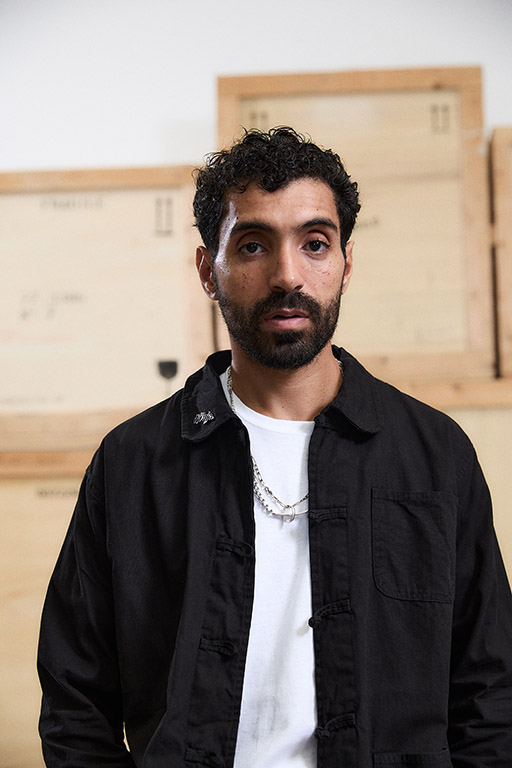
Kaïs Dhifi (b. 1980, Tunis) is an artist living and working in Tunis. Entirely self-taught, he developed his practice outside institutional frameworks, working across music, graphic design, publishing, and photography before fully committing to visual art around the age of forty.
After years spent between Europe and Asia, his return to Tunisia marked a decisive turning point. His work is now primarily sculptural, using engraved and assembled aluminum to create compositions that evoke imagined artifacts and hybrid narratives between past and future.
Since his first self-initiated exhibition in 2020, Dhifi has presented his work in solo and group exhibitions internationally, including in Tunisia, France, Germany, the United Arab Emirates, and Burkina Faso, as well as through residencies and large-scale installations.