A Lebanese artist approaches an absurd ever-collapsing world with a pen, paint, and trumpet.
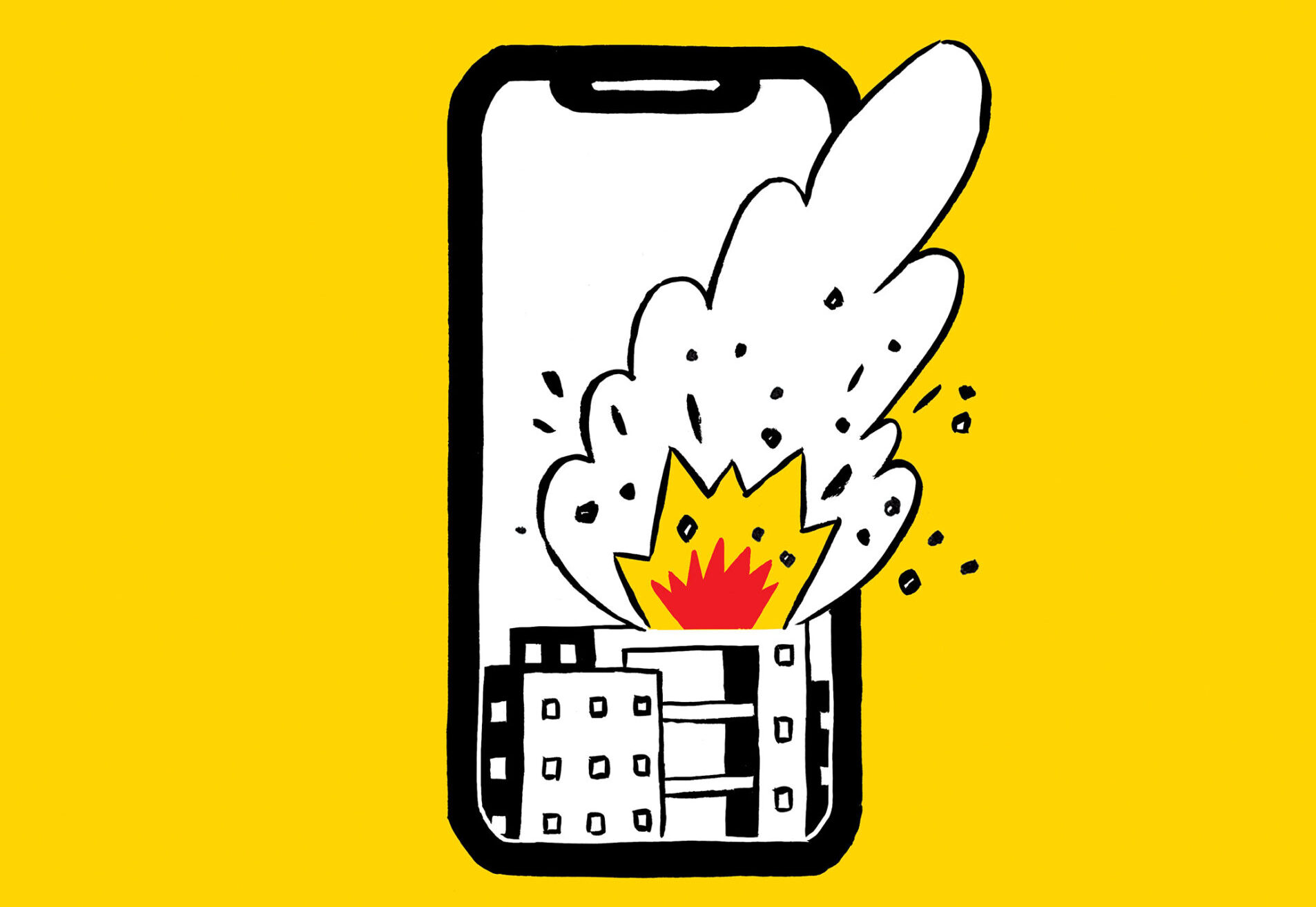
Mazen Kerbaj’s latest work, Gaza in My Phone, first reached me through the same medium as the image it was based on: an infinite social media scroll of Israeli violence against Palestinians in Gaza. It was October 2023, the early days of the genocide, when everyone was expecting it to end soon. Kerbaj posted a drawing of a plastic trash bag, with a hand-drawn text that read: “I never thought I would see something worse than the body of a murdered child, until I saw footage of a father carrying the remains of his son in a plastic trash bag.” It was a simple drawing, thick black lines on an empty white page, weighed down by the tragedy described in a condensed block of text. I knew immediately what footage he was referring to.
The next drawing was also familiar, and then came another, and another. We were all watching the horror unfold on the same social media platforms, unable to stop what was happening, unable to stop looking. Others were unable to see it at all. By keeping a record of what he was witnessing, Kerbaj invited his followers to bear witness alongside him, making the images more legible to an audience and, perhaps inadvertently, creating a record of time. I spoke with Kerbaj about his practice for TMR’s COMEDY issue, in a virtual conversation between New York and Berlin, sometime between the last war and the next.
Mazen Kerbaj is a Lebanese comics artist, visual artist, and experimental musician from Beirut, a city that is very much alive in his work, even after his move to Berlin in 2015. He is the author of more than fifteen books, and his short stories and drawings have been published widely in newspapers and magazines. Between his semi-autobiographical comics, large-scale installations, experimental album covers, and the colorful silkscreen prints that seem to hang on every wall in Beirut, Kerbaj’s work is at once ubiquitous and singular. There is a thoughtful overlap of comedy and tragedy across his practice; dark and unapproachable topics are illustrated in simple figures, the weight of impermanence is laid out in epistolary drawings between mother and son, sounds of war and trumpets blend into an absurd soundtrack.
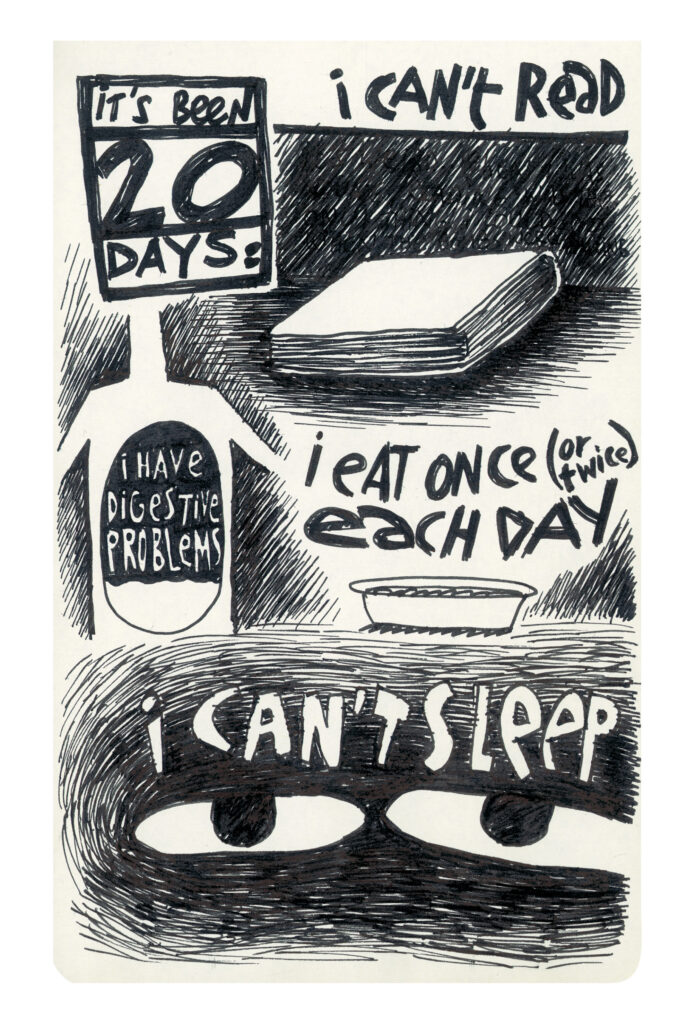
Kerbaj has always been preoccupied with documenting his personal experiences and the political reality around him, so it was no surprise to see him sharing drawings about the genocide in Gaza. Despite the marked change from his usually humorous approach, he maintained the same accessible style and visual language, aiming to bring as many people in as possible. Kerbaj was only just wrapping up the book tour for Gaza in My Phone when we spoke. Even though the book began as real-time testimony intertwined with nonstop social media news, he explains that, in his mind, the drawings were always destined to become a book. When published online, the drawings react to events as they happen: an image encountered in today’s news becomes a drawing today or tomorrow, something shared between people in the same helpless position of watching from afar. In book form, the drawings take on a different life: less ephemeral, more chronological, more consequential—continuous.
A social media post suffers from an algorithmic life cycle, shared and liked for a moment, after which it eventually falls to the wayside. A publication endures much longer. When Kerbaj’s drawings, dated October 9, 2023 to January 15, 2025, are arranged chronologically, a larger picture of the genocide emerges, one that cannot be scrolled or reported away. Each image becomes part of a narrative, a sequence, allowing the reader to grasp how events accumulate, how the shock appears and then dulls with every reappearance or repetition. “Each drawing is not alone anymore,” Kerbaj tells me, “Each drawing, whatever it is, in the book, answers everything that came before, and predicts everything that’s coming after.”
For readers dulled by repeated exposure to the horror of this genocide, the sequence restores a sense of accumulation; for those who have not encountered these events, it preserves a record. Kerbaj wants the book to remain for twenty, thirty, or even a hundred years, even though its subject matter can make the future difficult to imagine. The book does not try to serve as news, even though it is based on real events and real images, but the retrospective linear structure allows readers to encounter this story from the artist’s perspective: a helpless rage mediated through a screen. “Each worse makes us think it is the worst, until the next worse,” Kerbaj says. Read in sequence, the drawings also make us conscious of our changing attention: what first shocks us can become familiar, even as the violence intensifies, an algorithmic effect on the spectator’s attention.
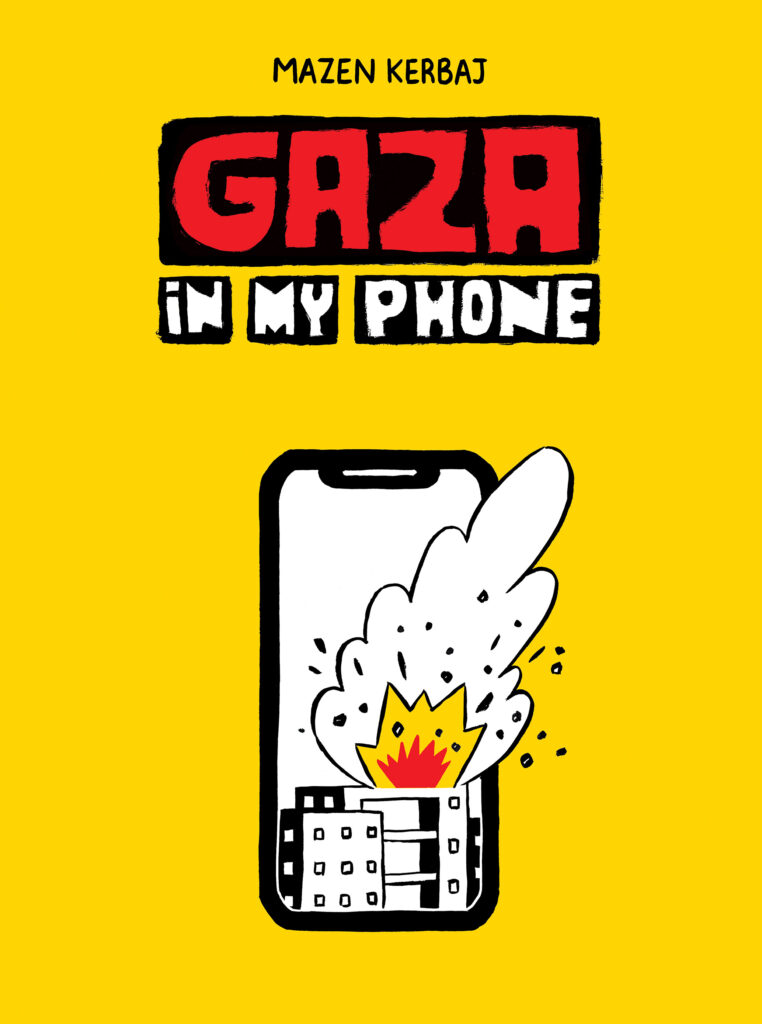
The phone is not merely the device through which Kerbaj encounters the news; it is part of the work. The drawings emerge from a contemporary condition in which distant violence arrives in intimate, everyday spaces: the same device that is used to exchange messages with friends delivers a livestream of mass death. Kerbaj observes that when spectators encounter images of catastrophe, the original image can provoke an instinctive desire to look away. For the artist, a drawing offers another way of looking. A cartoon, for example, may initially appear accessible, even cute. Its visual language invites the reader in before the caption or context reveals what it represents. The intention is not to make violence more palatable, but to make it harder to ignore. For Kerbaj, the simple drawing is supposed to “hit you where you were not expecting it to hit.”
This practice did not arise out of a journalistic desire to share the news, but Kerbaj’s need to respond to and process what is happening, first for himself, and then to share with a wider audience. “I always say that I do these drawings first and foremost to save myself,” he tells me. He describes the act of making art out of an overwhelming experience as a coping mechanism rather than emotional detachment. He had produced something similar during the 2006 Israeli war on Lebanon, when he recorded the events in a wartime blog of drawings, sketches, comics, dispatches. He posted daily, immediately, not pausing to edit or pontificate. The blog was later adapted into Beirut Won’t Cry, a book of nearly 200 drawings that remains one of his most celebrated works. It was also one of his earliest public collaborations with his mother, the late poet and artist Laure Ghorayeb. The mother-son duo exchanged notebooks during the war: one would begin a drawing and leave it for the other to complete.
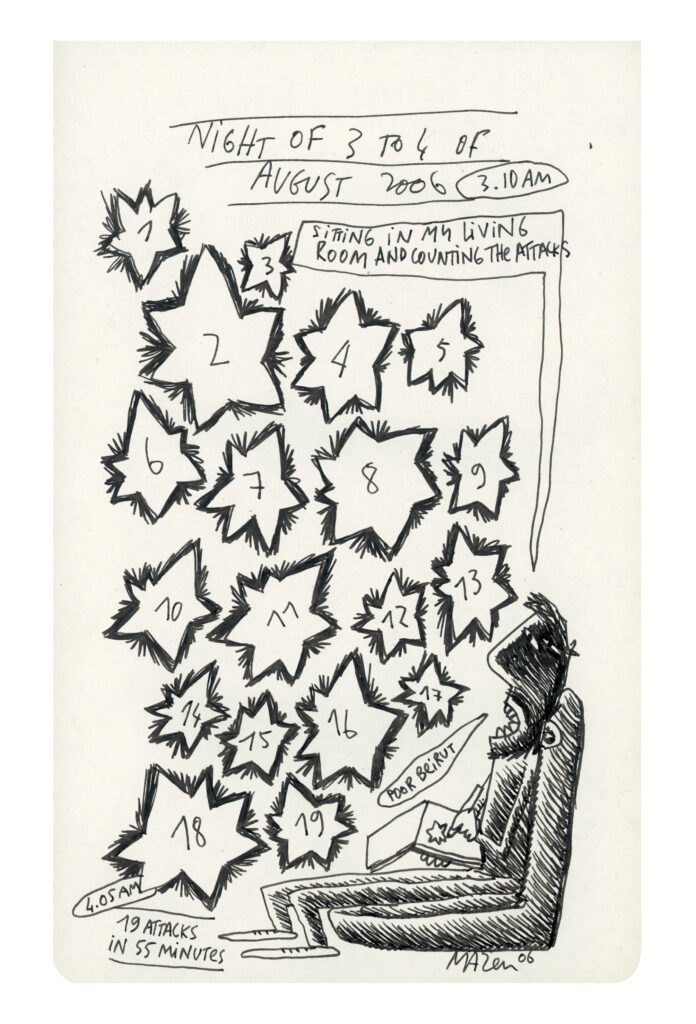
At the same time, Kerbaj was also working on an improvisational musical piece, playing the trumpet against the sonic backdrop of Israeli air raids. The recording was later released as Starry Night. On the night of July 15-16, 2006, with bombs falling over the southern suburbs of Beirut, he set up a minidisc recorder on the balcony of his apartment and began recording the bombardment outside. The result was an acoustic encounter bordering on the absurd: a duet between the improvised sounds of the trumpet and live bomb explosions. Kerbaj has since resisted the heroic image sometimes projected onto him for making music under fire, insisting that he was frightened, like everyone else, but committed to continue listening and making music while the world fell apart.
Despite the different forms and events, these projects share a central, continuous impulse: an artist responding to the madness, perhaps with a madness of his own. While the works are undoubtedly political, Kerbaj maintains a distance from the discourse, choosing instead to center his personal experience, reflections, and feelings at the exact time of the event, without reconstructing them in retrospect. The work does not place him outside of the events he records, but within the absurdity of living through them.
Growing up, Kerbaj remembers reading comics before he could read words. He studied the images in his older brother’s collection and invented his own stories, following the illustrations panel by panel. By six or seven, he already imagined becoming a comics artist. As a child, he remembers watching his mother draw amid the chaos of the Lebanese Civil War. She sometimes spent six months on a single painting, maintaining a consistent practice in an otherwise unpredictable situation. Her patient practice is echoed in his work to this day. Kerbaj’s parents, both artists, warned their children against assuming that art would provide an easy life. Nevertheless, he persisted, earned a degree in graphic arts at Académie Libanaise des Beaux-Arts (ALBA) and also worked in commercial advertising to fund the self-publication of his own comics.
Despite the mostly solitary nature of drawing, Kerbaj’s years in Beirut as a young adult were filled with creative collaboration and cultural organizing, especially within the city’s budding experimental music scene. After his friend and collaborator Sharif Sehnaoui gifted him a trumpet, Kerbaj began playing the instrument without any training. His amateur experience made him a distinctive improviser, pushing the trumpet’s acoustic boundaries with playful, unconventional techniques. Kerbaj went on to found Irtijal festival and Al Maslakh label with his music collaborators, becoming a key figure in the Lebanese experimental scene, while also creating a space for other artists in Lebanon to experiment together in a collaborative environment.
Although the artist sees these two forms in conversation with one another throughout his practice, they take on very different lives. The comics, especially the testimonial form, is a slow and laborious process, and the publishing cycle is even slower. By the time the book is released, Kerbaj says, he has often moved on to a different project. Improvisational music, by contrast, is ephemeral, collective, created with and for others in a specific moment, released into the world without delay. His experience in music changed his understanding of artistic ownership, the artist’s ego, and the social purpose of making work. “I’m not interested in the result of things, I’m more interested in the process,” he tells me.
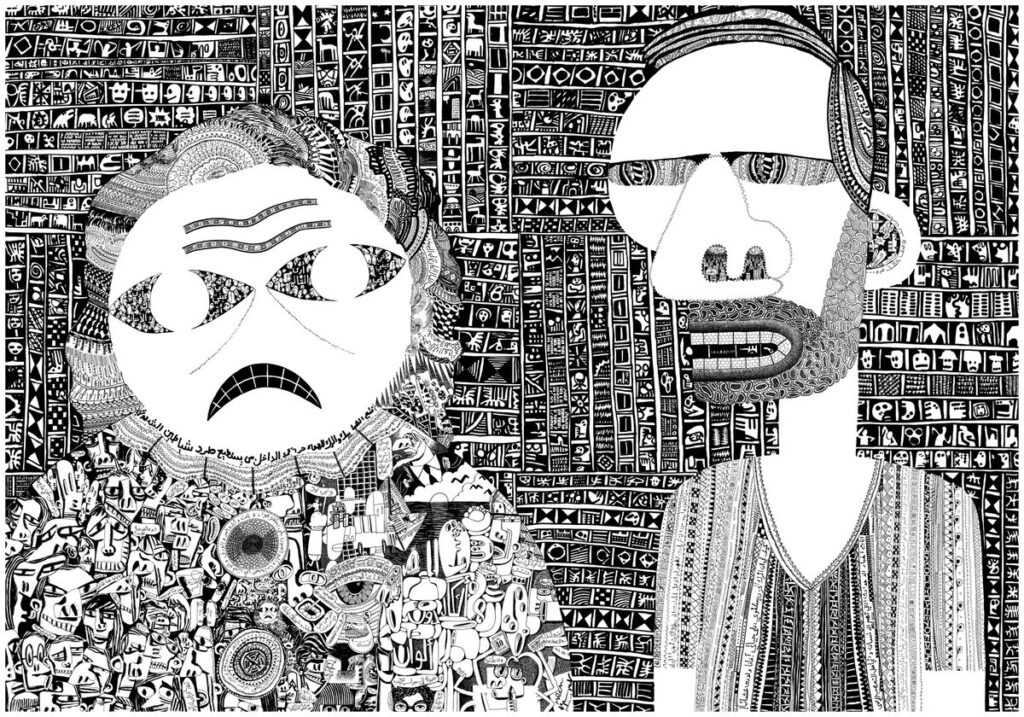
There was a marked shift in the process and positionality of Kerbaj’s work after his relocation to Berlin in 2015. The physical distance from Beirut also shaped and expanded his collaboration with his mother and his autobiographical comic about his father, actor and artist Antoine Kerbaj. In 2017, two years after the artist’s move to Germany, Laure and Mazen began corresponding on a continuous roll of paper that they sent back and forth between Berlin and Beirut, overlapping drawings and writings in a single work. The correspondence continued until Laure’s death in 2023, but Kerbaj now carries on with the work his mother left behind.
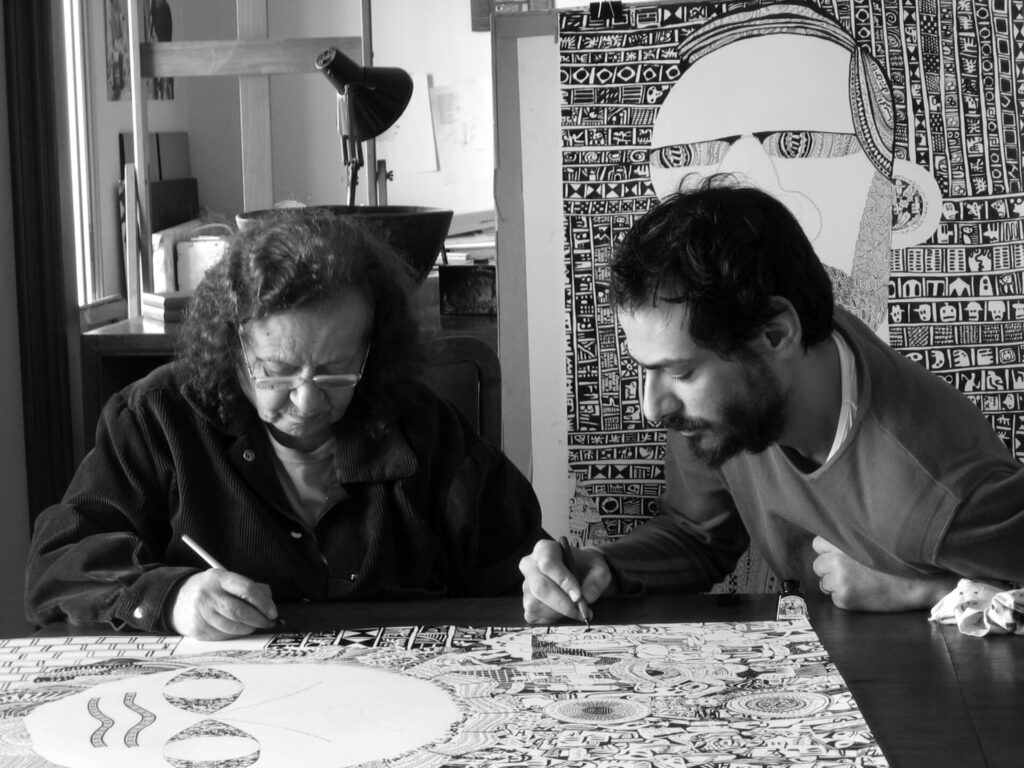
The roll of paper becomes both a collaboration and a material record of a relationship sustained across distance, other over time. Through this process, Kerbaj, the time-keeper, comes to record also the physical space and distance that separate a relationship; a relationship to home, to family, to catastrophe. His preoccupation with recording events as they unfold has matured at this stage in his artistic career. The work blurs time and space, both the physical and virtual, and the relationships between the living and the dead.
After decades of being in the middle of the action, so to speak, Kerbaj was suddenly removed from familiar context and thrust into a German-speaking world that expected him to answer for what was unfolding. When Israel unleashed its military campaign on Gaza in the aftermath of October 7, Kerbaj felt responsible to convey what he was seeing, even if it wasn’t his body under the bombs. Beyond narrating his experience as a witness, he sought to address an international audience in the English language, a deliberate decision to reach as many people as possible. He was especially conscious of reaching people in western countries, some of whom were encountering the history and scale of the violence through a different frame of reference. He also chose his words, tone, and drawings precisely to dodge any censorship. He learned to find indirect ways to say what he wanted to say, using subtlety and visual language to communicate what might otherwise be suppressed or banned. As he puts it, “I wanted to speak directly to these people.”
Kerbaj’s work does not carry any grandiose claims to stop a war, nor does it suggest that witnessing and documenting this catastrophe is a substitute for the testimony of the Palestinians living through it. He responds to what he sees, in his own way, and then passes it on to a public audience, leaving readers to respond for themselves, without dictating their encounter with his experience.
When Kerbaj says he draws to save himself, it is easy to believe him, and to see how the line between public book and private diary is almost irrelevant to him as an artist. Yet making work does not resolve the helplessness of watching the horror from afar. In our conversation, Kerbaj touched on the guilt that accompanies the ordinary business of living and creating while others are being killed: the feeling that it is wrong to find satisfaction in making a drawing, or to create something about the catastrophe as it is ongoing. Even guilt, he suggests, can become another burden, because it offers no meaningful help to those who are suffering. To be depressed from a distance can feel like an indulgence; to continue with daily life can feel equally intolerable. Making art does not resolve these contradictions, but putting pen to paper gives them somewhere to go.
Many admirers of Kerbaj’s work, which has taken many forms throughout his career, are eager to paint him as an artist responding to war, perhaps even as an activist. At the end of the day, he is a Lebanese artist who also happened to live through war, and in turn, created work about his experience, just as he also created work about his father, or learning German, or the assassination of his friend Samir Kassir. War and crisis are part of his practice, as they are part of our lives, but they are not the entirety of it.
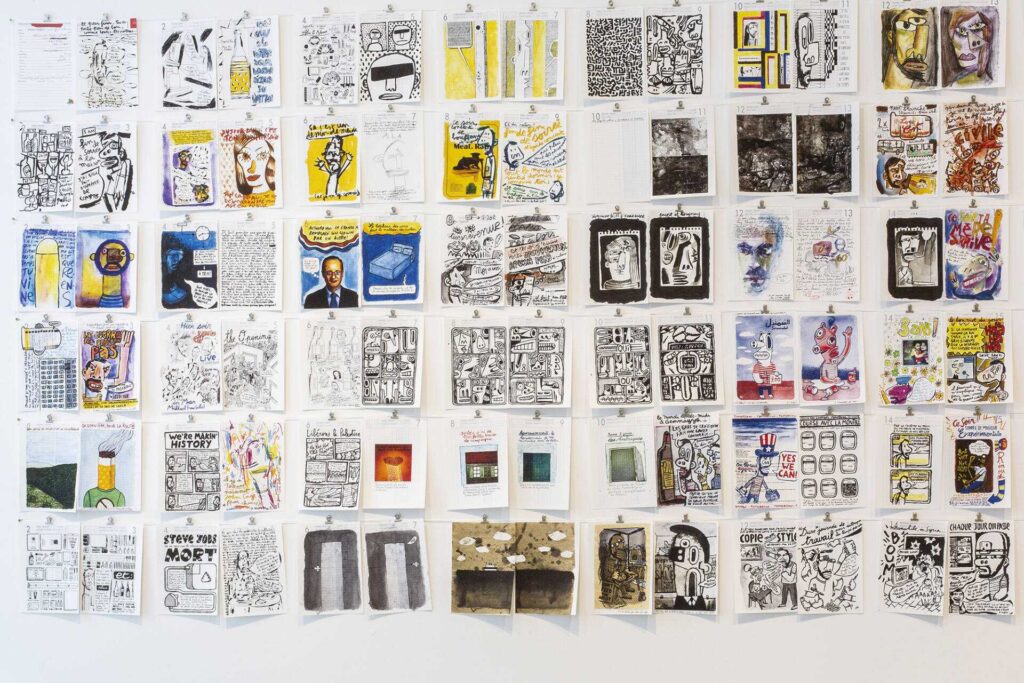
Yet, despite the melancholy that runs through much of his work, Kerbaj’s work is filled with humor and playfulness. He describes his sense of humor as a “lifelong shield” against terrible things. Growing up in Beirut during the Civil War, he learned to turn fear and pain into sarcasm, irony, and jokes. He doesn’t reserve humor for subjects that are easy to laugh about then turn it down when the subject demands somberness. On the contrary, he is drawn to the things people are least willing to joke about or confront. “I think life is a tragic comedy, and I’d rather laugh about anything than cry about it,” he said, insisting that no war or genocide can take away his sense of humor. He offers no consolation or resolution but continues to draw and record in the most heightened moment, releasing his work into the world with all its contradictions. In Kerbaj’s practice, humor does not normalize the suffering but offers a way to diffuse the tension and confront the unbearable.
“My only way to stay sane is to continue doing what I’m doing,” Kerbaj says.