Ahmed El Attar offers insight into his new play, Salma, Mon Amour, as well as what it's like to help create an entire theatre ecosystem from scratch.
One year after Arabic was the invited language at the Avignon Theatre Festival, I was finally on my way to actually watching a performance in Arabic. The year before was full of dance pieces and talks about the Arabic language in French, but there had been very little actual Arabic spoken at any of the performances. In his closing remarks, the festival’s artistic director, Tiago Rodrigues, had acknowledged this criticism, saying there would be more work in Arabic the following year and also acknowledging that the festival had in fact received threats over its choice of language.
And while this year’s invited language was Korean, Arabic and the Arab region retained a strong presence. Three months earlier, Olivier Galzi, Avignon’s newly elected far-right mayor, speaking on France Inter said he was “shocked last year by the way the Avignon Festival had, to some extent, been used to address the Palestinian issue in an overly forceful manner,” adding that the festival was not there “to put up the Palestinian flag” (author’s translation). In response, three days into the festival, a collective of the far-left organizations La France Insoumise, No Pasaran Jeunes, CGT Vaucluse Présence palestinienne and the BDS movement covered the main square in a giant Palestinian flag measuring 32 by 15 meters. I also witnessed a middle-aged woman wearing a keffiyeh around her shoulders being manhandled by festival security guards outside a theatre for her “bad behavior.” They told me she had moved her seat without permission—but so had many others, and as far as I could see, she was the only one to be forcibly removed. In the Off festival at 11 Avignon, I saw two shows in Arabic: Mona El Yafi’s Ma nuit à Beyrouth (My Night in Beirut) about the administrative nightmare of renewing a passport in war-torn Lebanon, and Alif, written and directed by Abdelwaheb Sefsaf about the beauty of the Arabic language. In the official festival there was Salim Djaferi’s Bâtir (performed in French) about embedded racism towards Algerians in French town planning, and then there was Salma, Mon Amour, (Salma, My Love) written and directed by Ahmed El Attar.
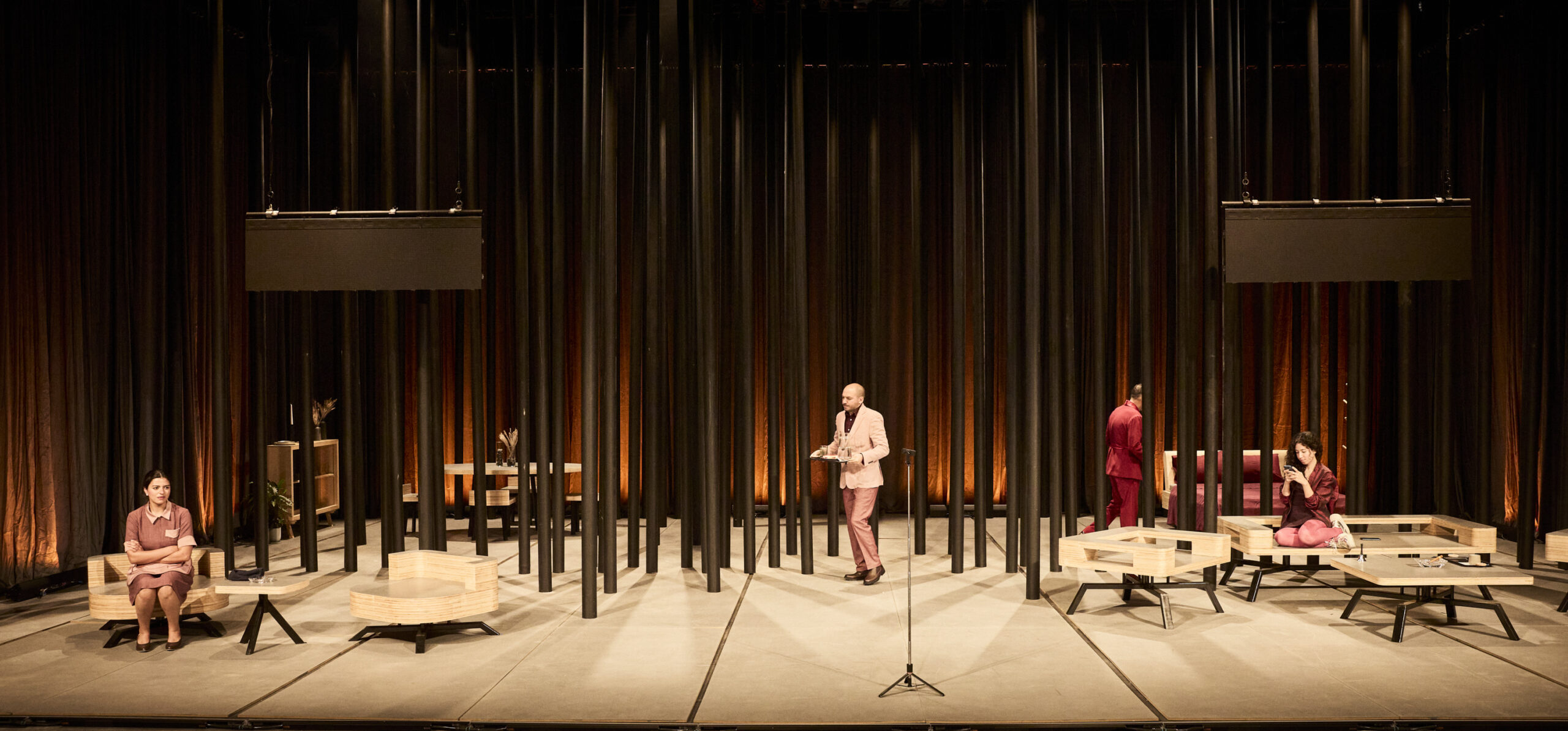
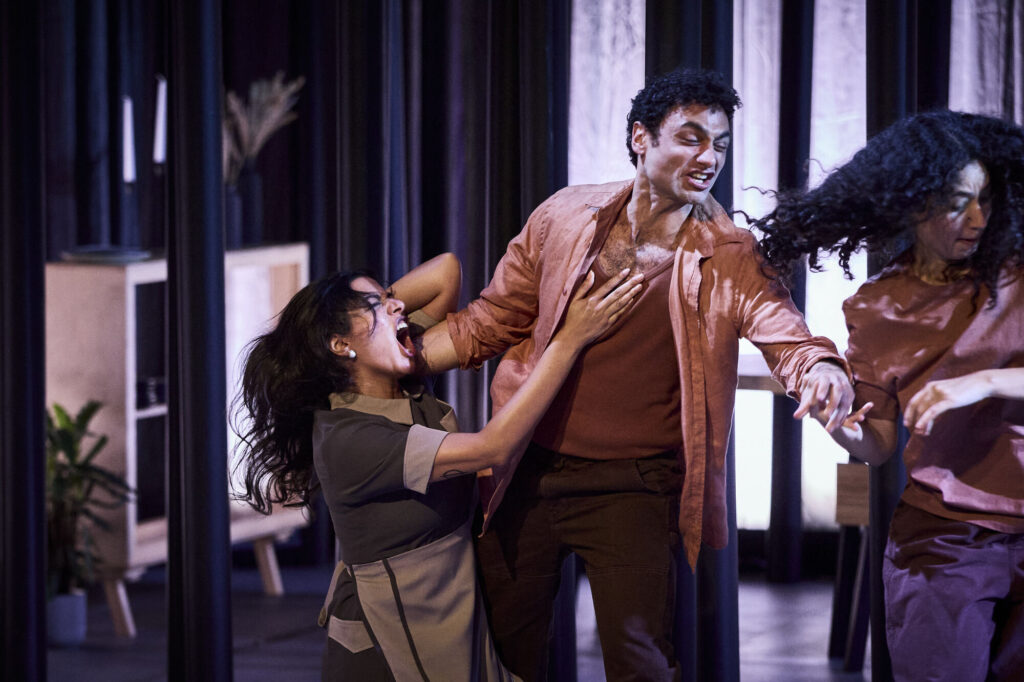
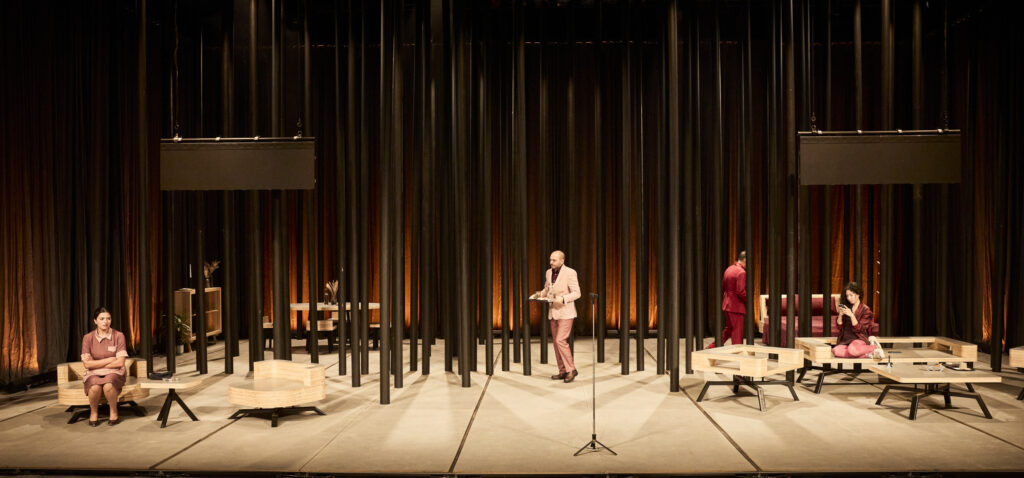
I went to watch the play on a Sunday morning, not having registered that the theatre was so far out of town. When I arrived, there was a queue of people waiting to show their bags to security. We were asked to remove liquids to be stored until after the show, and drink from any water bottles in our hands. A heavy new protocol, I thought, but I never encountered it again throughout the festival. Perhaps it was due to the fact the theatre was not in Avignon but in neighboring Vedène, which has a different mayor and quite possibly different security rules. I took my seat, and after the announcement to switch off our phones in French and Korean, the actors walked on stage to perform—in Arabic, with French subtitles—the tragedy of a wealthy Egyptian family whose lives descend into chaos after October 7, 2023. As war unfolds, the family fight to save their son’s marriage to a wealthy American, while their daughter Salma (in a stunning performance by Nanda Mohammad) quietly awakens to the horror and destruction of Gaza she sees unfolding on social media. When she quits making her cute TikToks in favor of posting about innocent civilian deaths, the family try to silence her, driving the action to a tragic ending. The writing was compassionate, sardonic—and devastatingly on point.
I met up with playwright Ahmed El Attar some time later to ask him about the show, and about his role as founder and director of D-CAF, the Downtown Cairo Arts Festival. I began with wondering about the inspiration behind the play.
Georgina Van Welie for TMR: What compelled you to write Salma, Mon Amour?
Ahmed El Attar: I went through a real shock of realizing that all the values I had built my existence on had been completely shattered by the genocide, by the lies from the media and the changing of realities. Everything that we believed about equality, freedom, freedom of expression, justice, everything disappeared to protect a genocide… I think a lot of people went through the same. Afterwards I asked [myself], now what? I need to say something. What am I going to say? I realized what concerns me is what happens after? Now that this has happened, now that the world has been exposed, the genocide has taken place… Thousands of people died, endless numbers are still in that open air prison and being bombed. What is the future? A lot of people talk about the present, the media, artists, but I am interested in what happens next. When this is over, since every war, every moment in human history comes to an end eventually. What happens next? What are we expecting from the next generation? Not only the ones who have been bombed and killed and lost their families and been maimed and lived the atrocities, but everyone else who witnessed it. How will they react? Do we think the world is going to go on normally, business as usual? I think not. So Salma is that character, she is young, from a very wealthy Egyptian family. I deliberately made her non-political at the beginning. She is an ordinary rich girl, the world is beautiful, everything is great, everything has been given to her. Then she comes face to face with the genocide, with the images. She starts to question it from the perspective of a sheltered young woman. The moment she starts to question, everyone tries to silence her. Things escalate to the point where she has to make a choice. I am inspired by Greek tragic heroines, choosing between her values and her family. An impossible choice.
TMR: The ending of the play, which I won’t spoil, is particularly strong. You are often asked about how you handle censorship in Egypt. And yet did you somehow feel able to say more over there than in the West?
AE: Yes. It’s a recurring question that I’ve asked and been asking for many years. I think censorship is stupid. But there is a good side to censorship in that it allows an artist to find solutions. Of course I would love to be in an environment where I can say what I want, the way I want, but restrictions are also good for artists. When you have everything there is no struggle, and struggle is part of the creative process. I know it’s a very controversial way of looking at it, but that’s how I see it. You start with yourself, your doubts… these restrictions are important for me because they allow me to find different creative ways of saying what I wanted to say without having my head chopped off… As you said, the reality today is there is no difference. In France, the UK, the States, there are certain red lines you cannot cross as an artist or an individual. People have been thrown in jail for supporting Palestine Action in the UK and accused of crimes of terrorism. This is a playbook that we know about and have lived all our lives. So it’s very hypocritical to be asked [about censorship by eestern journalists]. My question back is: what about censorship in Europe now? Why can’t we just say things out loud and not be treated as a terrorist or antisemitic? We ourselves are semitic so we can’t be anti-ourselves. So yes, there is much hypocrisy in the West… it’s a cliché, but the light of the truth is always there. You can push it away, you can hide, but it will find you. Mandela was in jail for thirty years, he was on the terrorist list in the UK and USA, apartheid was supported by the West and for a long time boycotting South Africa didn’t appear to be working. I have no doubt that we will come to the moment when all this will be acknowledged, and hopefully the people who perpetrated [the genocide] will be punished and receive justice, because without this justice, the world will collapse.
*
El Attar’s reference to the end of South Africa’s apartheid echoed some of the themes that marked this year’s festival:twentieth-century century fascism, totalitarianism, and imperialism. I attended shows set during and in the decades after World War Two that had innocent individuals pitched against the state machine in Nazi Europe, and other works that explored U.S. intervention in Korea and Chile. Shows such as Malrodor by Julien Gosselin were monumental and seminal. Yet I was troubled by a lack in the overall programming around current events such as Venezuela, Gaza, and the war against Iran. I do not believe theatre is journalism. However, if you are going to cite historical events as some kind of warning, then not naming the current victims of state terror is, to my mind, falling short. What was brave about Salma, Mon Amour, was that it is set today and that it furthermore refuses absolute victimhood. Some of the play’s characters actively ignored the horror unfolding in their neighboring country, some were abusive to their servants. I asked El Attar if this was because he was writing about the present, or because he believes such human contradiction is a prerequisite of good drama. His answer was both. He wished to surprise the audience by upending their expectations and beliefs, because “when an audience is destabilized they are able to perceive things differently. Everyone is a victim to a certain degree, and also complicit. No one is purely good and no one is purely bad.” On the question of violence and the way the play addresses class hierarchy in Egypt through the family’s abuse of their domestic servants, he said: “If you are someone who oppresses your inferiors you are also complicit… Gaza is one part of the puzzle, we can’t ignore the rest, we would not be complicit if the rest wasn’t as ugly as it is, it’s not about being ugly here and we are all fine there… no. We are not fine.” Indeed, it is also wishful thinking for Europeans to believe they have the moral high ground or that violence has been relegated to their history.
Putting Arabic on stage in Avignon carries a different significance from Korean or Spanish, because as many commentators and academics argue, Arab communities are among the principal targets of France’s contemporary far right. Al Attar goes further. “All of the racism,” he says, “the segregation in France, is built on the hatred of the Arabs, of everything they are. Their language, their religion, their appearance. Right or wrong, this is the situation.” A theme that was echoed in Salim Djaferi’s play Bâtir. In this context, the festival’s choice to feature Arabic was a courageous one, bringing with it particular expectations and responsibilities. And yet one of those must surely be allowing the audience to actually hear the language. Like many people, El Attar was disappointed with the lack of spoken Arabic last year. “Where is that language?” he asked. “Where is the sound of it? We needed to hear it more. I love dance… it’s a form of expression and shows the contemporality of work in the region. But the language stays at the heart of it… and there wasn’t enough of it.” He accepted that the ultimate programming choices belong to the Artistic Director and that although he would have loved to be part of last year’s festival, he was nevertheless very happy to be part of this one. I wondered if performing it this year, in the context of the war in Lebanon, Gaza, and Iran, and with the election of a far-right mayor, meant that the work had even more relevance. He repeated that it was a brave choice, and a potentially controversial one for the inner politics of Avignon and France to have featured his play, which will tour to Paris, Ardeche, Choisy-le-Roi, Bayonne, Nantes, Douai, and Marseille before going to Brussels. He stressed that he doesn’t wish to engender controversy in France but is aware that the play and the choice to program it could be controversial. This contradiction —on one side programmers fighting to present work in Arabic, in particular work that confronts the difficulty of talking about Gaza, and on the other certain politicians censoring and condemning solidarity with Gaza—is symbolic of a wider split in the country. The result ends up being ambiguity: a country trying to achieve an impossible balance.
TMR: Can you speak about your other role, as founder and artistic director of D-CAF, Downtown Cairo Arts Festival?
AE: From very early on I wanted to do something more than just create plays. Because I’m connected to my community, my society. I’ve lived most of my life in Egypt, except for six or seven years in Paris. Other than that, I have lived in Egypt and still live in Egypt. I’m very much an Egyptian, Arab, African, whatever. And I’m concerned about my society and how it evolves. And I know what theatre did for me on a personal level. How it saved me.
*
Because El Attar is such a believer in art’s impact on society, he also believes that if an artist has other skills such as arts producing, it is their duty to use them in a country where the means and infrastructure to make theatre are limited. The facility of simultaneously serving as both artist and producer is key to his work. El Attar is aware of what is needed and what is lacking in the local theatre industry and has the tools to address it. The fact that it also brings alternative income also allows him the freedom to make the artistic work he wants. In the late ‘90s, he was already experimenting with different art forms. Although he is not a musician, seeing how much interest there was in electronic music, he organized one of the first electronic music workshops in Egypt, bringing together a Dutch and Greek musician with local artists and producing a CD. When he saw Egypt didn’t have many comic books, he made one. In 2000, in parallel with rehearsals for his show Life is Beautiful, he organized lighting workshops with his French designer at that time. Some of those participants have gone on to become professional lighting designers. These were all steps toward realizing his ambition to create a complete theatre ecosystem in Cairo.
In 2005, after successfully organizing and raising the funds for these workshops, he created Studio Emad Eddin, named after the street on which it is located. A street that, from the 1920s right up until the ’50s had been known as the “Broadway” of Cairo, full of cabarets, theatres, and bars. The Studio, inspired by the Jerwood Space in London, was intended to provide rehearsal spaces and training for actors. It evolved from a practical need—El Attar had been commissioned to put on a large show for the Berlin Festspiele, Mother I Want to be a Millionaire, and realized he had nowhere to rehearse it. “If I am at that level,” he said, “getting all the funding I need but I don’t have a rehearsal space, what about others?” And so, he decided to create a studio to do just that. These rehearsal spaces are still running today: 450 square meters, six different spaces, equipped to host all kind of rehearsals. They are used by professionals as well as the many students who take part in theatre across the city, servicing a total of 24,000 hours of rehearsals a year.
The nature of arts funding within the Arab region makes it challenging to raise sufficient budgets to create independent productions.
Having established the rehearsal space, what next? A performance venue, of course. El Attar and his people took over the Falaki theatre at the American University, the same place where they had produced a mentorship program for young artists entitled To Be Continued. Then came Rawabet, the oldest independent theatre in downtown Cairo, a small, 150-seater black box. This notion of independent production is important. Each of these projects are funded by international foundations as well as generated income. This avoids being “under the gun” of any one funder as he puts it. From the beginning, it is the project comes first rather than the funder’s agenda.
Then there was the question of how to see other people’s theatre work. The government’s Experimental Theatre Festival that had been so dynamic in the ‘80s and ‘90s was no longer interesting in his opinion. There was no independently curated theatre festival in Cairo. That was the impetus behind the creation of D-CAF, the Downtown Contemporary Arts Forum, to bring international work to local artists and audience. In parallel, he created the Arab Arts Focus biennial, an important and unique opportunity for theatre and dance makers from the Arab world and its diaspora to share work in progress with international arts programmers with the aim of getting the work funded and programmed. The nature of Arts funding within the Arab region makes it challenging to raise sufficient budgets to create independent productions. Performance-runs tend to be short, which limits the number of people who can see them. International touring allows artists to both access funding and revenue, often sadly much more than what they could back home, and increases the exposure of their work, which then leads to further touring. Through the Arab Arts Focus, many artists have found success in being programmed and subsequently toured the same piece for two or three years.
In 2018, El Attar and his team opened Mektebi, a co-working office for the creative sector to support the managerial side of the business. This year they started CAT, Cairo Art Step, a training program for technicians—much needed in the region as there is currently no school in Egypt or the wider region teaching the technical skills necessary for artistic production apart from one in Morocco. They also built an Arabic curriculum for lighting, sound, and video design. The pilot was tested over three years to train ten technicians in each field, in blocks of seven weeks; the first block has just been completed. The importance of these initiatives cannot be overstated. While continuing to make work in Avignon, Berlin, and beyond, the ecosystem that El Attar and his team have created at home is facilitating the next generation of Arab theatre makers in a region where it is hard to earn a living from performance and where many young people turn instead to film and the visual arts.
I wanted to challenge him on one thing however.
TMR: At the daily question and answer session of the Café des Idées in Avignon, you said, “we do not just need such institutions we must also create excellence in them.” And yet excellence is too often measured against European theatre norms. Do you ever struggle with the question that troubles some Arab theatre makers when funded by western agencies? That is, the question of who is this work really for? Or how we can also address the growing need to make work that speaks to and for people from our own communities?
AE: Well, I don’t know who said that to be international, you have to be local… by connecting to your roots and going beyond them. It’s not about recreating your heritage. It’s about recycling it in your contemporary life. I’m a city boy; I was born and raised in Cairo. I grew in cement. The Nile was not far, but this is my environment. The pollution, the cement buildings… the hustle, the rumble, the noise, the pollution, the overpopulation…
*
On the question of “excellence” in institutions, he was clear that the problems in the Arab world derive from the fact is it not a meritocracy. Wasta, a form of nepotism based on favors, “is killing us,” he said. “And will keep killing us as long as we do it.” Many people, he says, get to make work “not because you’re a good director or doing a good project. It’s because this person likes you, or even your mum knows someone’s aunt… and as long as we’re working this way, we’re never getting anywhere.” Because of this system, he says, the people who deserve to succeed rarely do. He attributes the ongoing success of the organizations he helped create to the fact they are not linked to him in this way. He gave the example of Studio Emad Eddin which has set rules. Reservations happen every Sunday morning, first come first serve, no red carpet. If you want good seats at good times, you must come early to be first in line. He accepts this is archaic, but it is the only way to counter wasta. It also builds trust: artists know someone will not jump to the head of the line because of who they know. He says the buildings are well-maintained, and the teams ensures a level of good communication with everyone. He also stressed the need to be independent. “It’s not about the money. It’s about what you represent. It’s about the values you defend, not just the power, not who is funding you.” An ambitious goal certainly, but by having diverse funding bodies and a steady revenue stream, by eradicating wasta, by bringing in international work, by training local technicians and creating community spaces, he and his team are putting Cairo theatre on the map.
To conclude, I returned to the Avignon Festival.
TMR: In the program note, Tiago Rodriguez wrote that, “To celebrate its 80th edition, [the festival] raises the flag of questions.” Surely this is partly referencing the Palestinian flag controversy. And so, while it is important for artists to ask questions, my question to you is, in the face of such horror and everything else we’re all living through, do you also feel a responsibility to provide some answers?
AE: Yes, we have responsibilities to help the audience formulate answers. I don’t think we should give them answers… I don’t think an artwork needs to give answers. Because when you watch something and everything is laid out and you’re consuming it, it works just for the moment. Oh, it’s sad, oh, how horrible, and we can cry, and then we leave… it becomes a moment out of time. I have done my share. I sympathized, and I’ve done my part. I don’t need to do any more.
*
Judging from the animated discussions in the theatre foyer after Salma, Mon Amour, I felt certain that El Attar had succeeded in prodding the audience to ask themselves many questions. What they do with their answers and the crime of Gaza, however, is another question.
Salma, Mon Amour will continue its tour this winter:
8-10 October MC93 Maison de la Culture de Seine-Saint-Denis (Bobigny, France)
13-14 October Comédie de Valence CDN Drôme-Archèche (France)
16 October Théâtre de Choisy-le-Roi (France)
3 November Scène Nationale du Sud-Aquitain (Bayonne, France)
November 6-7 Mixt terrain d’arts en Loire-Atlantique (Nantes, France)
November 9-10 Tandem Scène nationale (Douai, France)
November 13 LaMAM – Maison des Arts Marseille (France)
December 6-11 Théâtre national Wallonie-Bruxelles (Belgium)