From shared fruit to shared memory, a Kurdish American writer traces how culture survives through ritual, kinship, and acts of gathering.

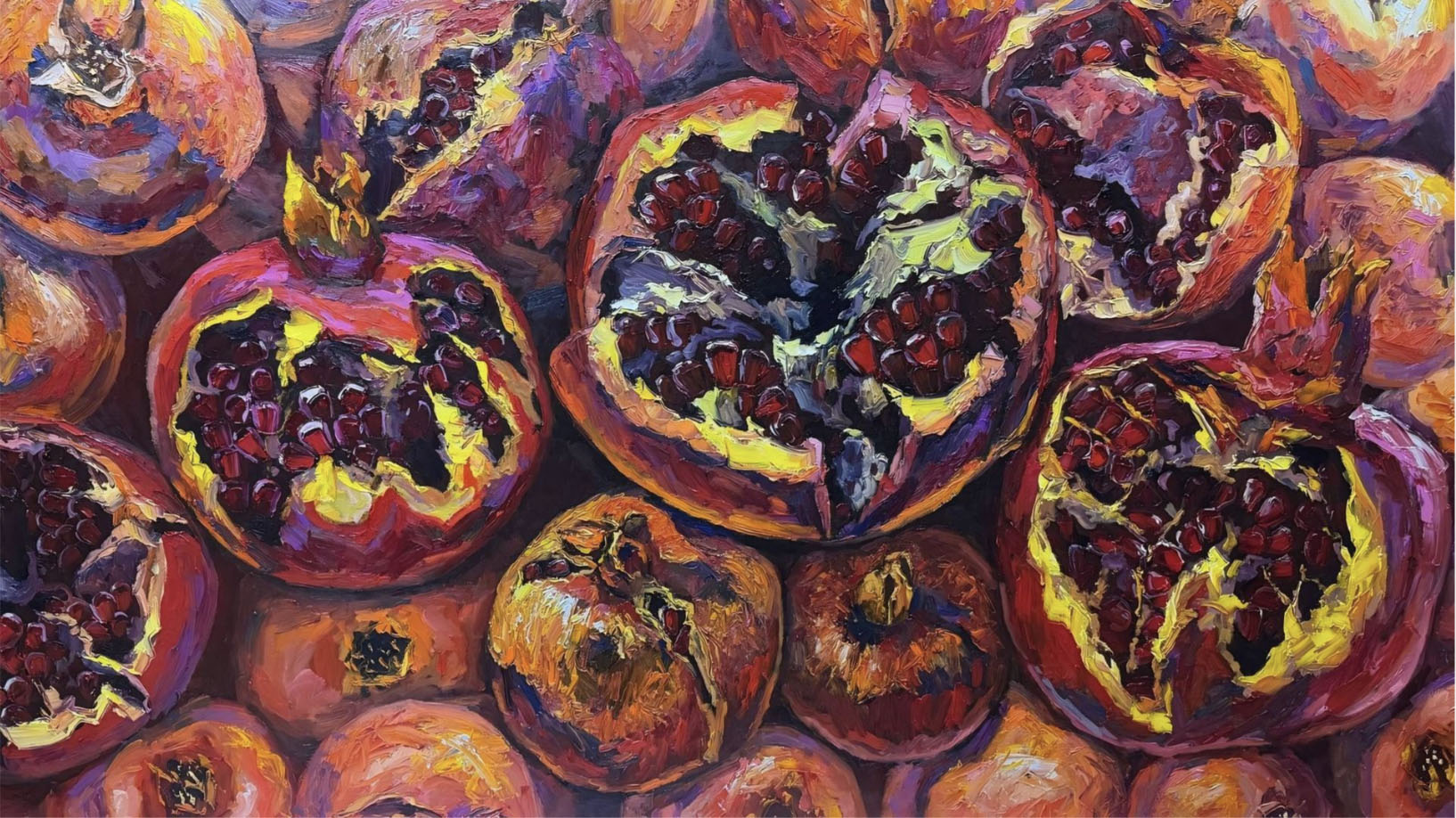
At our Kurdish family gatherings, the table is a loud painting: bowls of nuts, plates of dried fruits, staggered coffee mugs, red and blue decks of cards, and each adult fanning fourteen cards in one hand. When I was younger, my aunts and uncles would pass a large mixing bowl around the table with two or three pomegranates arranged around a small knife. They would take turns scoring the rind and teasing out the seeds, then share the bounty.
The fruit holds my attention. The beehive of it. The secret chambers. The cave of bright, glossy rubies. The pleasure in the uncoupling. The satisfaction when each little kernel drops into the bowl with an audible tap. Or when an entire cluster unlatches at once. A communal experience, a gatherful fruit.
At the pool, I wave to a neighbor I first met on a walking path behind our house. Months ago, I overheard her children talking, and I asked, “Are you by chance Kurdish?” She looked surprised. I’m not often clocked as a Kurd — depending on the viewer and the context. She replied, “Yes, we are Kurdish! How did you know?” I explain myself, my family. Her children like to speak to me in Kurdish, delighting in the fact that they know more of the language than me. Every time I see her at the pool, she asks after my mother.
In my grandmother’s uterus, my mother’s fetus-body held the possibility of me inside. My grandmother carrying my mother carrying me.
Kurds often ask me how my mother is doing; it’s customary. I often say “Good,” and nod slightly in a way that says, “You know, pretty good, but I have nothing else to say.” The truth is, I don’t always know how she is doing. The truth is, I don’t always know what to say. When the conversation reaches the territory where I can no longer omit, I feel like I’m committing a transgression — to be Kurdish and estranged from my mother.
*
Summer 2023, I am carrying around six months of pregnancy in my body. I have not yet told my mother. The walls between us are too high and thick. But I have been wearing her dress as a ritual of protection. The same dress that has held her body — her body that once held me — now holds my body while I grow a life inside. Navy blue cotton dotted with pink peonies. This is the closest I will come to my mother holding me in pregnancy.
When I worry about stress affecting the fetus’ development, I think of my grandmother who carried thirteen pregnancies in Southern Kurdistan and Baghdad, a Kurdish woman under Saddam Hussein’s genocidal campaigns and displacement strategies. While the infestation of patriarchy endangered her both within and beyond the home, she grew life, delivered life, nurtured life; one of those lives was her first daughter, my mother.
My grandmother also carried me, technically, given that a fetus with ovaries is born with all the eggs (or oocytes) they will have in their lifetime. In my grandmother’s uterus, my mother’s fetus-body held the possibility of me inside. My grandmother carrying my mother carrying me. My wife and I chose to give our daughter my grandmother’s name as a middle name: Amineh.
I cannot ignore that by this same science, my mother also carried my child, in a way, when she was pregnant with me. It’s more difficult for me to feel the same kind of awe in this iteration of the magic. But a kind of cosmic spark it is, nonetheless. And still a balm.
When I was going through multiple rounds of fertility treatments, my friend Zhawen lived walking distance from my house. I would walk over to rub her pregnant belly and bask in the glow of our sisterhood beyond blood.
Over tea laced with rose and cardamom, she told me that God better hears the prayers of a pregnant woman. “The belief,” she said, is that her “prayers will be louder and reach closer to God.” She had been praying for me to become pregnant — for my wife and I to welcome a baby. She comforted me when I got a phone call that our fourth attempt did not work. The next one did work though. Zhawen’s mother’s name is also Amineh.
Once I started growing life, I sank my teeth into every fruit I found. The sugar moves through the house that is my body.
*
Walking the sun-soaked sidewalks in our Northern Virginia suburb, I pass by neighbors planting a fig tree in their front yard. I hear a small child asking a question. “Dayah,” he says over and over to the woman with soil in her palms. And I think of my own mother and of her mother.
In the coming weeks, in a different part of the neighborhood where a large persimmon tree spills over a backyard gate and onto the sidewalk, I see a car backing out of its parking spot. A teenager tosses a cup of water onto the windshield, and I am instantly brought back to the countless times family members spilled into driveways barefoot, giggling, hiding cups behind their backs. And then as the car would start to drive away, an anointing — sometimes making it into the driver-side window if rolled down and if the anointer is sneaky enough — and a prayer for safe travels.
Iris puts her hand under my chin and says: You are beautiful, mommy. You are Kurdish.
Growing up in North Carolina, I never met another Kurdish person who wasn’t a relative. I didn’t have any Kurdish friends, though I did have a few SWANA friends. My childhood best friend was Iranian American. Every time she heard the door slam, indicating her father was home from work, she stopped whatever we were playing to yell down the stairs, “Salam, daddy joon,” before returning to our game. She had items in her home that I recognized: similar patterns on their tea tray, rugs with ornate designs, family photos in familiar poses — and I found some sort of comfort in that.
Now, living only a state away, I am nourished by the abundance of Kurdish community around me for the first time in my life. Here, in Northern Virginia, with proximity to Washington, D.C., and other pockets of our state where mass migrations settled, I am in the company of generations eager to preserve, celebrate, and share our culture. In March, we take my daughter to a kid’s Newroz celebration at the library. The children hold hands and dance together in a circle. They craft papier-mâché fires and paint shimmering fractals. That night, while getting my wiggly toddler ready for bed, I am kneeling, maneuvering her foot into a pajama leg, when Iris puts her hand under my chin and says, “You are beautiful, mommy. You are Kurdish.” I wrap her in my arms and say it back to her. In bed later, I picture her at the party, cautiously watching the children holding hands before looking back at me and stepping into the laughter.
*
My friend Aryan and I are texting confessions of Kurdish culinary transgressions, the Kurdish foods we don’t love. “I’m a bad Kurd,” I admit, “I hate tabouleh.” I add, “It’s a texture thing, I think.” He laughs and tells me, “Don’t feel bad, I’m not a fasolia enjoyer.” This exchange delights me; there’s something electric in our admissions.
Sometimes being a pescatarian in Kurdish spaces makes me feel “less” Kurdish. At Newroz last year I was in the buffet line with Lara, who skipped the meat trays, telling the host she was vegetarian, adding, “I know that makes me a bad Kurd.” We scooped rice and garnishes of tomatoes and onions onto our plates. Her relatives spent part of the evening urging me to visit Kurdistan, as if I needed convincing. “It’s safe, you know,” one relative said, looking directly into my eyes. “I know,” I responded, “I’m not worried.”
Later I pulled up pictures of my mother and her family on my phone. As if they were my passport, my entry fee. (I always share these moments suspended in time with anyone who is interested). I stopped scrolling at an image of my grandmother at a restaurant, red lips, gold necklaces. With her hand resting against her cheek, she looked at once like a celebrity caught in public and like every mother who has just finished a meal with her children. She looked alive.
I put down my phone and joined the dance circle.
*
One evening, at the end of my workday on campus, Sayran comes into my office to chat. We talk about her semester and upcoming graduation. We talk about her work as the president of the Kurdish Student Organization. We talk about her jewelry business and other things. I ask her about her weekend plans. “We will probably play Konkan for hours,” she says. This is the first time in my life I’ve met another Kurd outside of my family who plays this card game. Of course, many do, but the friends I’ve mentioned it to haven’t. Or perhaps I only mentioned it a couple times, then stopped, wondering if maybe this was just a family game?
We go back and forth talking about our house rules. It’s dark outside my office window; we’ve spent the early evening wrapped up in nostalgia.
When Sayran graduates, I give her two decks of cards that my cousin had custom-made for our family. The artwork is a pomegranate split open, soft pinkish red. I hand the box to her and feel my family growing. I watch her on stage and recall other conversations and interactions we’ve had over the years. The ways we’ve affirmed each other’s place in this world: how she told me where to order the best elaborate gold belts; how she brought me strawberry KitKats, because you can never visit empty-handed; how she looks at my daughter the way that I look at my nieces and nephews.
My wife and I play Konkan with our friends Nadia and Rosie. Nadia tells us that they played a similar game growing up called Conquian; we discover it’s possible the game originated in Mexico. Our group chat is now titled “Konkan Cooties” from a misspelling of “Cuties.” It is an addictive game, and we like to get everyone hooked. More players, more play. This means we don’t have to wait for the family gatherings or when the cousins come over to get our fix. When we learn that Nadia and Rosie’s recent move to New York City puts them only a couple of blocks away from one of my cousins, my wife immediately turns to me and says, “They can all play Konkan together!” though they’ve never met. I picture a gathering in the city: an apartment brimming with the voices of those who know us well, who have held us in the sacred and the tragic, who have walked with us in transition and transformation, who have cheered for our daughter’s first words and first steps. Warm hands lay down a Joker or an Ace, discard a final card, shuffle for another round.
*
When planning a queer, Kurdish American poets panel for a conference, my co-presenter and I go back and forth on titles, eventually suggesting, jokingly: “How Kurdish Are You?”
Though we have spent time unpacking this barometer of “Kurdishness” and are not worried about the insinuations, I still find myself insisting on multiplicity. Of course, Kurdish fractures are deeply rooted — geographically, topographically, politically, linguistically, spiritually. Perhaps embracing fragmentation is the most Kurdish thing one can do.
A wholeness not in spite of but because of. I pause before this line of thinking swerves into toxic positivity or romanticization. I pause and examine the freckles on my hands, the tattoo at my wrist, the hole in my sock.
*
My daughter finds me in my room looking through a photo album. I’m trying to locate a specific image to send to my cousins. Iris grabs the plastic protector and asks, “Who is that?” It’s a photo of my mother and I sitting on a plaid couch. I’m six or seven years old, on her lap. She holds me tight, her gold watch against my chest. She is beautiful. My smile is my daughter’s. “That’s my mom,” I say. She is happy with this answer. I can’t tell if I want her to ask more questions or not. She takes the album from me, and I let her.
In our fullness, in our variations, in our mountains and our valleys, in the blight and the bounty, we are children of the sun. Every ruby drop.