Select Other Languages Français.
A Syrian journalist from the Alawite minority, once in power under the Assad regime, turns against her father, family, and tribe, to become her own woman.
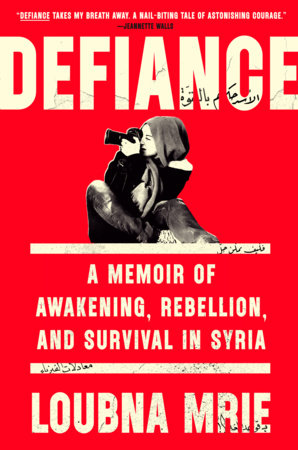
Defiance: A Memoir of Awakening, Rebellion, and Survival in Syria, by Loubna Mrie
Penguin Random House 2026
ISBN 9781984880000
Loubna Mrie’s first act of defiance was refusing to kiss the cloth at a Shi’ite shrine, a tradition in the Alawite faith. The cloth was covered in sweat and saliva. “It smelled like a sock,” she remembers in the opening scene of her newly released memoir. In Defiance: A Memoir of Awakening, Rebellion, and Survival in Syria, Mrie details her political awakening in revolutionary Syria. She writes with searing honesty about the revolution, touching on the ways in which the regime shapes the most intimate of relationships. Mrie vividly describes growing up in the shadow of her father, a powerful businessman and ally to the Assad regime, who dangles her inheritance, or “werteh,” over her head in exchange for her loyalty.
After she catches her father having sex with a 12-year-old girl, Mrie returns to live with her mother. Sickened by his actions, she makes excuses not to see him. Around that time, Mrie starts catching glimpses of protests against economic corruption in Tunisia on television — and while she had never cared much about politics, she becomes fascinated with the Arab revolutions, first in Tunisia, then Egypt, Libya, and other parts of the Arab world. When the thawra reaches Syria, she joins the street protests, even though she knows what it could cost her.
“All my life, I had been taught to memorize, follow, and obey instructions, which was essential to being a good woman, daughter, and Syrian,” she writes, reflecting on the urgency she felt the day of her first protest. “My decision to attend was motivated not by politics, which were still largely opaque to me, but by a desire to challenge this ingrained obedience and gain a better understanding of myself.”
Many Syrian authors, such as Kassem Eid and Marwan Hisham, have written their own accounts of the early days of the revolution, but Mrie’s perspective is unique in that she contrasts it with her childhood in Jableh, an Alawite city that is a stronghold of the Syrian regime. While some memoirists might be tempted to downplay affiliations with the Assad regime, Mrie does not shy away from doing so, illuminating the ways in which the regime had become entrenched in every aspect of people’s lives, brainwashing and threatening citizens and households into obedience. Her personal journey is a testament to a person’s ability to change their mind and an account of what it could cost them.
Mrie’s perspective as a young woman also makes Defiance stand out, drawing connections between the regime and the patriarchal system that upholds it. “‘Good’ women, like all marginalized Syrians, must follow the rules and never question or challenge the powers that be,” she writes, reflecting on the way that many of the women in her family also put up with her father’s humiliation and mistreatment. Still, when Mrie’s father learns of her activism and cuts her off, her female relatives beg her to make amends with him. “In return for total submission, we are led to believe that these authorities — fathers, husbands, dictators — will guarantee our safety.”
While it would be easy to look back on the early days of the revolution with rose-tinted glasses, Mrie doesn’t shy away from detailing its imperfections. Alongside the thrill of hearing her voice raised in a crowd and the rush of quickly learning to be a journalist, she chronicles how arguments over whether to flee or stay divided friend groups and led to painful fallings-out. “It would take me years to understand that, under pressure, under the fear of death by execution, by torture, by bombing, people can release the monster they’ve spent most of their lives repressing,” she writes, reflecting on one of her own shattered friendships. “I didn’t know then that almost every marriage, every friendship that I saw blooming around us in Damascus during this time would die.” These kinds of observations give Defiance a unique sense of intimacy, laying bare the ways that the political shapes the most personal of interactions.
When Mrie packs a bag for Turkey, she shows the reader how complicated it is to leave Syria. She does not have money to bribe the regime, meaning her only way out is being smuggled through opposition-held areas. A narrow miss with an FSA leader who suspects her of being a regime spy inspires her to record a video demonstrating her loyalty to the revolution. Once in Turkey, this catches up to her; when she tries to call her mother to let her know she’s arrived safely, she can’t reach her. A few days later, her worst nightmare comes true — her mother has disappeared.
The loss of her mother is compounded by the absurdities of life as a Syrian exile in Istanbul. One particularly memorable scene comes when she is attending a civil disobedience workshop for Syrian activists, and is instructed to split an orange in half with a Kurdish activist to demonstrate peaceful coexistence. “As the Kurdish man and I consume the orange and whisper about how ridiculous this is, the woman leading the session observes us from a distance, smiling and content, occasionally snapping photos that, I assume, are intended to reassure donors that their quest to save Syria is going well,” she writes with a signature humor that is as perceptive as it is scathing. It is a rare and welcome perspective on the hypocrisy of the tens of thousands of dollars that were channeled into similar “civil society” workshops across Turkey in the name of Syria, for while Syrians in the country starved, wealthy exiles discussed the future of the country from a distance. Examples like these offer insight into a kind of civil society industrial complex that is often present but rarely discussed — and almost never from a Syrian perspective.
While politically comprehensive, it is these private scenes of intimacy that stand out.
Still, it is these workshops that give her the connections she needs to return to Syria, this time as a journalist. Through the viewfinder of her camera, she tries to capture the Syria of which she has always dreamed, the one that embodies the slogans she and her comrades once chanted in the streets. When she witnesses instances of looting and thuggery, she chooses to ignore them. “I bury the stories of thugs, hiding them not just from my consciousness but from my camera, too,” she notes, reflecting on the impulse to ignore the less flattering aspects of the revolution. “I return to Turkey with hard drives that only reflect what I want to see: interviews and reports on local councils, rebel commanders who protect bread lines, classrooms where students are no longer forced to memorize the president’s speeches and those of his long-dead father, police officers who defected from the government and are now volunteering to ensure the country does not devolve into chaos.” Years later, it is the juxtaposition of these two narratives that make Defiance a rich and nuanced account of the revolution, both the dreams that people carried and the realities that faced them.
Like many journalists during the early years of the war, Mrie travels back and forth between Turkey and Syria. “Somehow, I discover that I still prefer it here over Turkey,” she writes. “In Turkey, surrounded by normalcy and stability, my inner turmoil felt out of place. Here, my inner and outer lives are in alignment.” She documents life in cities like Aleppo, nights spent surrounded by rebel commanders, journalists, and activists that remind her of the early days of the revolution. However, with each return, she sees more clearly the growing presence of foreign fighters, early signs of the rise of an Islamic State, and a surge in killings and kidnappings, all of which present her and her loved ones with a new kind of threat.
Still, she struggles with the idea of leaving, refusing to be like the politicians in Istanbul who have “been away from Syria for so long that when they speak about it, it feels like they’re describing a different place altogether — a country that has moved on without them, one that now only exists in their imagination after years of exile.”
When Mrie arrives in the United States, she finds herself studying photography with people who likely couldn’t find Syria on a map. Alienated from her classmates, she finds herself obsessively checking the news on her phone. “It’s easier to lie than try to explain the uncontrollable trembling of my hands when my phone buzzes,” she writes. “It’s my only connection to a country I left behind.” For Mrie, and so many others from the region who have had to leave, this is the jarring and sadly relatable reality they have to confront: grieving from afar, while the world smolders on.
Defiance is a powerful excavation, weaving between intimate family scenes and the wider political context. While politically comprehensive, it is these private scenes of intimacy that stand out. For instance, Mrie writes with nuance and sensitivity about her budding romance with U.S. medic Peter Kassig; her complicated relationship with her sister; and, of course, her mother. Throughout the book, Mrie comes to realize that it was her mother who encouraged her and her sister to “broaden their horizons,” quietly equipping them with the tools to become independent and to have choices, should they wish to pursue them. To Mrie, this is the ultimate act of defiance. Without it, her own journey of breaking free would have likely never happened.
Reading Defiance at a time when Syria is once again wrestling with its future is a surreal experience. Mrie’s experience as someone from a religious minority who participated in the revolution is a valuable one, sharing background and context on why Alawites historically felt persecuted without shying away from the ways they wielded this fear to justify a tyrannical regime. While Mrie herself worked as a journalist — first as a citizen journalist documenting the revolution and selling the footage to various news outlets, and later as a photographer on assignment with Reuters — she has access to a story that few foreign journalists can tell: the experience of growing up in Assad’s Syria and the inevitable brainwashing that it entailed, the ways that a family dynamic can subtly and explicitly reinforce it, and the lifetime it takes to unravel it through an ongoing practice of questioning the dominant narrative, even when it is not always convenient or safe to do so.
Still, the memoir might have benefited from a closer critique of the western journalism industry. Local journalists are often pushed to take unimaginable risks, resulting in the deaths of countless media workers, like those in Syria and Palestine. While Mrie covers a lot of ground, I would have loved to see her eviscerate the western legacy media’s coverage of the Middle East, particularly the way that these perspectives dominate mainstream media and are increasingly known to obscure the truth.
One of the most enjoyable aspects of the book is that Mrie is not afraid to be messy, describing drunken nights and arguments with friends and lovers that others might gloss over or choose to omit. As an Arab woman, reading these scenes was exhilarating. Too often, we are told to censor ourselves and share only stories that conform to expectations, presenting a façade of curated perfection that feels dishonest and significantly less interesting than our truths. Mrie’s choice to include these scenes felt like its own act of defiance, paving the way for others to do the same.
Most remarkable is the epilogue that Mrie says she never expected to write. Five years have passed since the final scene in the book — five years in which she, like many of us, attempted to distance herself from Syria and move on with her life. She’s checked into a rehab facility in New York City for alcohol addiction when she learns that the Syrian opposition is advancing on Damascus, with whispers that the regime might be in peril. She doesn’t let herself believe it, until she discovers that her father, the man who once held power and control over her life, is in jail, barely alive, and the family members who once cut her off were shifting their political alliances to those now in power.
“While many argue that the Arab Spring failed politically, with new dictators replacing the old ones, it succeeded in instilling in many of us a belief in the power of change and the conviction that we can never let our oppressors silence us in the name of order and protection,” she writes in the conclusion. “Today I know so many men and women whose lives have been transformed by this revelation. Some came out. Some left their husbands. Some changed careers and pursued their passions, not the futures their families wanted for them. So many women I know rebelled against their fathers, as I did, firm in their belief in their own power and freedom.”
Select Other Languages Français.