Translation has always been ripe terrain for metaphors: lost in translation, building bridges, false friends, and that seemingly perennial favorite, the unfaithful lover. It has also long been lambasted for its supposed inadequacies—an endeavor doomed from the start, its practitioners forever toiling towards an unachievable end, preferably in the shadows.
But what of translation’s possibilities? The unexpected ways it twists and diverts our languages, our cultures, even our perspectives on the world? What if we were to reframe this age-old craft—this so-called building of bridges, never mind where the bridge leads—as an endeavor primed not for failure, but transformation? For even if the carrier wanders, if some glimmers of the translator’s self, for example, were to slip into the source text, even if a so-called mistranslation is produced, might it also become a conduit to somewhere unexpected, and potentially even enlightening?
Here, we do not mean only the act of translating words, but of thoughts, experiences, emotions— even the self. Translation in its original sense: to carry across. And surely it succeeds because of its imperfections, and thanks to its human artisans, blissfully free of the polished, placid, grammatically-perfect, devoid-of-soul quality of the AI renderings that mar our contemporary reading world.
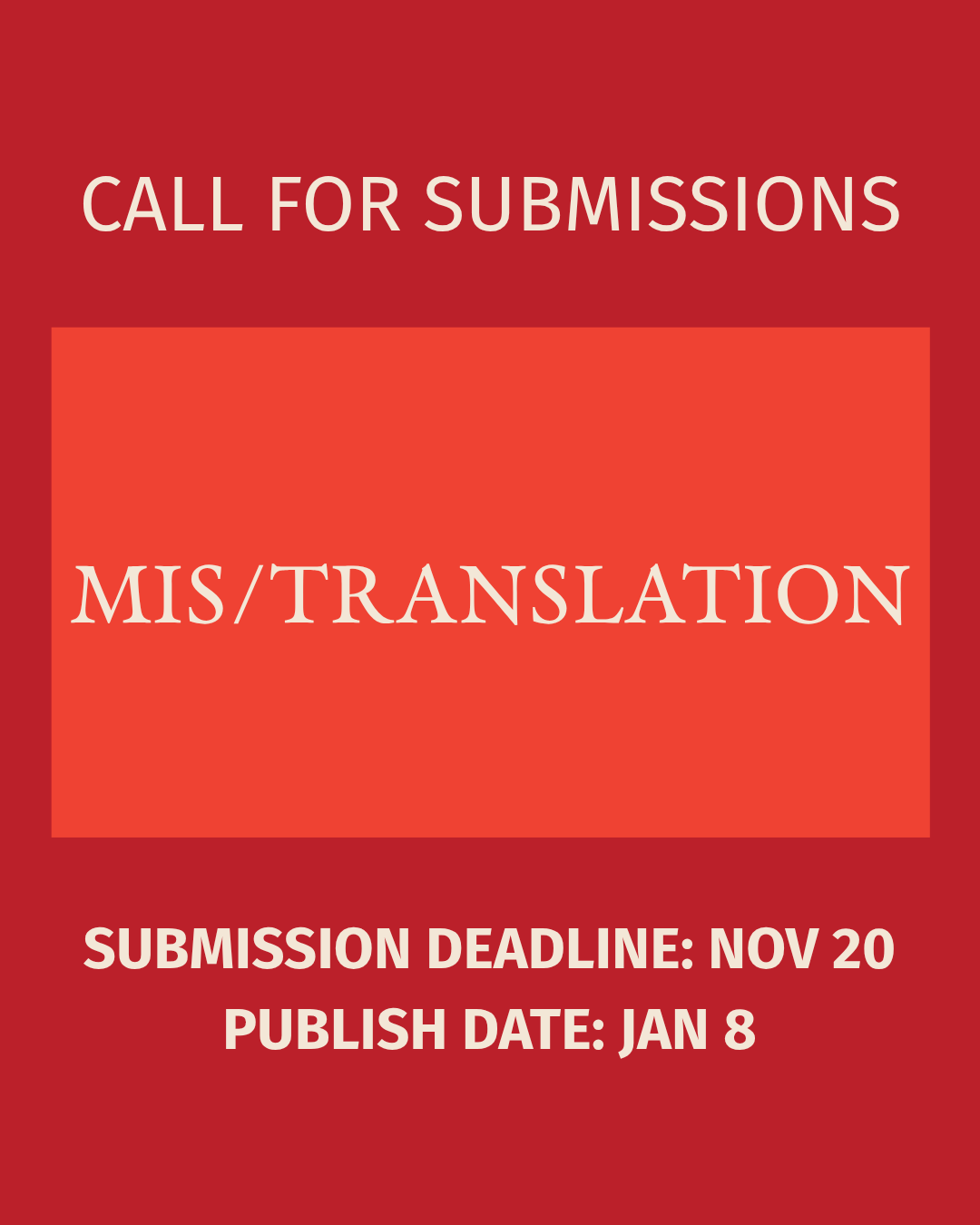
For our next theme issue, MIS/TRANSLATION, we invite works in translation but also, especially, about translation. Send us your meandering translator’s notes, your essays about the craft and its varied guises, your poetry, fiction, visual arts, and any other medium that inspires you. Tell us what gets lost, found, distorted, or invented in the crossing. Let us know how and when you may have mistranslated something, and what unexpected worlds it opened up.
Our submission window is open and will close on November 20.
Submit here: DUOSUMA
In addition to six bimonthly themed issues a year, The Markaz Review publishes regular weekly pieces. Our mission is broad but specific: to amplify voices from the “center of the world”—the Middle East, North Africa, and Southwest Asia (SWANA). In a world riven by injustice and inequality, we seek writing from and about these regions oft-overlooked, dismissed, and/or reduced to caricature and stereotype in and by western narratives. To this end, we invite submissions all year-round: essays, feature articles, short stories, memoir, translations, creative nonfiction, poetry, reviews of books, film, music, art, and theatre, as well as compelling profiles and interviews. For specific information about submissions (e.g., word length and how to query), please review our FAQ section. TMR is open to both emerging and established writers, and to writing in multiple languages, with a single caveat: literary excellence. So go ahead — wow us, surprise us, impress us, humble us, teach us.
Submit here: DUOSUMA