



- This event has passed.
TMR Book Club Discusses “The Raven of Ruwi and Other Stories from Oman” by Hamoud Saud, translated by Zia Ahmed.
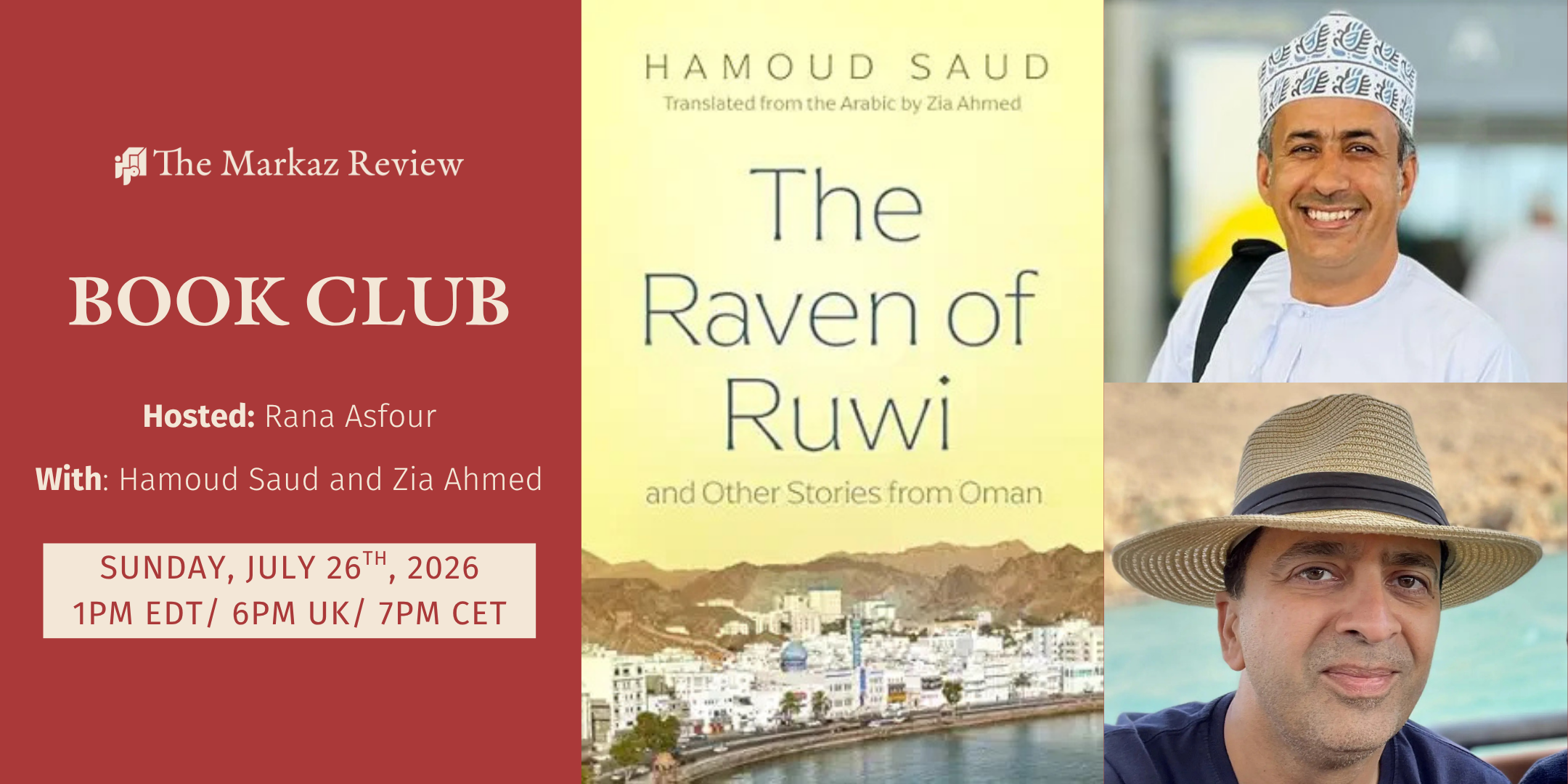
We will meet to discuss The Raven of Ruwi and Other Stories from Oman, a collection of short stories by Hamoud Saud, translated by Zia Ahmed on Sunday, July 26 at 1 pm EDT/19:00 CET. The author and translator will also be in attendance.
Sign up to join the discussion
In this lyrical collection, author Hamoud Saud invites readers into the soul of Oman, a country famed for its long coastline, rugged mountains, and stark desert landscapes. This geography provides the backdrop for stories that reveal both the beauty and hardship of a country and people on the margins. Focused on the capital city, Saud’s Muscat is not a postcard-perfect city but a living, breathing place of cement forests, forgotten roundabouts, and ravens perched on flagpoles.
Each story is fabulist in spirit but grounded in the textures of everyday life: the scent of karak tea, the chatter of schoolgirls, the heat rising from asphalt. In The Raven of Ruwi, a narrator wanders the city’s commercial district where Indian music drifts from balconies and the streets are filled with weary bank workers. In “The Sad Donkey of Muscat,” a blind man recounts the city’s history as told to him by a donkey. And in “Post Office of the Dead,” a forgotten postmaster receives letters from Dostoevsky and Kafka, triggering a surreal unraveling of time and self. At once intimate and expansive, The Raven of Ruwi and Other Stories from Oman is a powerful meditation on place, identity, and the stories that cities tell
ABOUT THE AUTHOR:
Hamoud Saud is an Omani writer of short stories and literary non-fiction. Among his published works are: ‘Amamat Al’askar [The Military Turban] (Alintishar Alarabi, 2013); Almarra Al’aaeda Min Alghaba Tughanni [The Woman Returning from the Forest Sings] (Dar Suwal, 2015); Ghurab Albank Wa Raihat Ruwi [The Bank Raven and the Scent of Ruwi] (Dar Suwal, 2017); Ahlam Mu’alliqa ‘Ala Jisr Wadi ‘Adai [Dreams Suspended on Wadi Adai Bridge] (Dar Suwal, 2019); and Ashjar Arrimad Wa Aa’ma Marrakesh [Trees of Ash and the Blind Man of Marrakesh] (Dar Nathr, 2022).